Artwork
Netherlandish Proverbs
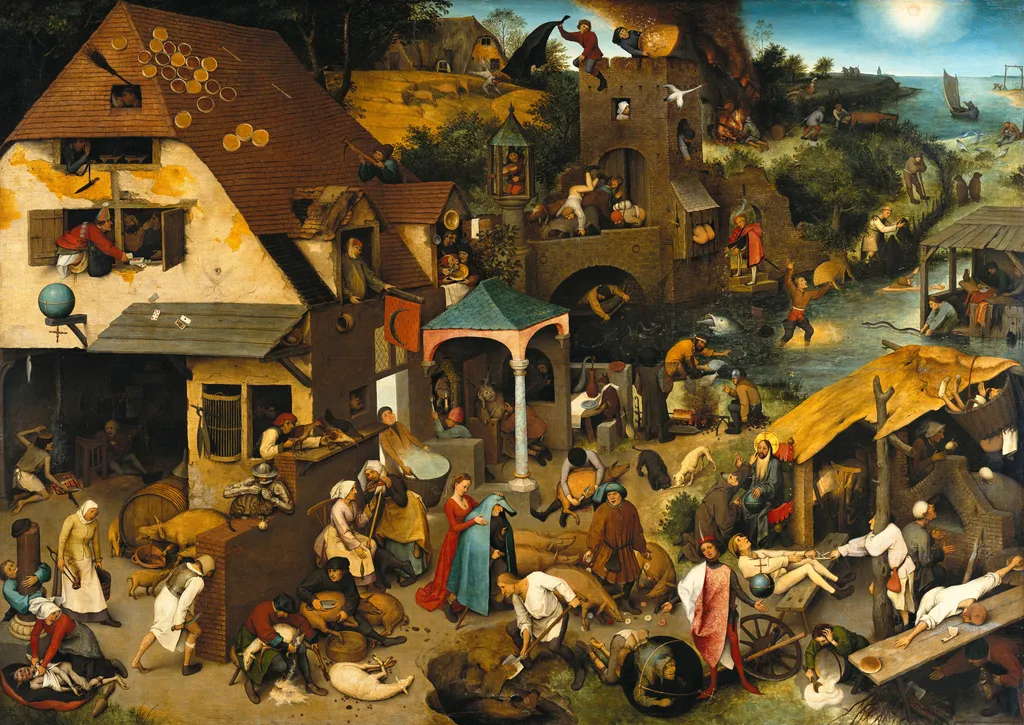
Netherlandish Proverbs is an oil painting by the Northern Renaissance artist Pieter Brueghel I. It dates from 1559 and is held in the collection of the Gemäldegalerie Berlin.
About this work
Subject & Meaning
At the centre, a woman drapes a blue cloak over her husband, symbolizing that she is cuckolding him.
Netherlandish Proverbs presents a village scene populated by humans, animals, and objects that serve as literal illustrations of roughly 125 Dutch-language proverbs and idioms, many still familiar today such as "swimming against the tide" and "banging one's head against a brick wall." The composition's original title, The Blue Cloak or The Folly of the World, signals that Bruegel's purpose extended beyond cataloguing sayings: he meant to expose the absurdity, wickedness, and foolishness of humankind, with figures rendered in the blank, vacant features he commonly used to portray fools.
At the centre, a woman drapes a blue cloak over her husband, symbolizing that she is cuckolding him. Nearby motifs reinforce the theme of human folly: a man fills in a pond only after his calf has died, another carries daylight in a basket, and a man shearing a sheep sits beside one shearing a pig, embodying the proverb "one shears sheep and one shears pigs." The German-language analysis further identifies an inverted globe standing for a "world turned upside down," while the French source reads the ensemble as a universal vision of folly assembled from popular sayings rather than a straightforward proverb dictionary.
Technique & Style
Executed in 1559, Netherlandish Proverbs is an oil painting on an oak panel measuring 117 by 163 cm. The work features a dense and somewhat asymmetrical composition characteristic of the artist's early style, orchestrating nearly 126 distinct proverb scenes into a unified, animated landscape. Despite the crowded ensemble, the composition remains ordered, with a main diagonal axis running from the lower left to the upper right. Spatial depth is achieved through an elevated vantage point and a rising background, though intentional perspectival deviations, such as frontally rendered background elements, enhance the scene's encyclopedic clarity.
Figures are largely isolated within their own activities, exhibiting the blank features Bruegel utilized to portray fools. The painting is generally in good condition, save for a few later moralizing retouches attributed to Victorian prudery.
History & Provenance
The painting Netherlandish Proverbs was created by Pieter Brueghel the Elder in 1559 and is executed in oil on oak panel. It was commissioned as part of a broader tradition of proverb illustration in the Low Countries, inspired by earlier works such as Frans Hogenberg's 1558 engraving of 43 proverbs. The work was originally titled The Blue Cloak or The Folly of the World, reflecting Bruegel's intent to catalogue human folly rather than merely depict proverbs.
The painting entered the collection of the Gemäldegalerie Berlin in 1914, having previously been documented in an English private collection and mentioned in an inventory from 1668. Its provenance prior to the late 19th century is unknown, but scholars believe it was produced using a standardized cartoon and underdrawing shared with other versions of the composition. The original work is signed and dated 'BRVEGEL, 1559' in the lower right corner.
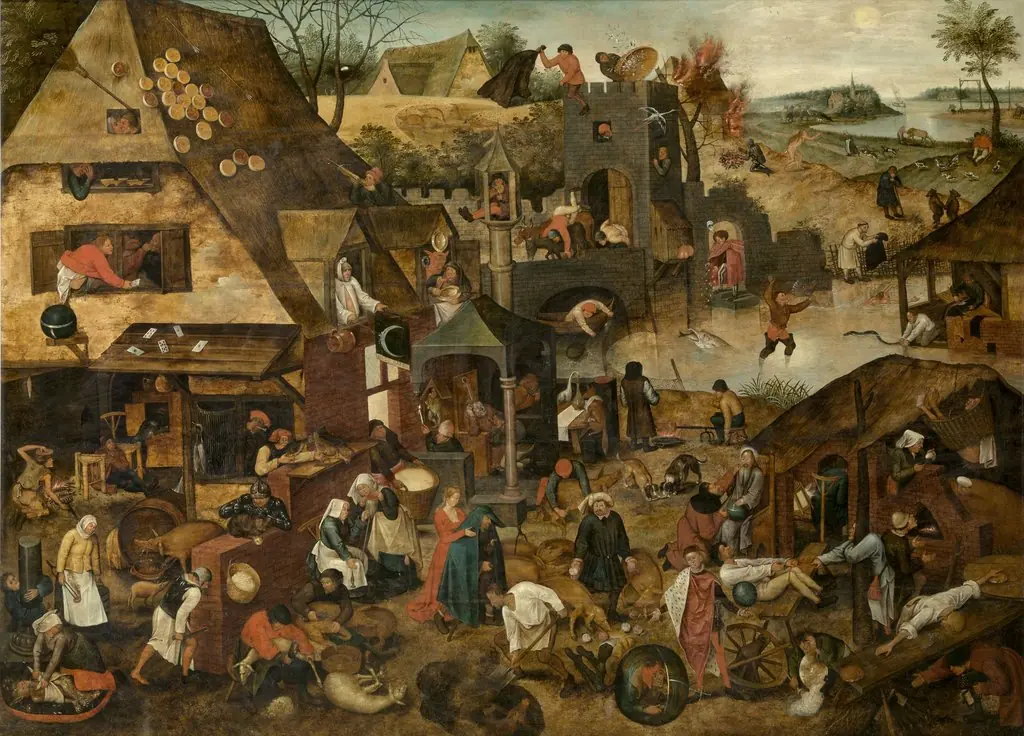
Multiple copies were made by Pieter Brueghel the Younger, with at least 16 known versions, some differing in the number and depiction of proverbs. The painting measures 117 cm in height and 163 cm in width.
The painting has been in the collection of the Gemäldegalerie in Berlin since 1914. It is displayed in the museum's Dutch paintings 15th–16th-century room 7 and is held as part of the Staatliche Museen zu Berlin (Stiftung Preußischer Kulturbesitz).
Earlier provenance traces the panel through Antwerp and England. In 1669 the art dealer Guilliam Forchoudt recorded it under the title De Blauwe huyck, and it was likely the work listed in the 13 August 1668 inventory of Peter Stevens's estate in Antwerp as Le Monde renversé. The painting subsequently passed into a private English collection before the Gemäldegalerie acquired it in 1914.
No earlier exhibition history is documented in the available sources.
Context
Created in 1559, Netherlandish Proverbs is widely recognized as Pieter Bruegel the Elder's first large-scale painting dedicated to the theme of proverbs, distinguishing it from his earlier works on paper. The composition synthesizes the Northern Renaissance interest in human folly, echoing literary traditions found in Erasmus's Adagia and Sebastian Brant's Narrenschiff. Originally titled The Blue Cloak or The Folly of the World, the work serves as a moral catalogue of human absurdity rather than a simple linguistic exercise.
Contemporary scholarship notes its close relationship to Frans Hogenberg's 1558 engraving, yet Bruegel's version is praised for its ordered integration of approximately 126 identifiable idioms into a cohesive scene. The painting's enduring significance is underscored by the production of at least sixteen copies by the artist's son, Pieter Brueghel the Younger, ensuring the image's survival and widespread dissemination across subsequent centuries.
Legacy
Pieter Brueghel the Younger specialized in replicating his father's compositions, producing at least sixteen copies of this work starting as early as 1614. These workshop replicas remain largely faithful to the 1559 original, though some variations exist, including one version that expands the number of depicted proverbs to 132. The painting's legacy extends into modern popular culture, serving as the cover art for Fleet Foxes' 2008 self-titled album and inspiring T. E. Breitenbach's 1975 painting Proverbidioms, which adapted the concept to English idioms.
More recently, the composition influenced a 2024 pixel-art video game titled Proverbs. Critics have long praised the work for its ordered portrayal of human folly, recognizing it as a seminal example of using vernacular wisdom to catalogue human absurdity.
Overview
Pieter Bruegel the Elder’s 1559 oil painting on oak, commonly known as Netherlandies Proverbs, presents a bustling village tableau where dozens of figures enact literal versions of contemporary Dutch sayings. The work functions as a visual catalogue of human folly, populated by ordinary activities and absurd incidents that together illustrate the era’s popular proverbs.
Own this work as a print
Artist & collection

Artist
Pieter Bruegel (also Brueghel or Breughel) the Elder ( BROY-gəl, US also BROO-gəl; Dutch: ; c.

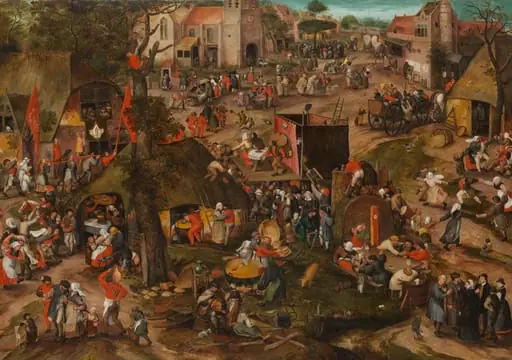 A Flemish Kermis with a Performance of the Farce ‘Een cluyte van Plaeyerwater’
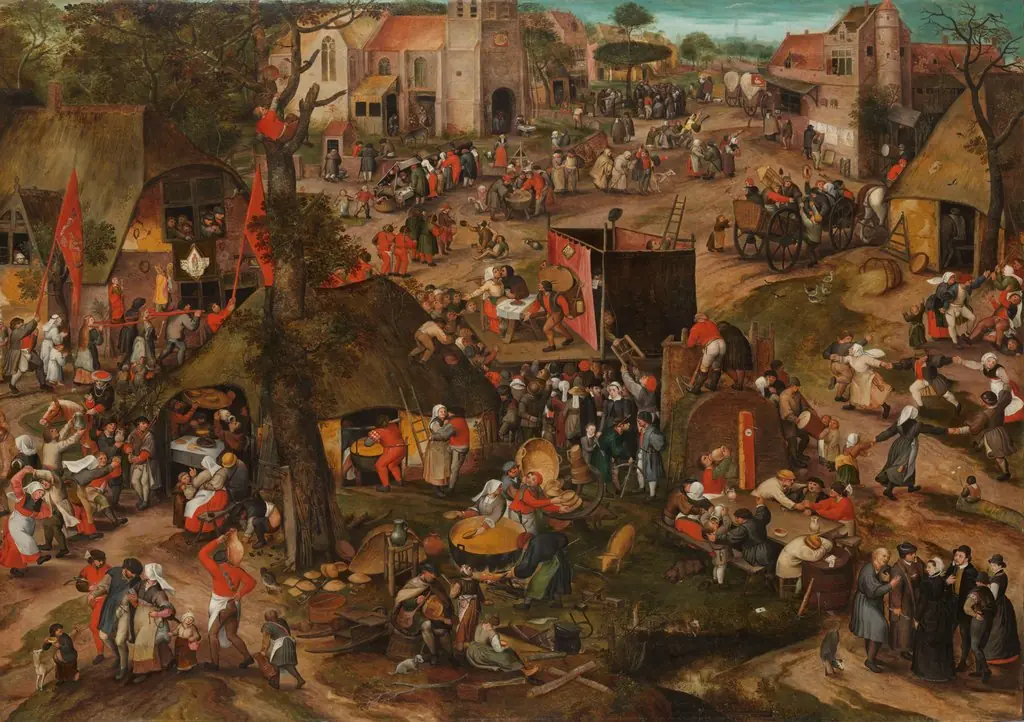 A Performance of the Farce 'Een Cluyte van Plaeyerwater' (A Clod from Plaeyerwater) at a Flemish Kermis
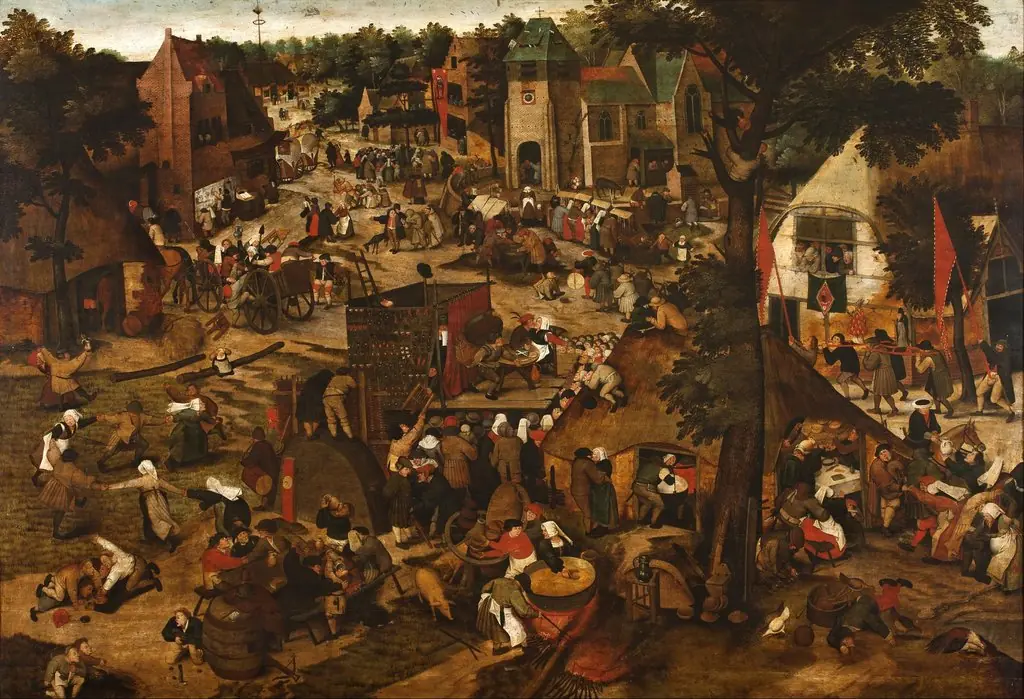 Fair with a Theatrical Presentation
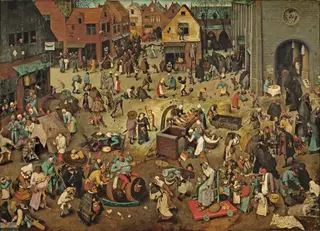 The Fight Between Carnival and Lent
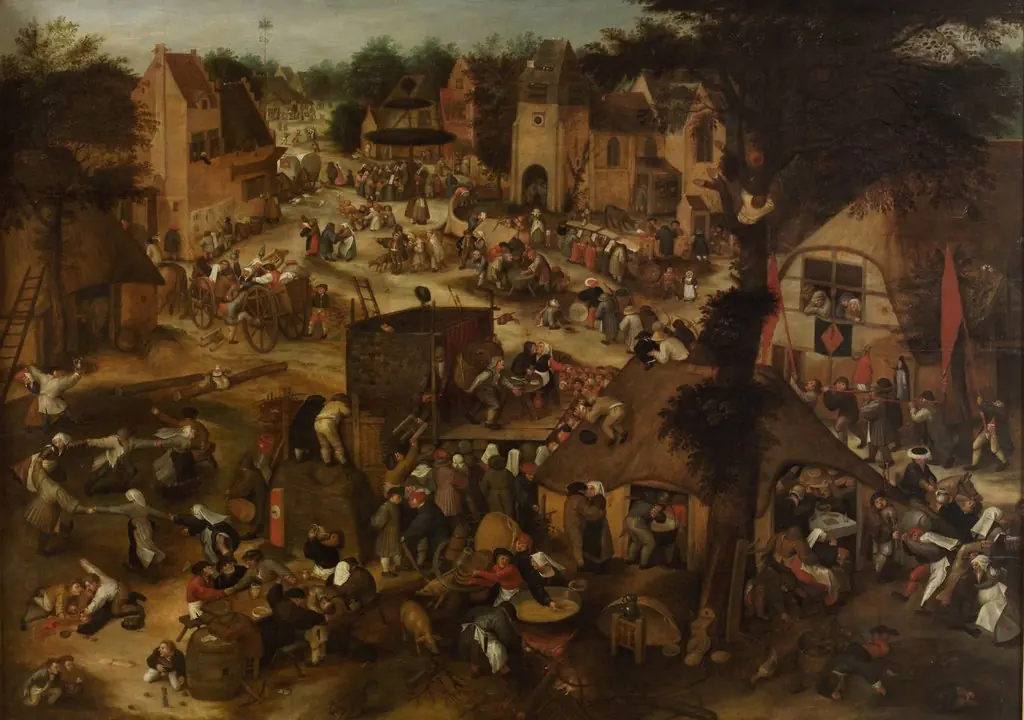 Performance of the farce 'Een Cluyte van Plaeyerwater' (A Clod from Plaeyerwater) at a Flemish Kermis
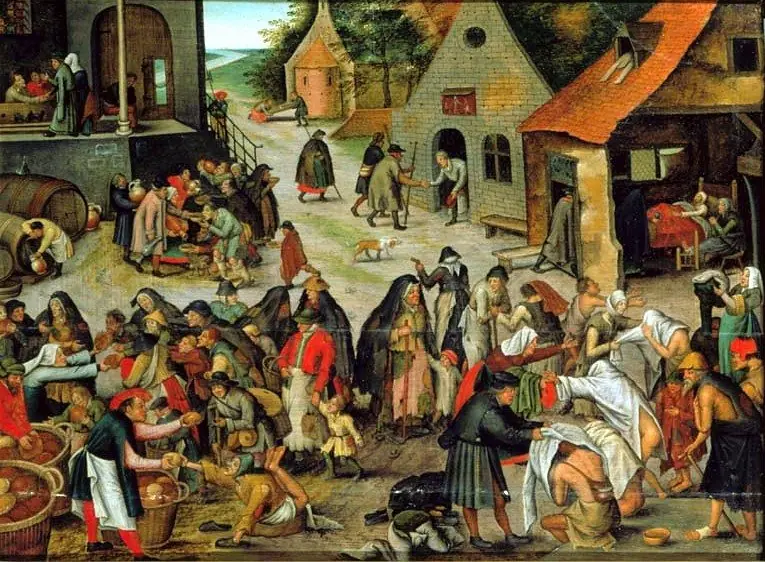 The Seven Acts of Mercy by Pieter Brueghel the Younger
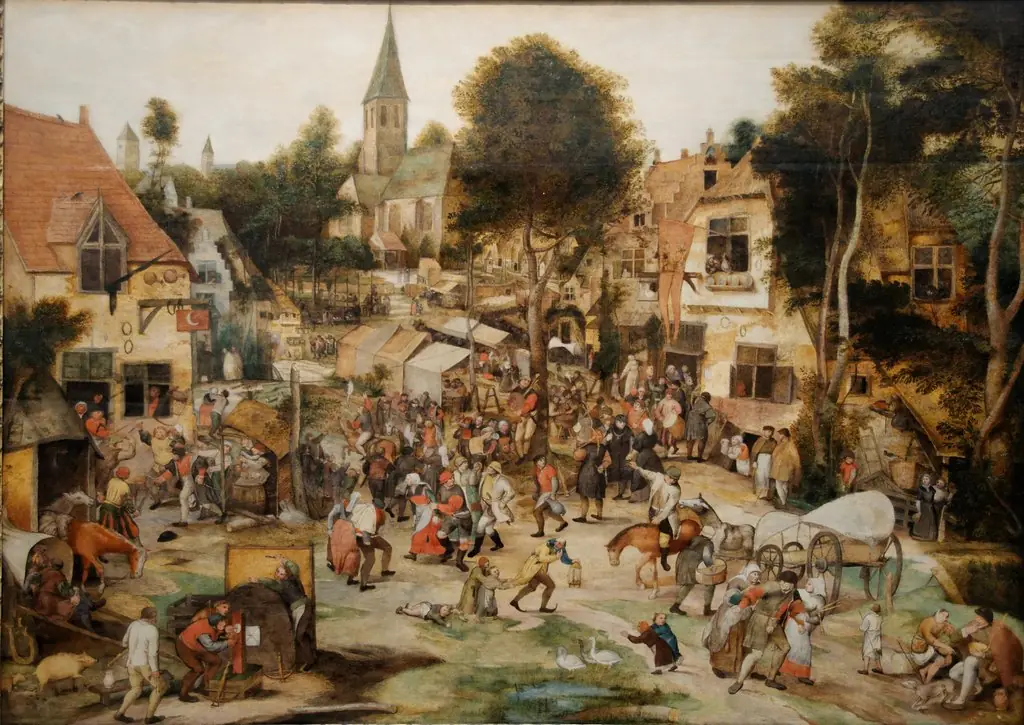 Kermis
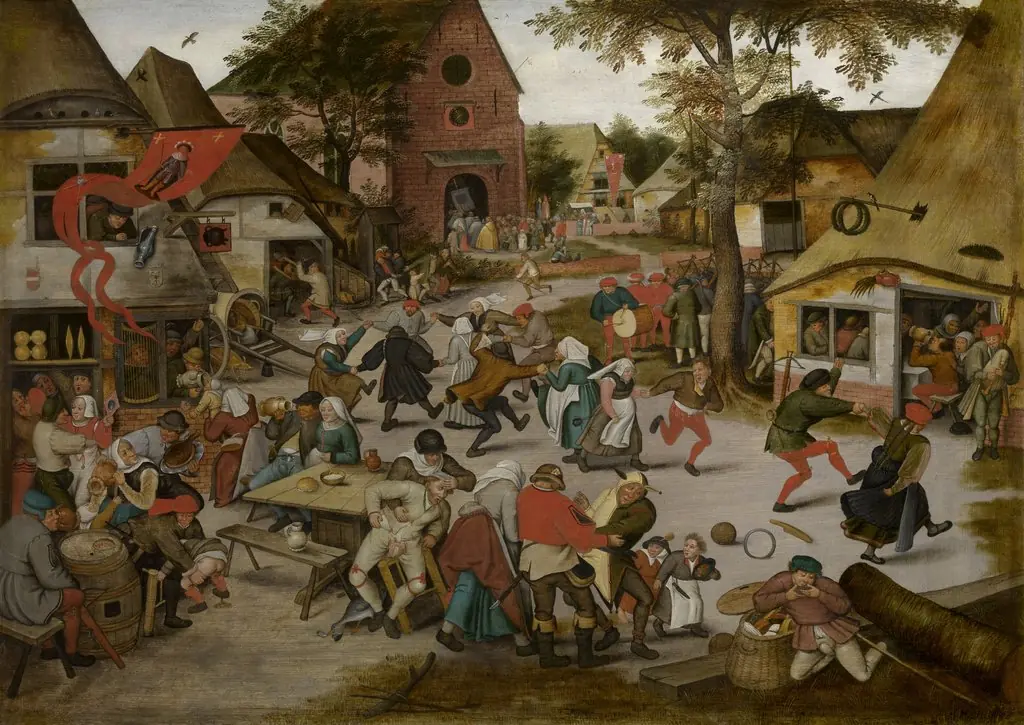 Kermis of Saint George
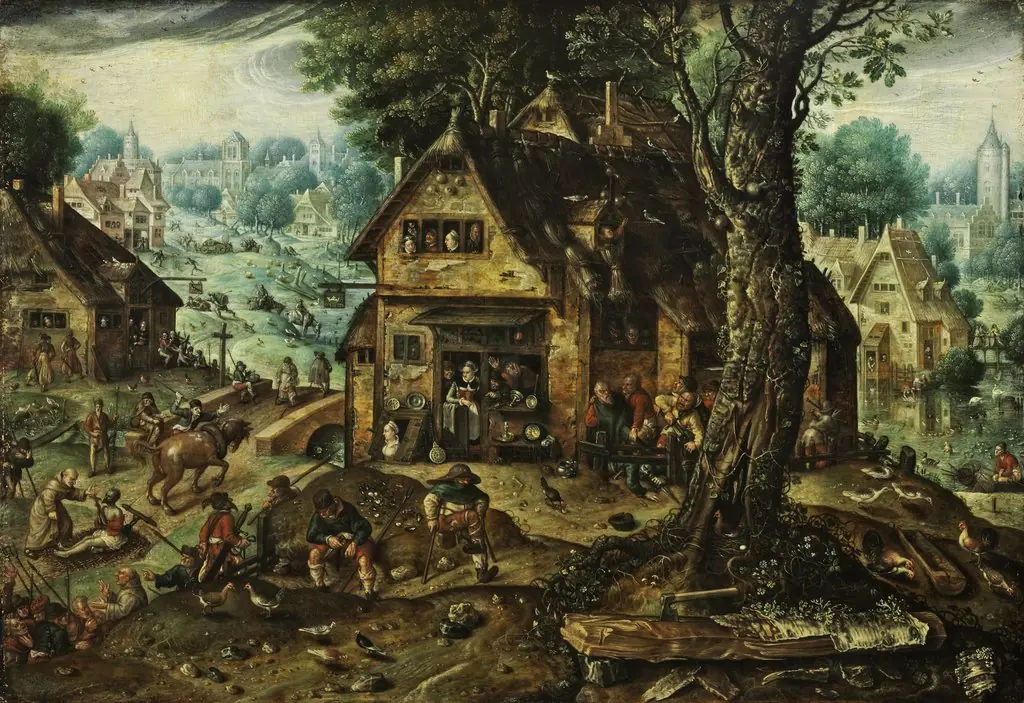 View of the village with numerous people
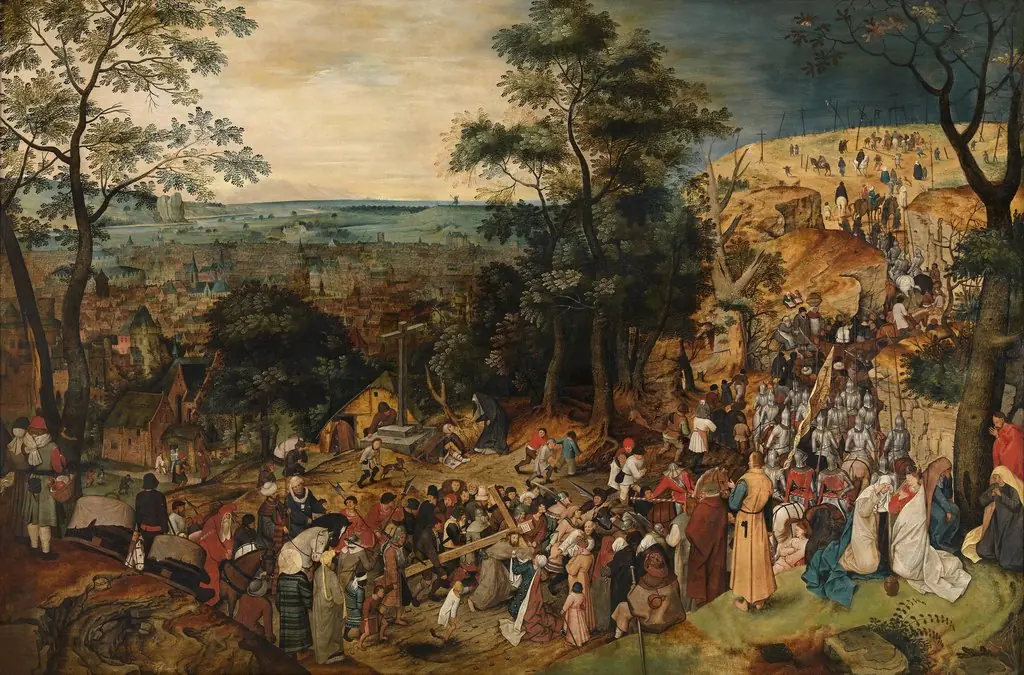 The Bearing of the Cross
 The Procession to Calvary
- Proverbs