Artwork
Madonna with Beardless Saint Joseph
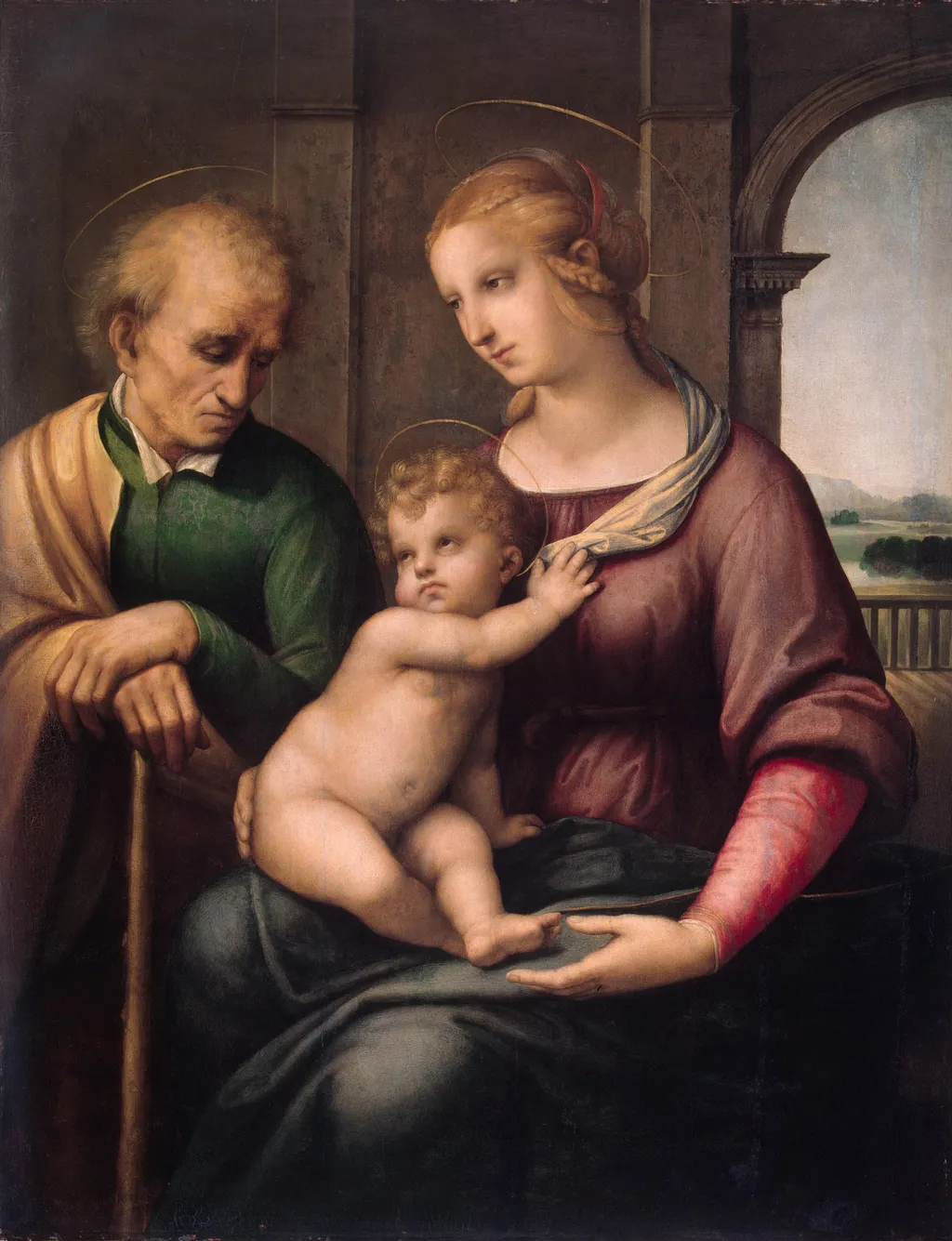
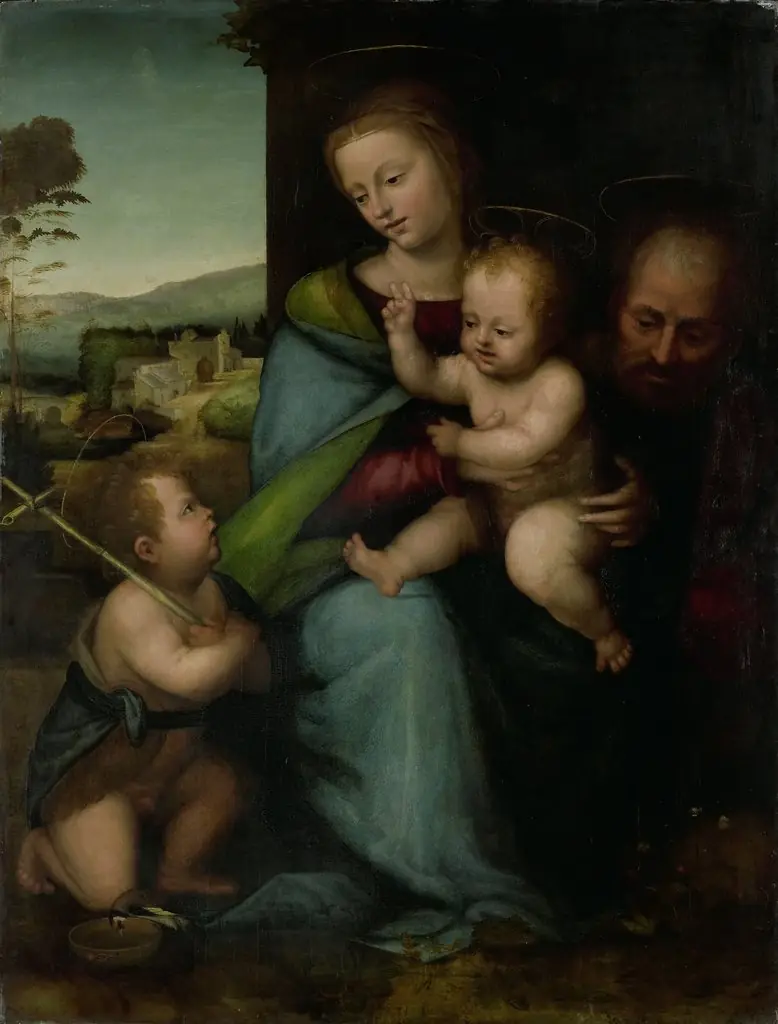
Madonna with Beardless Saint Joseph is a tempera painting by the High Renaissance artist Raphael. It dates from 1506 and is held in the collection of the Hermitage Museum. Created around 1506, this tempera panel portrays the Virgin Mary, the infant Christ, and a beardless Saint Joseph.
About this work
Subject & Meaning
The composition demonstrates Leonardo da Vinci's influence through the Child's twisting pose, the Virgin's hairstyle, and the soft, flowing lines.
The painting depicts the Holy Family: the Virgin Mary seated with the Christ Child on her lap, and Saint Joseph standing at the left. The work's distinctive title derives from Joseph's unusual beardless appearance, diverging from traditional iconography. The three figures exchange glances in a carefully composed network of gazes and gestures, creating an atmosphere of reflective melancholy.
Joseph appears troubled as he looks toward the Child, while Mary seems resigned to foreknowledge of her son's tragic destiny. The Christ Child twists toward his mother in a gesture of reluctance, as she reaches to caress his foot.
The scene is set in a dimly lit interior, illuminated only by an opening at the right revealing a landscape beneath a bright sky. The composition demonstrates Leonardo da Vinci's influence through the Child's twisting pose, the Virgin's hairstyle, and the soft, flowing lines. Raphael harmonizes these elements into a scene of everyday intimacy, blending simplicity with grandeur.
Technique & Style
The painting is executed in tempera on panel, measuring 72.5 × 56.5 cm (sources vary slightly, with one citing 73 × 57 cm and another 74 × 57 cm). Its technique reflects Raphael's Florentine period, with Leonardesque influences evident in the Christ Child's torsion, the Virgin's hairstyle, and the figures' soft, flowing contours.
The composition presents the Holy Family in a dimly lit interior, illuminated by an opening at right that reveals a landscape beneath a bright sky. The three figures are arranged in a carefully studied yet natural exchange of glances and gestures, creating a closed, harmonious ensemble suffused with reflective melancholy. Mary sits with the Child on her lap, her left hand reaching toward his foot in a tentative caress, while the beardless Joseph stands to the left, staff in hand, his expression seeming troubled as he gazes at the infant.
The subdued palette, restrained lighting, and balanced pyramidal structure exemplify the High Renaissance synthesis of simplicity and splendor, while the subtle psychological interplay between figures anticipates Raphael's mature narrative sophistication.
History & Provenance
The Madonna with Beardless Saint Joseph is dated to approximately 1506, created during Raphael's Florentine period. It is widely identified as one of the small Madonnas painted for Guidobaldo da Montefeltro during the artist's brief stays in Urbino between 1505 and 1506, a connection noted by Giorgio Vasari. The earliest definitive documentary evidence for the work appears in the 18th century, when it was likely held in the collection of the Duke of Angoulême in Paris.
From there, the painting entered the renowned collection of Pierre Crozat. In 1772, Catherine II of Russia purchased the Crozat collection almost in its entirety, incorporating this work into what would become the core of the Hermitage Museum in Saint Petersburg.
The Madonna with Beardless Saint Joseph is held in the Hermitage Museum in Saint Petersburg, where it is listed under inventory number 782. The work entered the museum's collection in 1772 when Catherine II acquired the Pierre Crozat collection, which formed the foundational core of the Hermitage. Its earliest documented appearance was in the 18th century within the collection of the Duke of Angoulême in Paris, before moving to Crozat's possession.
The painting was loaned for the National Gallery's 2022 exhibition commemorating the 500th anniversary of Raphael's death, but permission for the loan was withdrawn following the Russian invasion of Ukraine that year.
Exhibition history includes its participation in the National Gallery's 2022 exhibition, delayed from 2020 due to the COVID-19 pandemic, and prior references in cultural works such as Alexander Pushkin's poem referencing the Hermitage-held version.
The work has been displayed in exhibitions focusing on Raphael's early period and the High Renaissance, including thematic displays at the Hermitage and international exhibitions marking the artist's quincentenary.
Context
The painting is regarded as an early work from Raphael's Florentine period, with details such as the Virgin's hairstyle and the Christ Child's twisting pose reflecting the influence of Leonardo da Vinci and supporting a dating to around 1506. It is usually identified as one of the small Madonnas that Giorgio Vasari saw in Urbino and that Raphael painted for Guidobaldo da Montefeltro during brief stays in his native city between 1505 and 1506.
An early nineteenth-century restoration prompted Alexander Pushkin to write the poem "Renaissance" and to reference the work in his dramatic verse "Mozart and Salieri," where his Salieri declares that an incompetent painter "stains Raphael's Madonna" for him. The painting entered the Hermitage through Pierre Crozat's collection, purchased almost in its entirety by Catherine II of Russia in 1772 and forming the core of the future museum.
The National Gallery requested the work for a 2020 exhibition marking the 500th anniversary of Raphael's death, but the loan was postponed to 2022 due to the COVID-19 pandemic and ultimately withdrawn following the Russian invasion of Ukraine.
Legacy
The painting's reputation extends into literature and cultural memory, most notably through Alexander Pushkin, who wrote the poem Renaissance and referenced the work in his drama Mozart and Salieri after its early 19th-century restoration. Its modern institutional significance was highlighted when the National Gallery requested the painting for its 2020 Raphael anniversary exhibition; the loan was delayed by the COVID-19 pandemic to 2022, then cancelled following the Russian invasion of Ukraine. The work remains a foundational piece of the Hermitage Museum, having entered in 1772 as part of the Crozat collection acquisition that formed the museum's core.
Overview
Created around 1506, this tempera panel portrays the Virgin Mary, the infant Christ, and a beardless Saint Joseph. The three figures occupy a modest interior, with Mary in a red‑brown garment, Joseph in green, and a dark wall behind them punctuated by a distant landscape seen through an arch.
Own this work as a print
Artist & collection
Artist
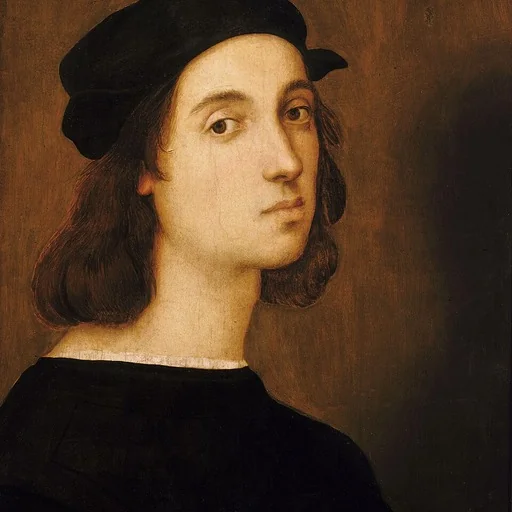
Raphael was born Raffaello Sanzio in Urbino on April 6, 1483, the son of Giovanni Santi, a painter and poet attached to the ducal court.

 Holy Family
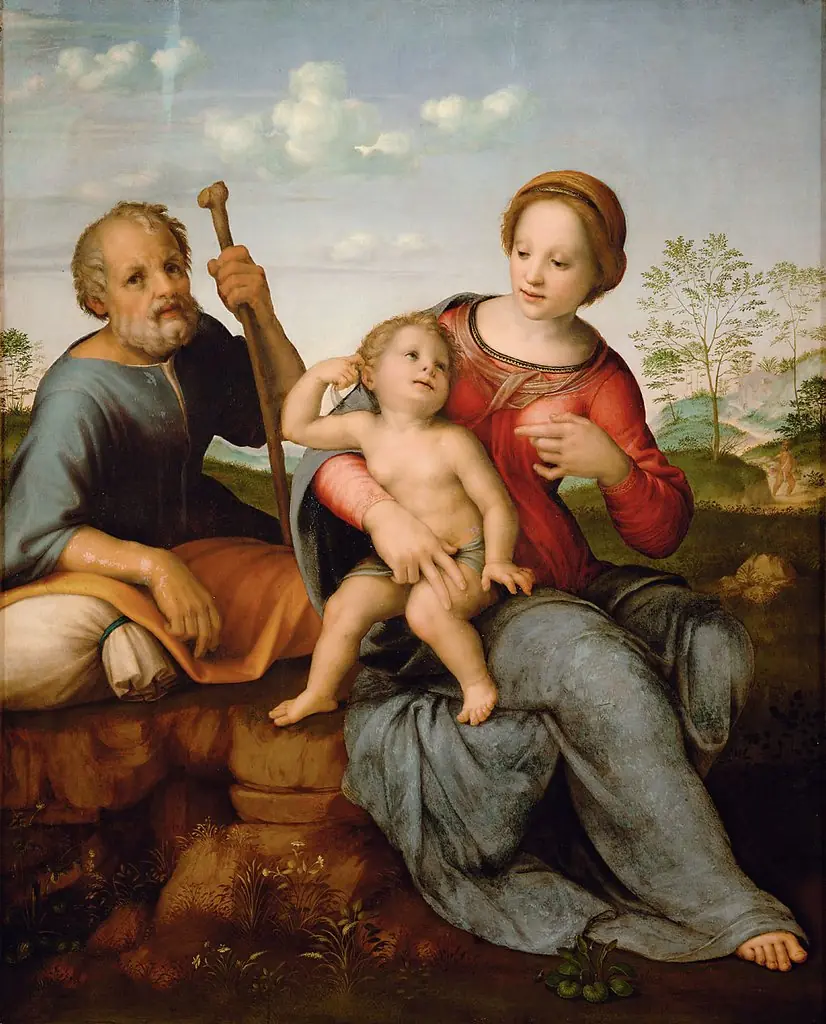 Holy Family in a Landscape
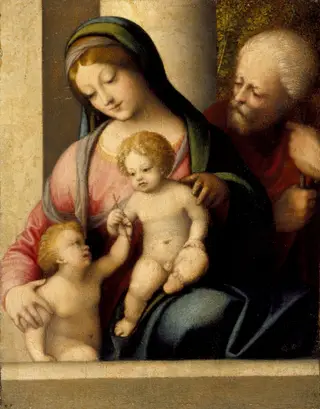 Holy Family with the Infant St. John
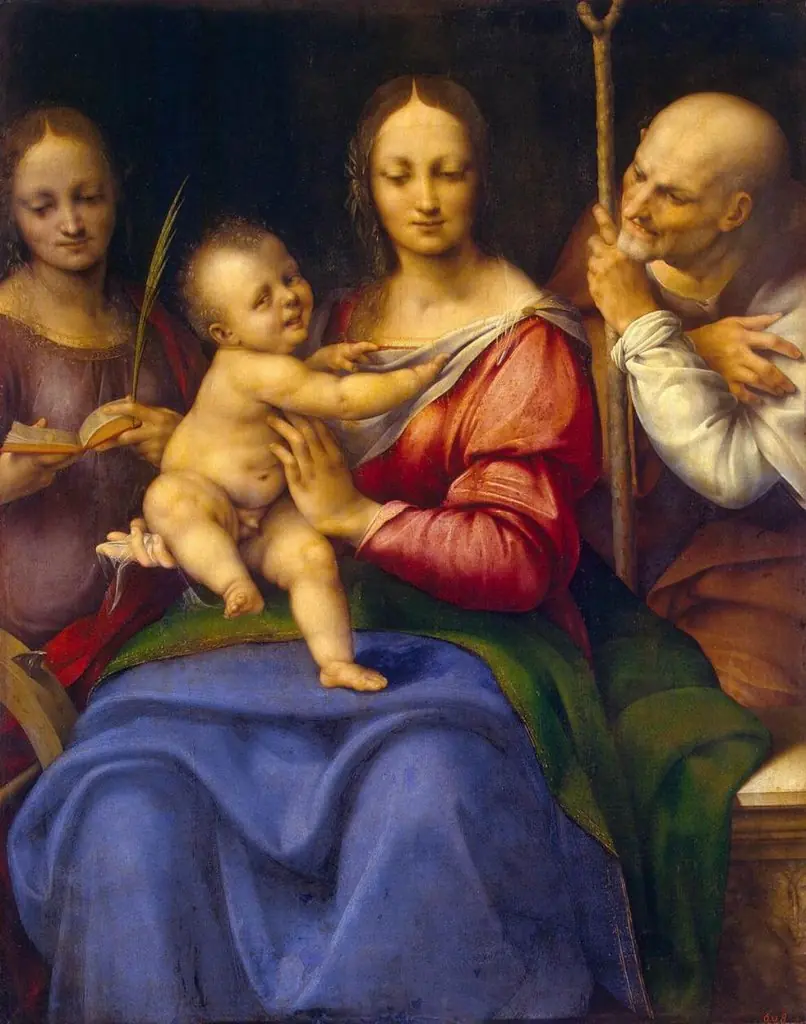 Holy Family with St Catherine
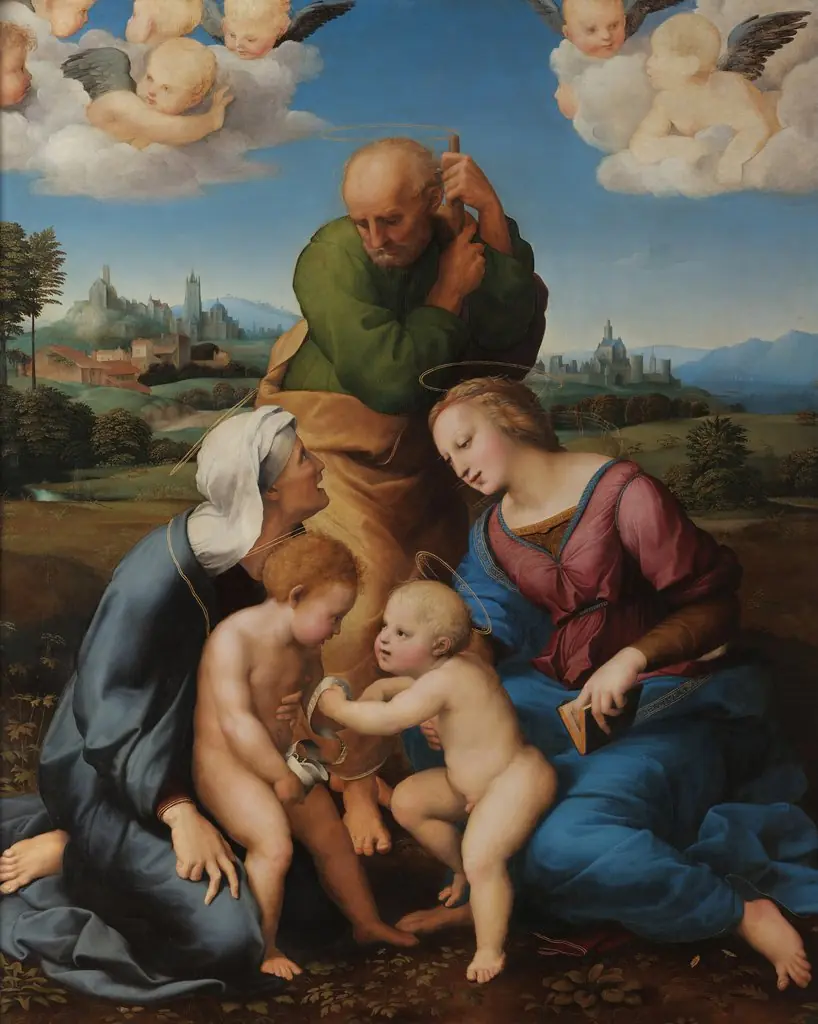 Canigiani Holy Family
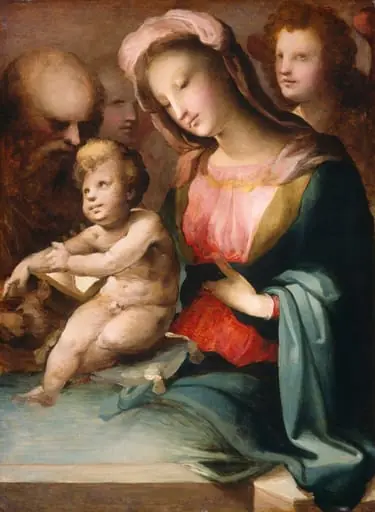 The Holy Family with Angels
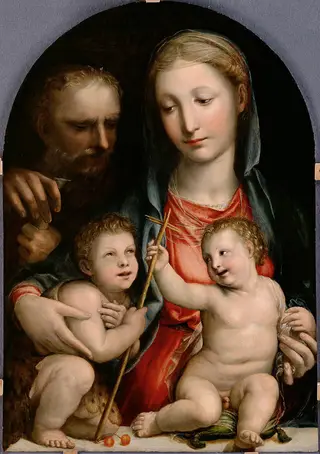 Holy Family with St. John the Baptist as child
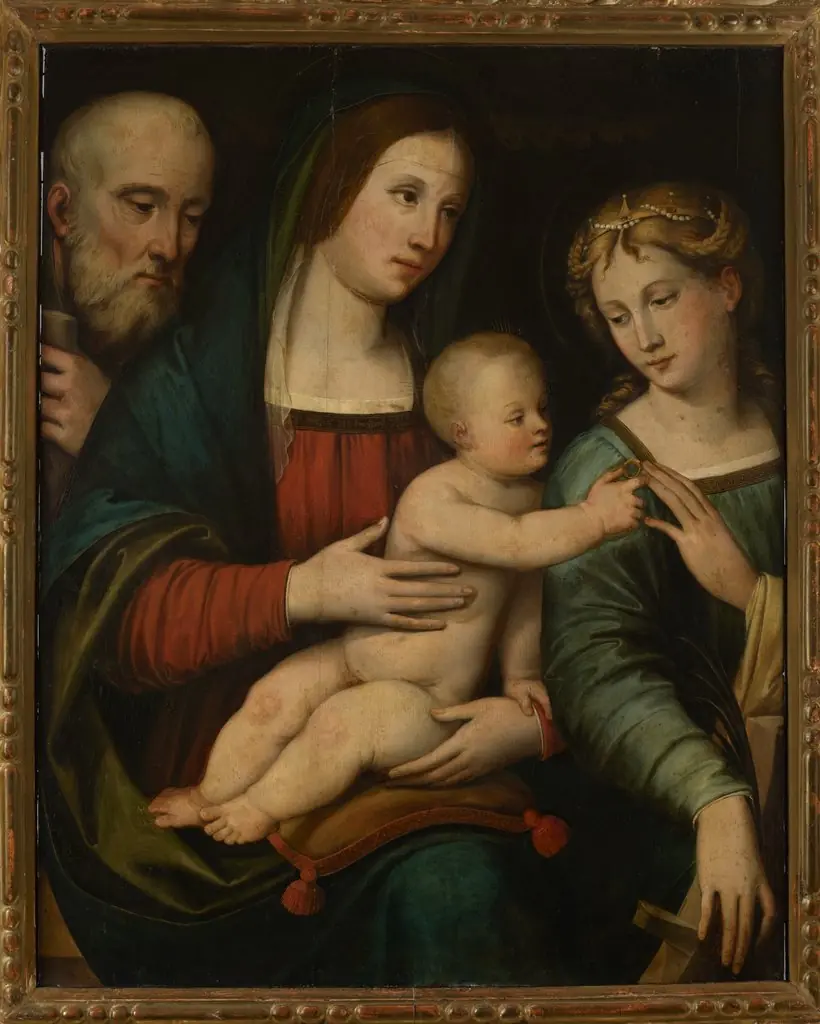 Mystic Marriage of St Catherine of Alexandria
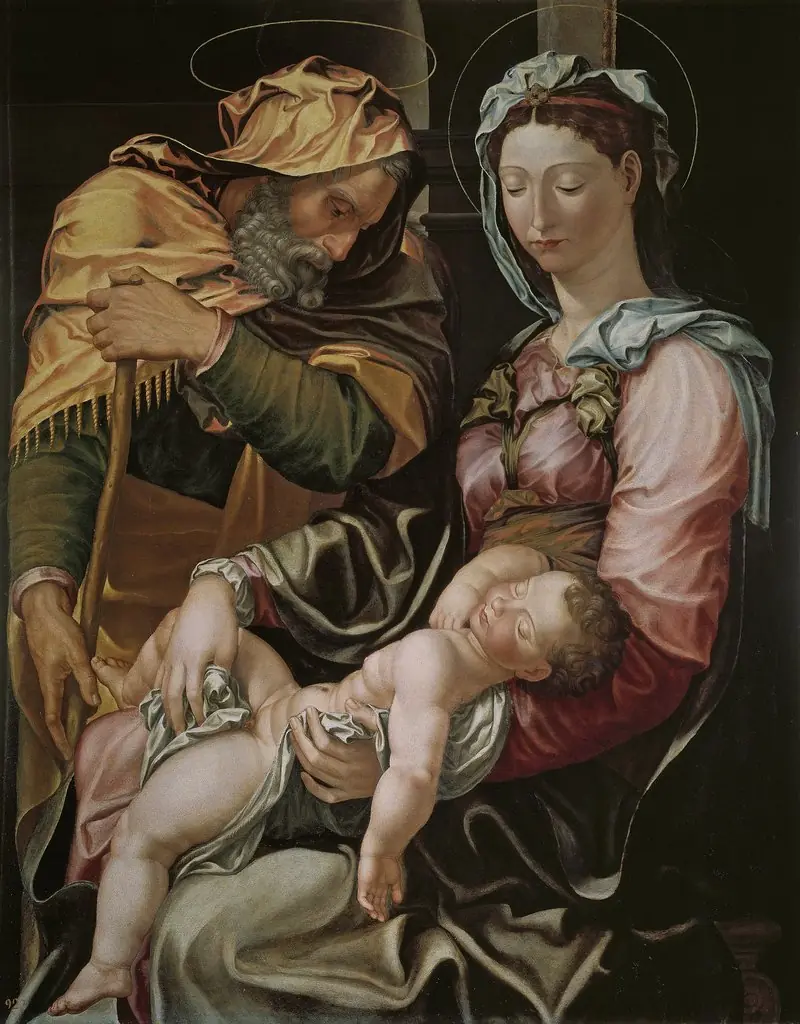 La Sagrada Familia
 The Holy Family with the Infant John the Baptist