Artwork
Abraham's Sacrifice
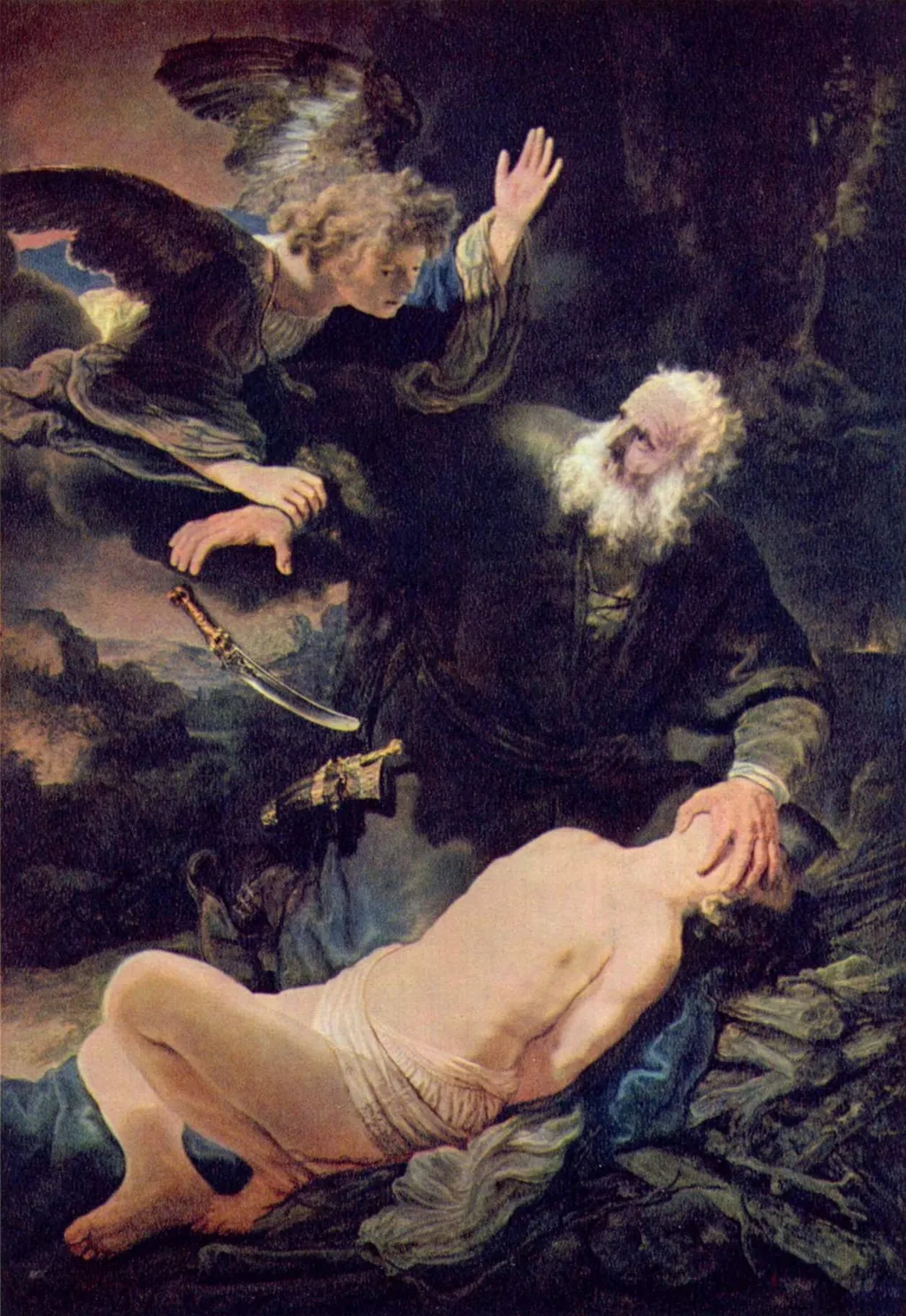
Abraham's Sacrifice is an oil painting by the Dutch Golden Age artist Rembrandt van Rijn. It dates from 1635 and is held in the collection of the Hermitage Museum.
About this work
Subject & Meaning
The work captures the climactic moment an angel physically intervenes, grasping Abraham's arm to halt the descending knife just before it strikes Isaac.
Rembrandt's 1635 painting depicts the Binding of Isaac, a biblical narrative from Genesis where God tests Abraham's faith by commanding him to sacrifice his son. The work captures the climactic moment an angel physically intervenes, grasping Abraham's arm to halt the descending knife just before it strikes Isaac. Unlike textual accounts where the angel speaks from heaven, Rembrandt renders a tangible interruption, with the messenger focusing intently on Isaac to ensure timely rescue.
The composition utilizes dramatic chiaroscuro to contrast Abraham's dark figure against the illuminated, semi-nude body of the bound boy, whose face is obscured by his father's hand. This scene serves as a significant prefiguration of Christ's sacrifice for both Protestant and Catholic viewers, symbolizing absolute devotion. While Protestants view Abraham's action as exemplary faith, Catholics emphasize the necessity of manifesting belief through deeds.
Technique & Style
Executed in 1635, the work is an oil painting on canvas measuring 193 × 132 cm, signed and dated by the artist.
Rembrandt’s handling emphasizes strong chiaroscuro, sharply separating the dark silhouette of Abraham from the lighter flesh of Isaac and the angel’s drapery to heighten dramatic impact. The composition arranges the three figures vertically, linking angel above to Abraham’s outstretched arms and Isaac’s near-nude body; the suspended knife arrests the motion, while Abraham’s upward gaze signals realization of deliverance. The angel physically restrains Abraham by gripping his arm, directing attention toward Isaac’s body rather than Abraham’s face, a choice that underscores the urgency of timely intervention.
Stylistically, the painting channels Caravaggisti tenebrism through pronounced theatrical lighting and volumetric modeling, aligning with Baroque tendencies evident in works by Caravaggio and the Carracci.
History & Provenance
Rembrandt painted Abraham's Sacrifice in 1635, a work signed and dated "REMBRANDT. F. 1635". The painting depicts the biblical Binding of Isaac and is currently held in the Hermitage Museum in Saint Petersburg.
While the specific identity of the original patron remains unknown, historical analysis suggests the work's conception was likely influenced by the artistic and theological views of its commissioners. The creation history involves a close relationship with a second, nearly identical version produced around 1636, now located in the Alte Pinakothek in Munich. Sources indicate that the Munich version may be a copy executed under a new commission, whereas the 1635 Hermitage original is characterized by a more sketch-like execution and heightened emotional expression.
Rembrandt's 1635 painting Abraham's Sacrifice is held in the collection of the Hermitage Museum in Saint Petersburg. The work is an oil on canvas measuring 193 cm in height and 132 cm in width, signed and dated "REMBRANDT. F. 1635".
Sources indicate the existence of a second, closely related version painted around 1636, which is housed in the Alte Pinakothek in Munich. While the Hermitage version is noted for its sketchier execution and heightened emotional expression, the provided texts do not list specific accession numbers or a detailed exhibition history for either work.
Context
Painted in 1635 during the height of the Dutch Golden Age, Rembrandt's depiction of the Binding of Isaac belongs to a broader tradition of Baroque religious painting in which dramatic chiaroscuro and physical immediacy were used to heighten the spiritual stakes of biblical narrative. The composition's theatrical lighting, with Abraham rendered as a heavy dark mass against the brighter flesh of Isaac, reflects the influence of Caravaggio and the Carracci, channeling their violent, emotionally charged style into a Protestant context.
The subject itself carried strong confessional resonance: both Protestants and Catholics read Abraham's willingness to sacrifice Isaac as a prefiguration of Christ's crucifixion, with Protestants emphasizing Abraham's unwavering faith and Catholics stressing that belief must be enacted in deeds. Rembrandt's exact theological intent is difficult to determine and likely depended on the views of his unidentified patrons.
A closely related version from around 1636 is held by the Alte Pinakothek in Munich and is generally regarded as a later copy made for a separate commission, less sketch-like and more restrained than the Hermitage original.
Overview
Created in 1635, this oil on canvas by Rembrandt portrays the biblical moment when Abraham prepares to sacrifice his son Isaac. The composition centers on the two figures on a stark, rocky ground, illuminated by a dim light that highlights the tension of the scene. An angel intervenes from above, halting the act with an outstretched hand, while the surrounding darkness deepens the emotional impact.
Own this work as a print
Artist & collection

Artist
Rembrandt Harmenszoon van Rijn, known mononymously as Rembrandt, was a Dutch Golden Age painter, printmaker, and draughtsman.