Artwork
The Departure of the Shunammite Woman
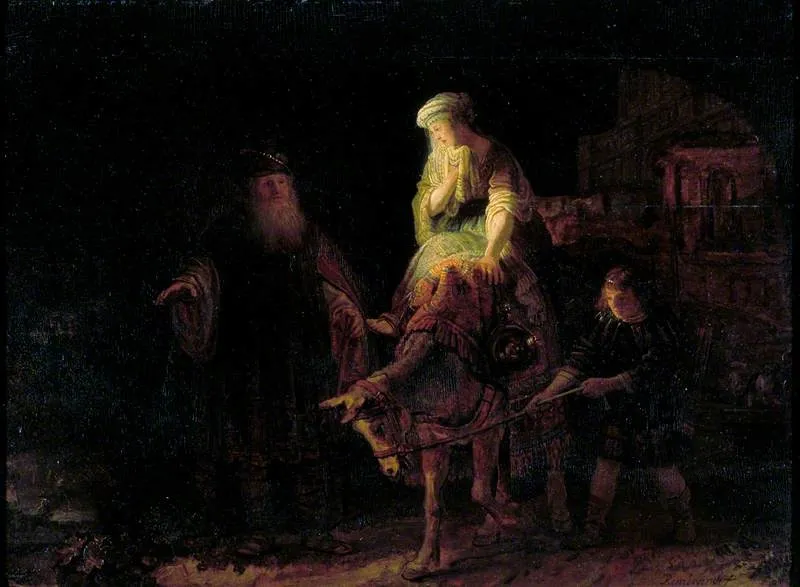
The Departure of the Shunammite Woman is an oil painting by the Dutch Golden Age artist Rembrandt van Rijn. It dates from 1640 and is held in the collection of the Victoria and Albert Museum. Painted in 1640 by Rembrandt Harmenszoon van Rijn, this oil-on-panel work depicts a moment from the biblical story of the Shunammite woman.
About this work
Overview
Painted in 1640 by Rembrandt Harmenszoon van Rijn, this oil-on-panel work depicts a moment from the biblical story of the Shunammite woman.
Painted in 1640 by Rembrandt Harmenszoon van Rijn, this oil-on-panel work depicts a moment from the biblical story of the Shunammite woman. It reflects Rembrandt’s interest in intimate, emotionally charged narratives drawn from scripture, diverging from the more common secular themes of Dutch Golden Age painting. The piece is part of the Victoria and Albert Museum’s collection, where it remains a quiet example of his later biblical studies.
Subject & Meaning
The scene illustrates the Shunammite woman’s departure from her home after being warned of an impending famine, as recounted in 2 Kings 8. Her sorrowful gaze and gesture toward her face convey personal grief, while the man holding the donkey’s reins appears attentive, perhaps a servant or guide. The second figure in the background and the distant building suggest a world beyond the immediate moment, reinforcing the weight of her solitary journey.
Technique & Style
Rembrandt employs chiaroscuro to deepen the emotional tone, using thick, textured brushwork in the woman’s garments and the donkey’s harness to contrast with the muted, shadowed background. The palette is dominated by earth tones and deep browns, enhancing the sense of quiet resignation. Facial expressions are rendered with subtle nuance, avoiding theatricality in favor of psychological realism.
History & Provenance
The painting entered the Victoria and Albert Museum’s collection in the 19th century, having passed through several private European holdings since its creation. Its attribution to Rembrandt has been consistently supported by stylistic analysis and technical examination, though it was once misidentified as a work by a lesser follower. It has remained largely unaltered since the 1640s.
Context
In the 1640s, Rembrandt increasingly turned to biblical subjects as personal and financial pressures mounted. This period saw a shift toward introspective, emotionally restrained compositions, often focusing on quiet moments of human vulnerability. The Shunammite woman’s story resonated with themes of exile and divine providence, which aligned with broader religious and philosophical currents in Dutch society at the time.
Legacy
Though less widely known than Rembrandt’s larger biblical scenes, this painting exemplifies his mature approach to narrative intimacy. It influenced later artists interested in psychological depth over spectacle, and remains a key example of how biblical stories were reimagined in 17th-century Dutch art as human, rather than doctrinal, experiences.
Artist & collection

Artist
Rembrandt Harmenszoon van Rijn, known mononymously as Rembrandt, was a Dutch Golden Age painter, printmaker, and draughtsman.