Artwork
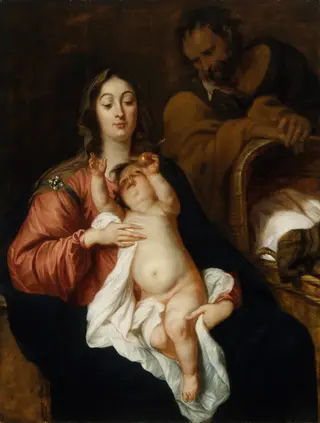
The Holy Family with Angels
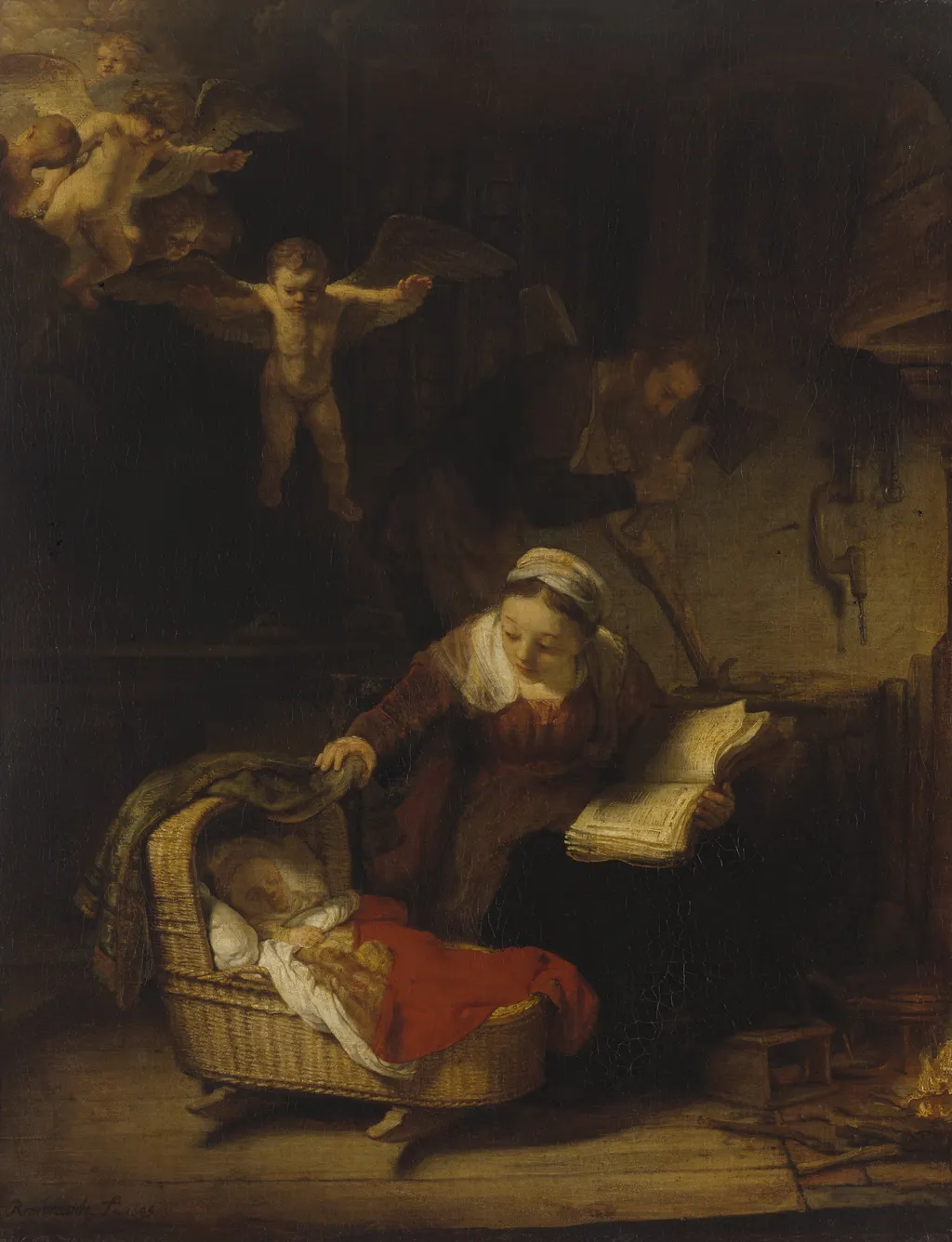
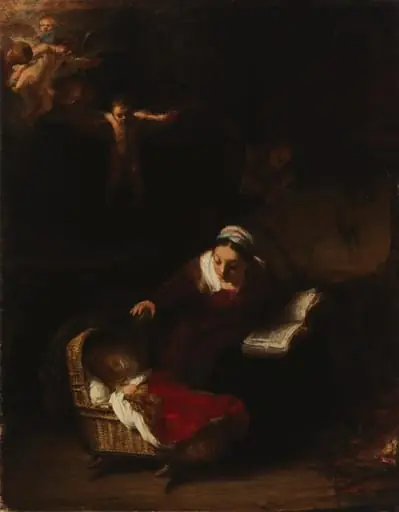
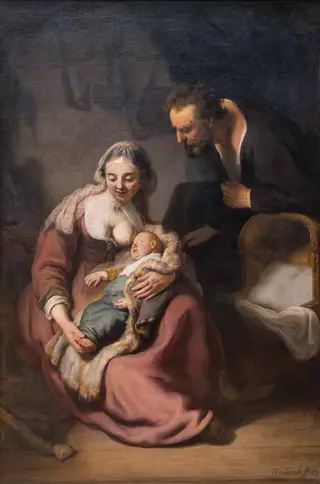
The Holy Family with Angels is an oil painting by the Dutch Golden Age artist Rembrandt van Rijn. It dates from 1645 and is held in the collection of the Hermitage Museum.
About this work
This is an oil painting on canvas by Rembrandt from the Dutch Golden Age. It shows a holy scene with Mary, Joseph, and the Christ Child surrounded by angels. The work lives at the State Hermitage Museum today.
Rembrandt painted it around 1645. It’s a small piece but full of quiet feeling. The angels add a soft, glowing touch.
Look up Rembrandt next.
Technique & Style
The handling of light emphasizes the cradle and the open book held by Mary, while the fine brushwork contributes to the painting's tactile realism.
The work is an oil painting on canvas, signed and dated 1645, measuring 117 cm by 91 cm. Its surface is built up with layered oil paint, and the composition is characteristic of Dutch Golden Age religious art, employing chiaroscuro to model figures in a domestic interior setting. Rembrandt depicts the Holy Family in a modest carpenter's workshop, with Joseph shaping a yoke and angels descending from the left, creating a contrast between everyday activity and sacred symbolism. The handling of light emphasizes the cradle and the open book held by Mary, while the fine brushwork contributes to the painting's tactile realism.
History & Provenance
The Holy Family with Angels was created in 1645 by Rembrandt van Rijn as an oil painting on canvas, signed "Rembrandt f. 1645". The painting was sold at an auction in The Hague in 1733 from the estate of Adriaen Bout for 150 florins.
It subsequently entered the Crozat collection in Paris, from which Empress Catherine II purchased it for the Imperial Hermitage. The painting appears in the 1901 Hermitage catalogue as No. 796 and is currently held in the collection of the Hermitage Museum in Saint Petersburg.
Context
Rembrandt's 1645 painting diverges from traditional Western European iconography, which typically depicted the Holy Family in settings like the Bethlehem stable or during the flight into Egypt. Instead, Rembrandt situates the scene within a contemporary Amsterdam household, blending domestic genre elements with sacred themes. Scholars note this intimate, everyday realism is complicated by the metaphysical presence of descending angels, preventing the work from being classified purely as genre painting.
Art historians have emphasized the work's rich symbolic structure. Joseph's crafting of a yoke, an atypical attribute in his iconography, is interpreted as a reference to Old and New Testament prophecies regarding the Messiah's easy yoke and God's salvific plan. Additionally, the foremost angel's outstretched arms has been read as a prefiguration of the Crucifixion.
Legacy
The painting attracted scholarly attention early on; Hofstede de Groot documented multiple copies, engravings, and reproductions that disseminated its image across Europe. Its acquisition by the Hermitage, facilitated by Catherine the Great, established its reputation as a central example of Dutch Golden Age religious art. Modern analysis emphasizes the unconventional domestic setting and the symbolic yoke carried by Joseph, which have influenced subsequent interpretations of the Holy Family motif.
The work's legacy persists through frequent citation in museum catalogues and art-historical literature, underscoring its lasting impact on the visual narrative of the Holy Family.
Overview
Rembrandt's "The Holy Family with Angels," created around 1645, is an oil painting on canvas from the Dutch Golden Age. This intimate work depicts the Virgin Mary, Saint Joseph, and the infant Christ, enveloped by a group of angels. The painting is recognized for its tender portrayal of the sacred family and is currently housed in the collection of the State Hermitage Museum.
Subject & Meaning
The composition centers on the Holy Family, rendered with a profound sense of quietude and domesticity. Mary cradles the sleeping Christ Child, while Joseph observes nearby. Surrounding them, angels introduce a celestial presence, their forms contributing a gentle radiance to the scene. This portrayal emphasizes the human tenderness within the divine narrative, a common theme in Rembrandt's religious works.
Own this work as a print
Artist & collection

Artist
Rembrandt Harmenszoon van Rijn, known mononymously as Rembrandt, was a Dutch Golden Age painter, printmaker, and draughtsman.