Artwork
David in Prayer
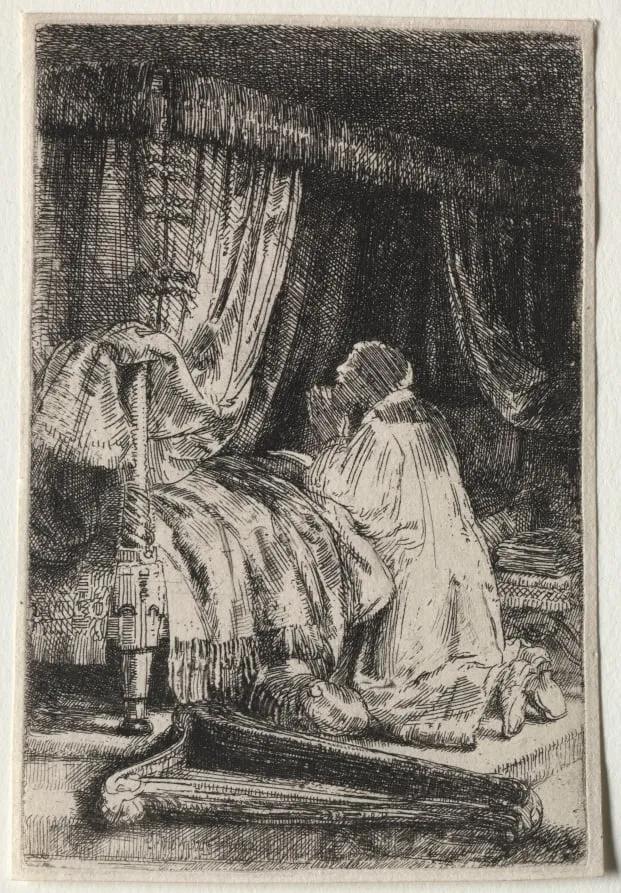
David in Prayer is a print by the Baroque artist Rembrandt van Rijn. It dates from 1652 and is held in the collection of the Cleveland Museum of Art.
- Accession no.
- 1974.257
- Credit line
- Mr. and Mrs. Charles G. Prasse Collection
About this work
Overview
Created in 1652, David in Prayer is an etching with drypoint by Rembrandt van Rijn depicting the biblical King David in a moment of private devotion.
Created in 1652, David in Prayer is an etching with drypoint by Rembrandt van Rijn depicting the biblical King David in a moment of private devotion. The composition centers on the figure kneeling on a simple bench, his head bowed and hands clasped in supplication. He is enveloped in a heavy, textured robe that dominates the foreground, rendered with the artist's characteristic rough, expressive lines.
The setting is a sparse, dimly lit interior defined by deep chiaroscuro; a heavy curtain hangs in the background, while a small table holding a book or box sits to the side, suggesting a scriptural context. Rembrandt employs extensive drypoint work to create rich, velvety blacks and a sense of atmospheric depth, emphasizing the psychological intensity of the scene over narrative detail. This work exemplifies the artist's mature style, where technical experimentation with light and shadow serves to explore themes of human humility and spiritual introspection.
Produced during a period of significant artistic maturity in the Dutch Republic, the print reflects Rembrandt's enduring interest in biblical subjects interpreted through a lens of profound personal emotion and realistic observation.
Subject & Meaning
The image depicts a man kneeling with his head lowered, hands clasped in prayer, clothed in a heavy robe and seated on a plain bench. A modest curtain forms the background, while a small table bearing a book or box suggests a private devotional setting, emphasizing personal piety and introspection.
Technique & Style
Rembrandt employs a stark chiaroscuro effect, using deep, velvety shadows contrasted with sharply illuminated areas on the figure’s face and hands. Rough, expressive lines define the drapery and furnishings, creating a sense of immediacy and emotional intensity typical of his late printmaking practice.
History & Provenance
Created in the final decade of Rembrandt’s career, the etching entered the Cleveland Museum of Art’s holdings through acquisition in the 20th century. Its provenance traces back to early collectors of the artist’s prints, reflecting the work’s continued scholarly and curatorial interest.
Context
The piece belongs to a series of religious and devotional subjects that Rembrandt explored in his later years, when his personal faith and artistic focus shifted toward intimate, inward‑looking scenes. The use of chiaroscuro aligns the work with Baroque conventions while retaining the master’s distinctive, introspective approach.
Artist & collection

Artist
Rembrandt Harmenszoon van Rijn, known mononymously as Rembrandt, was a Dutch Golden Age painter, printmaker, and draughtsman.

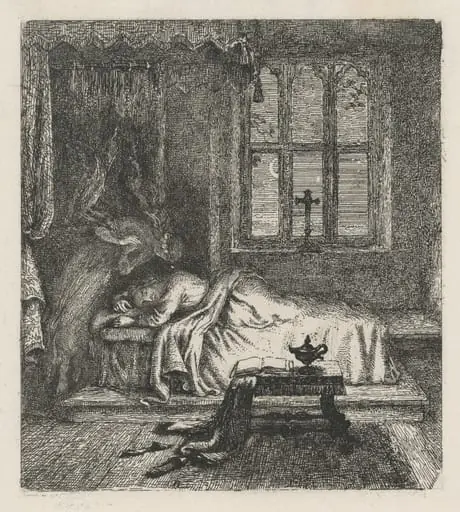 Milton's Dream of His Deceased Wife
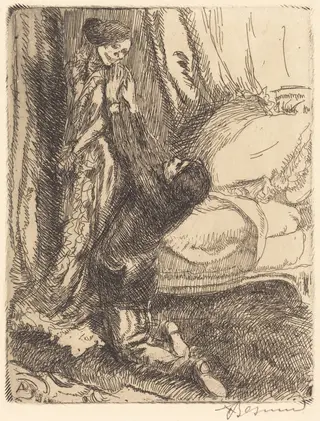 Coquette
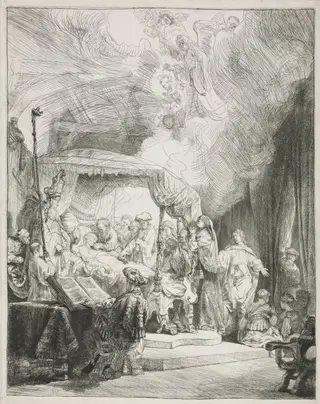 Death of the Virgin
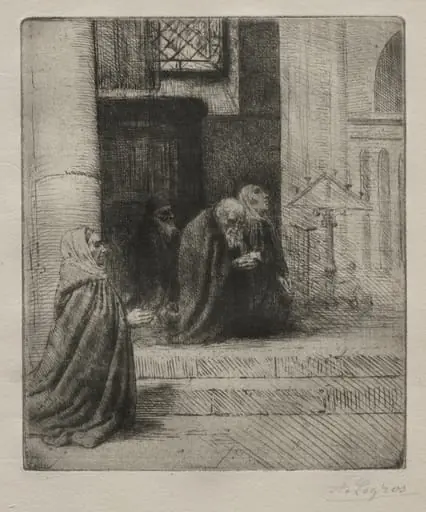 Interior of a Church
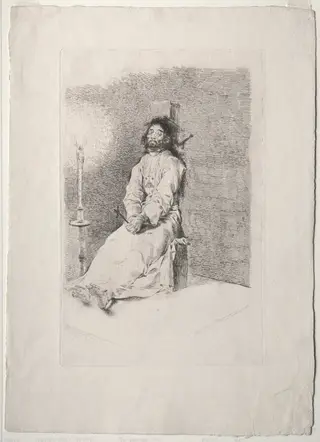 The Garroted Man
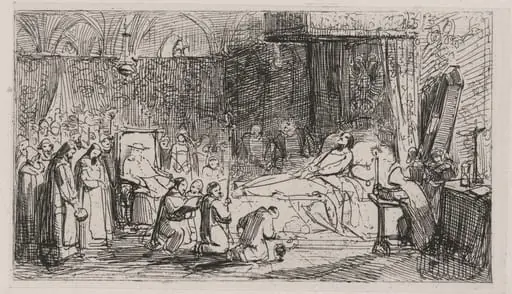 Death of Karl V in the Cloister of Saint Just
![Indian Summer [L'estate di San Martino], by Eleuterio Pagliano](https://artifactworldgallery.com/img/eleuterio-pagliano--indian-summer-l-estate-di-san-martino--c18fa1d8e52f5b86-w320.webp) Indian Summer [L'estate di San Martino]
Indian Summer [L'estate di San Martino] Love Mourns at the Tomb of Preacher Bruhn (Am Grabmal des predigers Bruhn trauert die eheliche Liebe)
 Communion in the Church of Saint Medard (La communion dans l'eglise St.-Medard)
 An Old Man in a Chair, Praying
 The Death of the Virgin
- David in Prayer