Artwork
Jacob Haaringh ('Young Haaringh') (Pieter Haaringh)
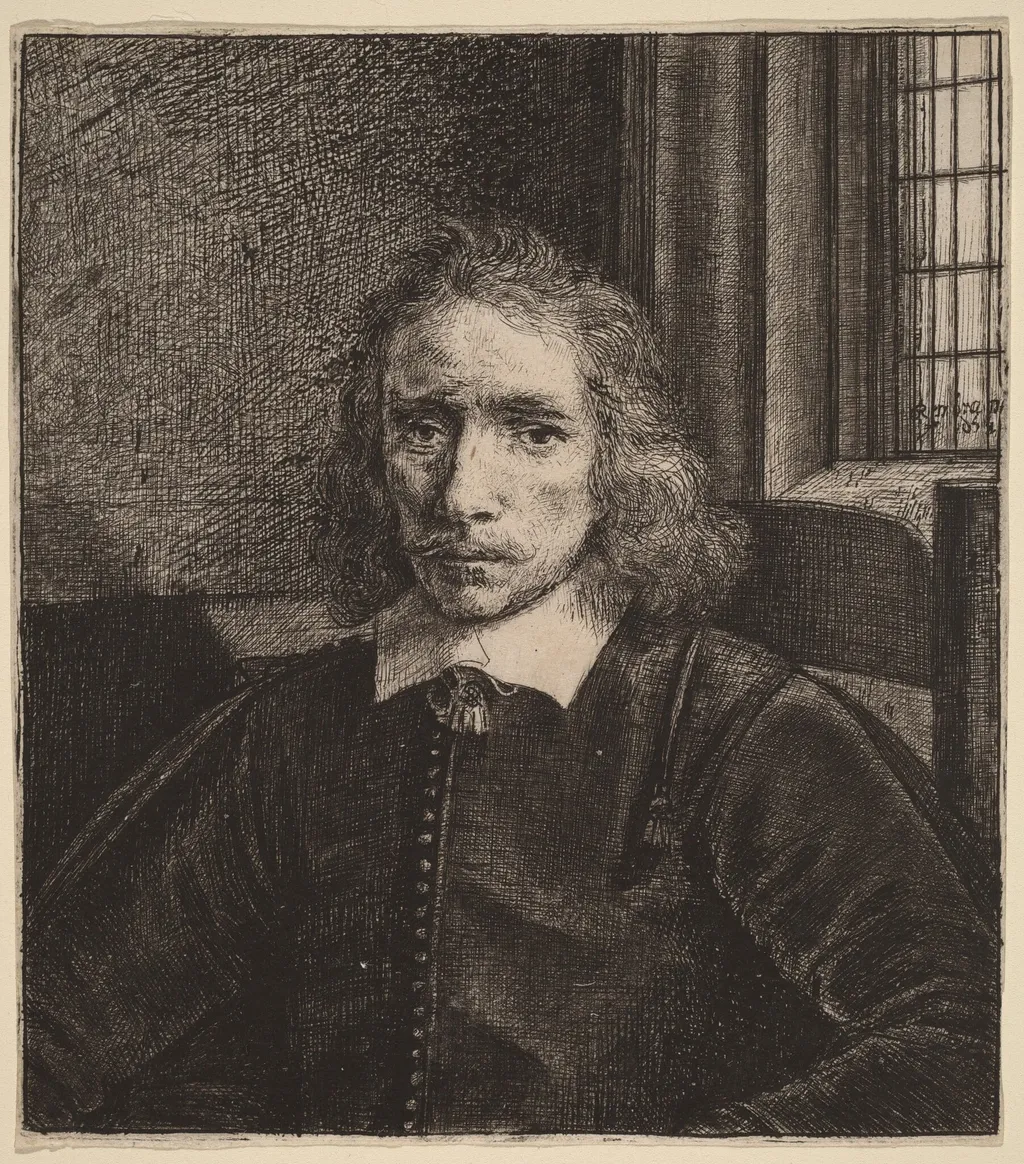
Jacob Haaringh ('Young Haaringh') (Pieter Haaringh) is an ink print by the Baroque artist Rembrandt van Rijn. It dates from 1655 and is held in the collection of the National Gallery of Art.
- Inscription
- Inscribed:by later hand, verso in graphite: RC 12085 / 135/2; by later hand, lower edge in graphite: D255 2 [not deciphered] scarce!
About this work
Overview
Rembrandt employs dramatic chiaroscuro, illuminating the sitter's face from the side while casting the majority of his hair and the background into deep shadow.
Created in 1655, Jacob Haaringh, also known as 'Young Haaringh' or Pieter Haaringh, is a portrait etching by Rembrandt van Rijn that combines etching, drypoint, and engraving on laid paper. The work depicts a young man with curly hair and a serious, contemplative expression, positioned in a three-quarter view. Rembrandt employs dramatic chiaroscuro, illuminating the sitter's face from the side while casting the majority of his hair and the background into deep shadow.
The subject wears a dark, high-collared garment with a visible ruffled cuff, characteristic of mid-seventeenth-century Dutch fashion. The composition includes subtle background details: a window with bars allowing faint light to enter and the arm of a chair visible at the edge, grounding the figure in a sparse interior. This print exemplifies Rembrandt's mature printmaking technique, where he layered multiple intaglio methods to achieve rich tonal variations and textural depth.
It stands as a significant example of his portraiture from the 1650s, a period marked by his exploration of psychological intensity and the expressive potential of light and shadow in print.
Subject & Meaning
The portrait depicts a youthful figure with tightly curled hair, a solemn expression, and a dark, buttoned collar accented by a ruffled cuff. Light falls from the side, illuminating the face while casting most of the hair in shadow, suggesting a contemplative mood and emphasizing the sitter’s individuality.
Technique & Style
Rembrandt employed a hybrid printmaking process: etching to outline forms, drypoint to deepen lines and add texture, and engraving for fine detail. The varied tool marks create a nuanced surface, particularly in the rendering of hair and fabric, and the chiaroscuro effect is achieved through careful manipulation of line density.
History & Provenance
Created in the mid‑seventeenth century, the print is part of Rembrandt’s extensive series of portrait prints. It bears the name Jacob Haaringh (also recorded as Pieter Haaringh), indicating a possible commission or personal connection, though the sitter’s broader biography remains limited.
Context
During the 1650s Rembrandt’s print workshop was prolific, experimenting with mixed techniques to achieve greater tonal range. This work reflects his mature period, when he explored psychological depth in portraiture and refined the interplay of light and shadow within the constraints of the print medium.
Legacy
The piece exemplifies Rembrandt’s mastery of printmaking and his influence on subsequent generations of artists who studied his approach to line, texture, and atmospheric lighting in monochrome works.
Own this work as a print
Artist & collection

Artist
Rembrandt Harmenszoon van Rijn, known mononymously as Rembrandt, was a Dutch Golden Age painter, printmaker, and draughtsman.