Artwork
Self portrait
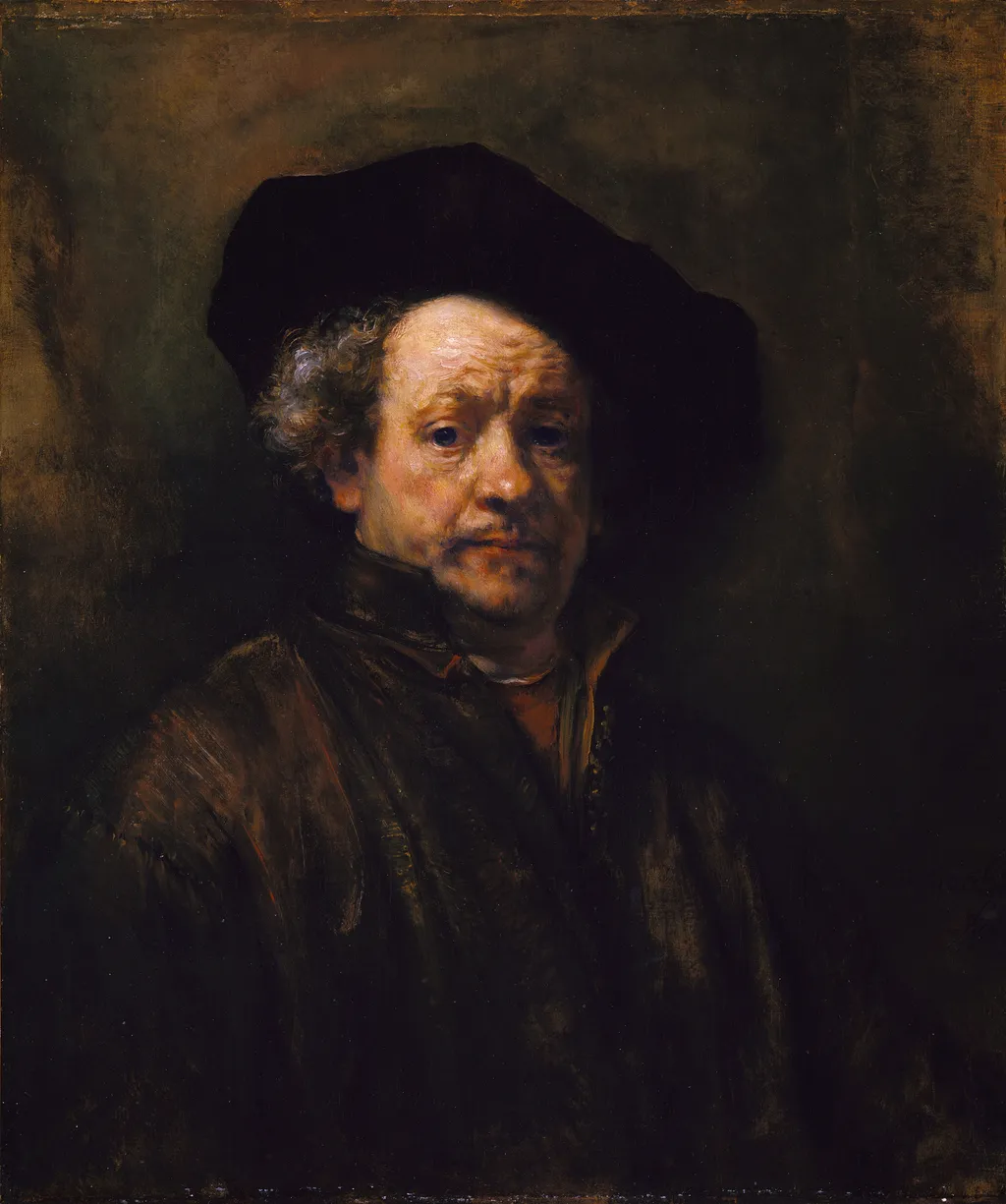
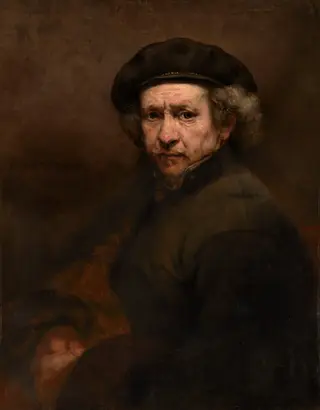
Self portrait is an oil painting by the Dutch Golden Age artist Rembrandt van Rijn. It dates from 1660 and is held in the collection of the Metropolitan Museum of Art.
About this work
Subject & Meaning
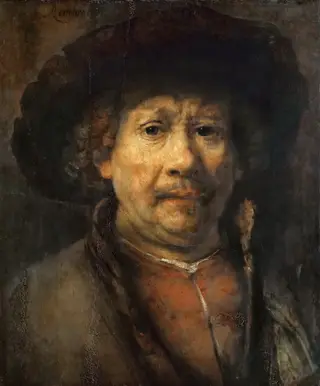
The 1660 Self-Portrait shows Rembrandt in a moment of personal crisis, portraying his wrinkled brow, worried expression, and prematurely aged features that signal financial ruin and emotional strain. The raised eyebrows and tilted cap convey a whimsical impatience, while the spark in his eyes and proud head position suggest resilience and defiant self‑affirmation despite neglect. The work thus functions as both a realistic record of the artist's appearance and a symbolic statement of endurance amid adversity, reflecting the anxieties of a fifty‑four‑year‑old painter facing bankruptcy, the sale of his collection, and the withdrawal of friends and pupils.
Technique & Style
In contrast, lighter areas such as the cheek are applied with a heavily loaded brush to suggest flesh texture and luminosity.
Executed in 1660, this self-portrait is an oil painting on canvas measuring 80.3 by 67.3 centimeters. Technically, the work demonstrates Rembrandt's mature mastery through varied brushwork; the rich black hat and warm green background are rendered with smooth handling, while facial shadows appear thin, warm, and transparent. In contrast, lighter areas such as the cheek are applied with a heavily loaded brush to suggest flesh texture and luminosity.
The composition features the artist wearing a red waistcoat beneath a heavy brownish coat and a jauntily tilted cap. Stylistically, the portrait captures a complex psychological state, combining a wrinkled brow and drawn mouth indicative of anxiety with a proud, erect head posture and a spark in the eyes that suggests defiance.
History & Provenance
The Self-Portrait of 1660 by Rembrandt is housed in the Metropolitan Museum of Art in New York. It entered the museum's collection through the bequest of Benjamin Altman in 1913 and has remained in the European Paintings department, where it is shown regularly in displays of Dutch Golden Age works. The painting is recorded in the museum's catalog as part of the Altman Collection. Its presence in the museum's permanent holdings reflects a continuous exhibition history since the early twentieth century.
Context
Executed in 1660, the year Rembrandt faced bankruptcy, the sale of his collection, and the loss of his studio, this self‑portrait captures a moment of acute personal crisis. Contemporary observers noted a "wrinkled brow and worried expression" that mirrors his troubled state of mind, while a 1913 critique praised the technical handling of the black hat and warm green background, describing the brushwork as "smoothly painted" and the flesh tones as luminous. As one of more than forty self‑portraits, the work exemplifies the Dutch Golden Age emphasis on introspective portraiture and situates Rembrandt's oeuvre within a trajectory of resilience despite near‑total eclipse of his reputation in the decades that followed.
The painting entered the Benjamin Altman Collection and has been on display at the Metropolitan Museum of Art since 1913.
Legacy
Rembrandt's 1660 Self-Portrait has exerted a lasting influence on the perception of the artist as a figure of both technical mastery and human resilience. Though his reputation suffered near-total eclipse in the late seventeenth and eighteenth centuries, by the twentieth century the work became emblematic of Rembrandt's enduring appeal, often cited as among the most popular paintings ever created. Its inclusion in the Benjamin Altman Collection and subsequent bequest to the Metropolitan Museum of Art in 1913 cemented its status as a touchstone of Dutch Golden Age portraiture.
Later writers frequently contrasted its intimate portrayal of aging and adversity with earlier, more idealized self-representations, reinforcing a modern image of the artist as a defiant, emotionally transparent figure. Comparative studies with other Rembrandt self-portraits have framed this work as a turning point in his late oeuvre, emphasizing its psychological depth and technical refinement as foundational to his posthumous legacy.
Overview
Rembrandt van Rijn's Self-portrait, painted in 1660, is an oil on canvas work from the Dutch Golden Age. This painting is one of more than forty self-portraits created by the artist throughout his career. It depicts Rembrandt at the age of fifty-four, offering a direct and unvarnished portrayal of the artist in his later years. The artwork is housed in the Metropolitan Museum of Art in New York City.

Own this work as a print
Artist & collection

Artist
Rembrandt Harmenszoon van Rijn, known mononymously as Rembrandt, was a Dutch Golden Age painter, printmaker, and draughtsman.