Artwork
Young Man in a Velvet Cap (Petrus Sylvius?)
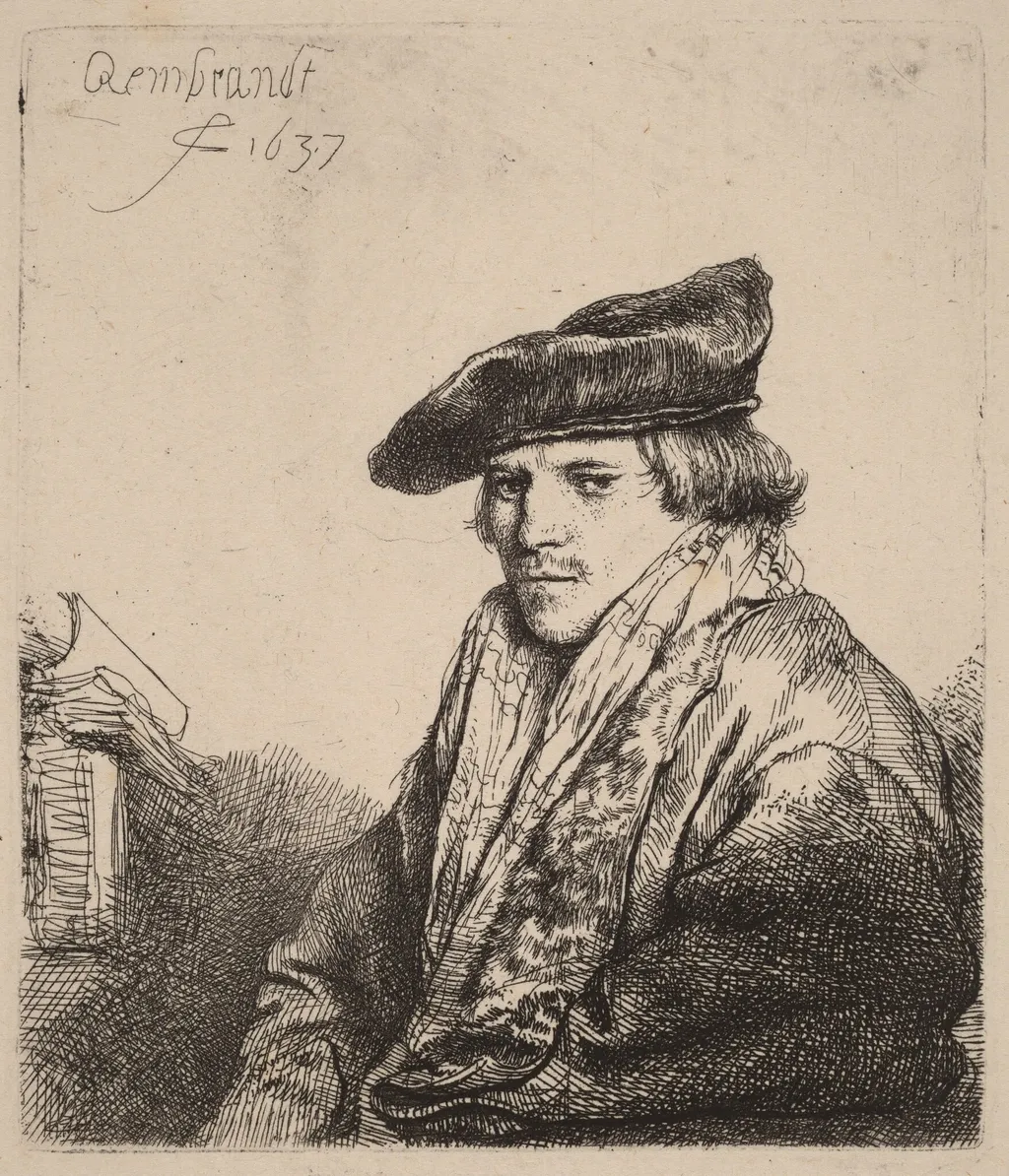
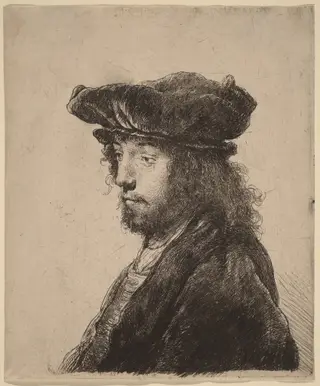
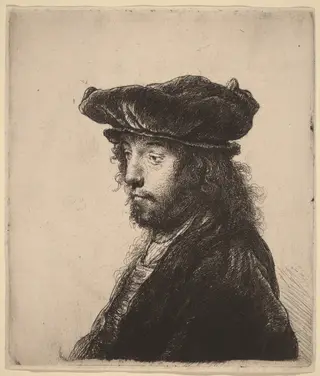
Young Man in a Velvet Cap (Petrus Sylvius?) is an ink print by the Baroque artist Rembrandt van Rijn. It dates from 1637 and is held in the collection of the National Gallery of Art. Young Man in a Velvet Cap (Petrus Sylvius?
- Inscription
- Inscribed:recto: in plate, at upper left: Rembrandt / f 1637; verso: at upper left, in graphite, in later hand: 268; at lower right, in graphite, in later hand: B. 268 II; at bottom left, in graphite, in later hand: B-186 [upside-down]
- Markings
- Marked:recto: none; verso: at lower left, circle stamped in black ink [not enough information to identify in Lugt, though possibly Henry Brodhurst, Lugt 1296?]
About this work
The artist signed it in the corner, "Rembrandt F 1637", meaning it’s from 1637.
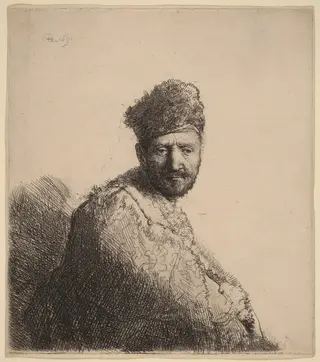
This sketch shows a man in a wide-brimmed hat, his face turned slightly away. His collar is high, and his hand rests on his chest. The lines are rough and dark, giving his clothes and hair a textured look.
The artist signed it in the corner, "Rembrandt F 1637", meaning it’s from 1637. The paper has a woven texture, and the lines look hand-scratchy, not smooth.
Next, check out etching to see how artists like Rembrandt made prints this way.
Overview
Young Man in a Velvet Cap (Petrus Sylvius?) is an etching by Rembrandt van Rijn, created in 1637. The work depicts a young man, possibly the scholar Petrus Sylvius, wearing a wide-brimmed velvet cap and a high-collared garment. His head is turned slightly away from the viewer, while his right hand rests against his chest in a gesture of contemplation or self-assurance.
Executed on laid paper, the piece showcases Rembrandt's mastery of the etching medium during his early Amsterdam period. The composition relies on bold, varied line work to create texture and depth, particularly in the rendering of the hair, the soft folds of the velvet, and the fabric of the collar. Dark, heavy strokes contrast with lighter, sketchier areas to model the figure's face and clothing, demonstrating the artist's ability to convey volume and psychological presence through minimal means.
Signed 'Rembrandt F 1637' in the lower right corner, this print reflects Rembrandt's ongoing exploration of portraiture and character study in printmaking, a field in which he achieved significant innovation. The work remains a notable example of his graphic output from the late 1630s, a time when he was establishing his reputation as a leading artist in the Dutch Republic.
Subject & Meaning
The portrait presents a solitary figure whose pose suggests contemplation or modesty. The cap and high collar indicate a fashionable attire of the period, while the hand on the chest may imply a gesture of self‑presentation or introspection, typical of Rembrandt’s interest in psychological depth.
Technique & Style
Rembrandt employed a direct, hand‑scratched line that yields a rough, textured surface. The etching’s dark, uneven strokes give the hair and clothing a tactile quality, contrasting with the smoother areas of the laid paper background.
History & Provenance
The print bears the inscription "Rembrandt f. 1637," confirming its creation date and authorship. It remains an example of Rembrandt’s early printmaking, produced during a prolific period when he was experimenting with etching as a medium.
Context
In the 1630s Rembrandt was expanding his repertoire beyond painting, exploring the possibilities of printmaking. This work reflects his engagement with portraiture, a genre he frequently revisited, and demonstrates his skill in rendering character through line rather than color.
Own this work as a print
Artist & collection

Artist
Rembrandt Harmenszoon van Rijn, known mononymously as Rembrandt, was a Dutch Golden Age painter, printmaker, and draughtsman.