Artwork
Madonna in Glory with Seraphim
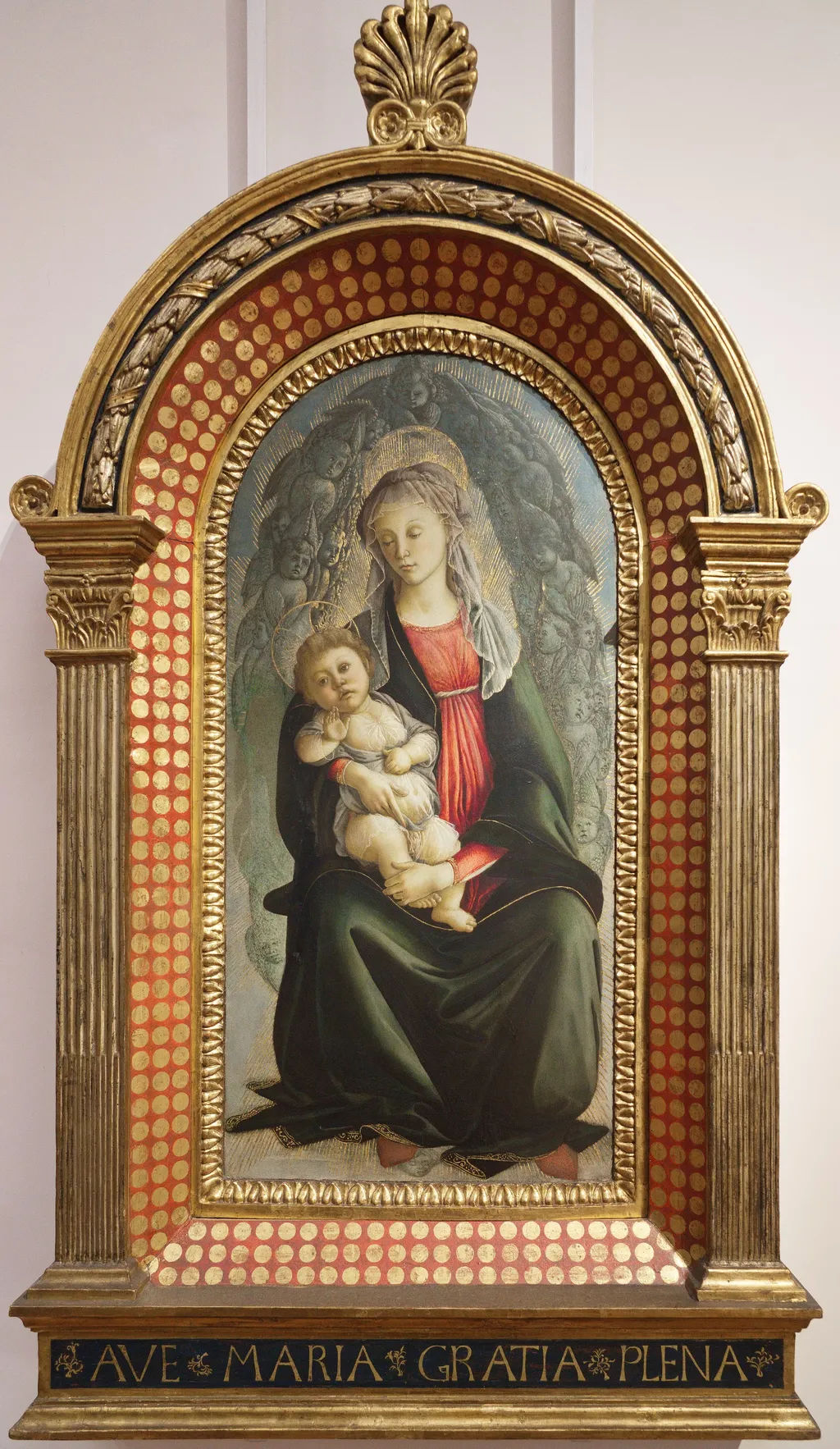
Madonna in Glory with Seraphim is a tempera painting by the Early Renaissance artist Sandro Botticelli. It dates from 1469 and is held in the collection of the Uffizi Gallery.
About this work
Technique & Style
The Christ Child, however, is depicted in a fully Botticellian idiom, with rounded forms and a faintly melancholic expression as he raises his hand in blessing.
Madonna in Glory with Seraphim is executed in tempera on panel, measuring 120 by 65 cm. Botticelli renders the Virgin enthroned on clouds within a mandorla of seraphim painted in grisaille, from which golden rays emerge, with both figures bearing haloes. The work is characterized by an incisive, graphic chiaroscuro that reflects the young artist's temporary adherence to Verrocchio's manner, with whom he may have trained. The Christ Child, however, is depicted in a fully Botticellian idiom, with rounded forms and a faintly melancholic expression as he raises his hand in blessing. The Virgin's elongated, loose figure and her delicately rounded face defined by contour lines recall the influence of Filippo Lippi. Botticelli applies meticulous care to the regular folds of the drapery and the transparency of the veils.
History & Provenance
The work was painted for an unknown patron around 1469-1470 and remained in the artist’s native city of Florence. It entered the Uffizi inventories in 1784 and 1825 as an anonymous piece, later attributed to Botticelli by Wilhelm von Bode, who placed it in the artist’s Verrocchio‑influenced phase. Subsequent scholarship confirmed this attribution, though Adolfo Venturi argued for a connection to the school of Filippo Lippi. The painting stays in the Galleria degli Uffizi, where it is recorded in the museum’s collection today. The painting is housed in the Galleria degli Uffizi in Florence. It was recorded in the Uffizi inventories of 1784 and 1825 as an anonymous work. Wilhelm von Bode first attributed it to Botticelli and dated it to the Verrocchio phase of his early career, around 1469-1470. Subsequent scholarship confirmed this attribution, although Adolfo Venturi attributed it to the school of Filippo Lippi. The work is cataloged in the Uffizi collection with the inventory number that corresponds to its accession as a museum-held piece, though the specific accession identifier is not provided in the sources. It has been exhibited in various exhibitions focusing on Botticelli's oeuvre and Renaissance art, including displays at the Uffizi and traveling exhibitions of Italian Renaissance paintings.
Context
The painting Madonna in Glory with Seraphim by Sandro Botticelli was created around 1469-1470 as a tempera work on panel, depicting the Virgin Mary holding the infant Jesus amid a heavenly vision surrounded by seraphim. It was first documented in the Uffizi inventories of 1784 and 1825 as an anonymous work, later attributed to Botticelli by art historian Wilhelm von Bode, who associated it with Botticelli's early Verrocchio-influenced period. Subsequent scholarship largely confirmed this attribution, though Adolfo Venturi disputed it, proposing instead that the work originated from the school of Filippo Lippi. The piece exemplifies transitional stylistic traits: Botticelli's characteristic elongated forms and melancholic figures are evident in the Virgin's posture and delicate facial features, while the graphic chiaroscuro and treatment of drapery reflect Verrocchio's workshop practices. The infant Christ, rendered with rounded contours and a blessing gesture, marks a departure from Verrocchio's influence toward Botticelli's mature aesthetic. The composition aligns with other contemporary Botticelli works such as the Madonna of the Rose Garden, both housed in the Uffizi, reinforcing his focus on monumental, emotionally resonant sacred imagery.
Artist & collection
Artist
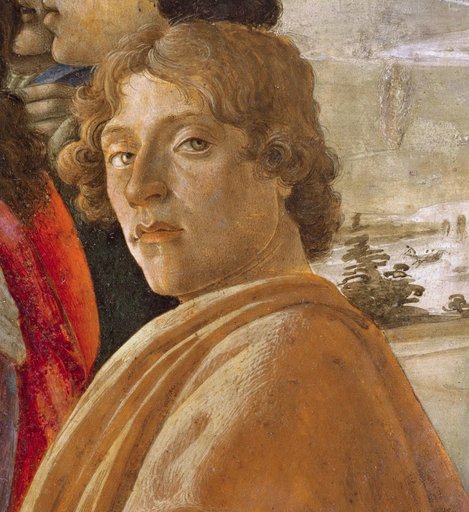
Alessandro di Mariano di Vanni Filipepi, better known as Sandro Botticelli or simply Botticelli, was an Italian painter of the Early Renaissance.