Artwork
Madonna of the Rose Garden
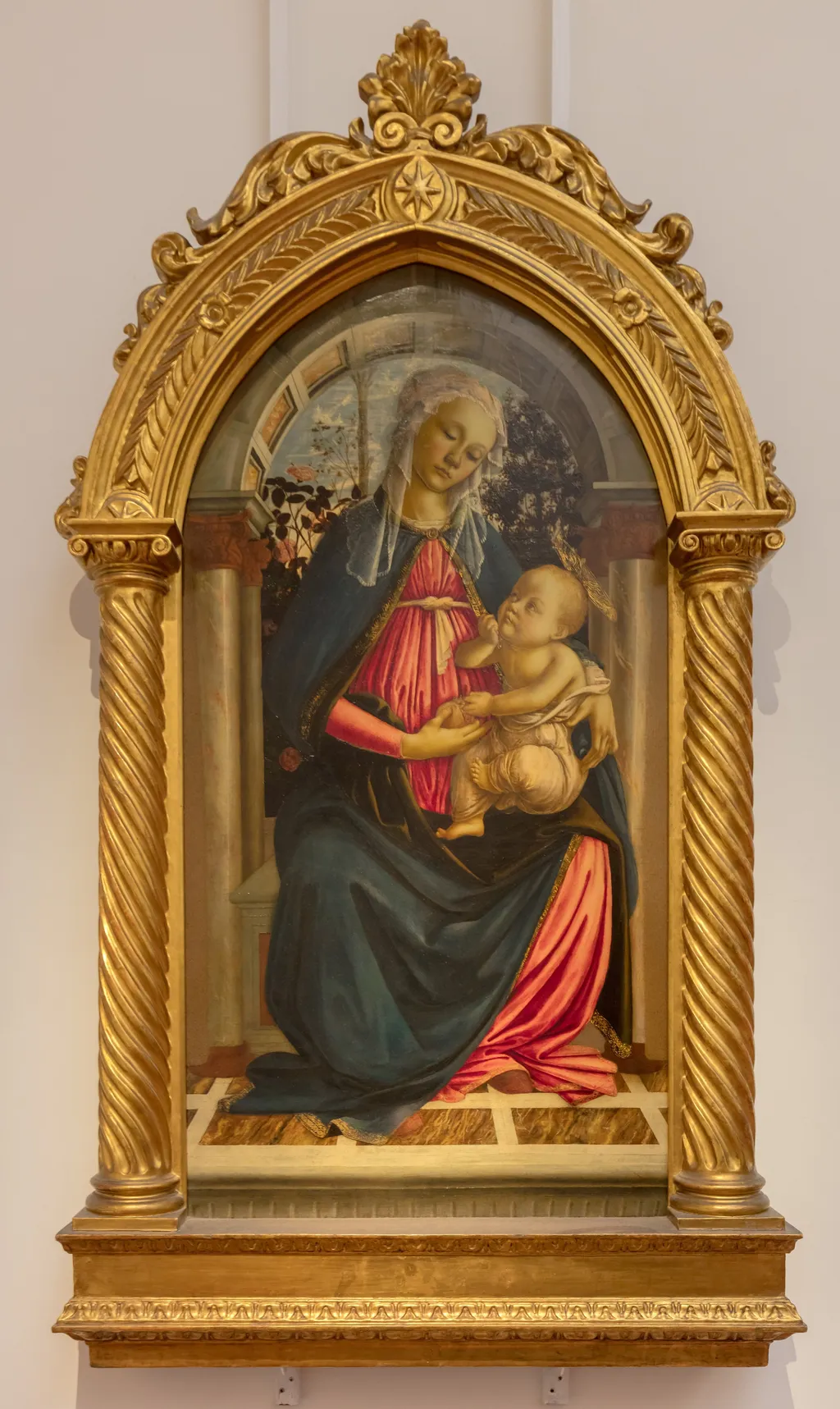
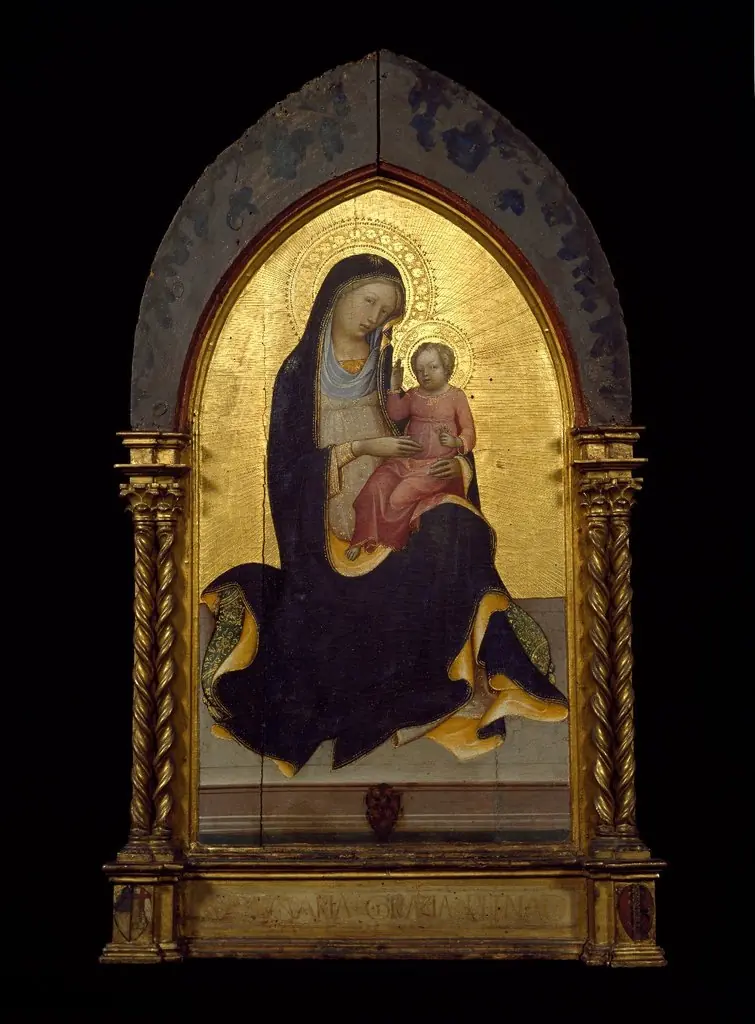
Madonna of the Rose Garden is a tempera painting by the Early Renaissance artist Sandro Botticelli. It dates from 1469 and is held in the collection of the Uffizi Gallery.
About this work
Overview
Measuring 124 cm in height and 64-65 cm in width, it is one of the artist's earliest surviving works and is now held in the Uffizi Gallery in Florence.
The Madonna of the Rose Garden (Italian: Madonna del Roseto) is a tempera painting on panel by the Italian Early Renaissance master Sandro Botticelli, dated to approximately 1469-1470. Measuring 124 cm in height and 64-65 cm in width, it is one of the artist's earliest surviving works and is now held in the Uffizi Gallery in Florence. The painting occupies a significant place in Botticelli's oeuvre as a foundational example of his youthful style, produced during his formative period in or near the workshop of Andrea del Verrocchio. Its attribution and dating were first established by the German art historian Wilhelm von Bode, who placed it in Botticelli's "Verrocchiesque" phase, a chronology subsequently confirmed by other scholars. The work's importance lies in its demonstration of the young Botticelli's emerging artistic identity, synthesizing influences from Verrocchio and Filippo Lippi while already displaying distinctive personal characteristics that would define his later career.
Subject & Meaning
The painting depicts the Virgin Mary seated frontally, holding the Christ Child on her lap beneath a loggia. The iconography centers on two principal symbolic elements: the rose garden behind Mary and the pomegranate she holds in her right hand. The roses identify Mary as the "Mystical Rose" (Rosa Mystica), one of her devotional titles, while also evoking the "rose without thorn" (rosa sine spina) as a symbol of her immaculate nature. The pomegranate, from which the Christ Child tastes, carries multivalent significance: fertility, royalty, and, through its red color, prefiguration of the blood of Christ's Passion. Mary wears her traditional colors of dark blue mantle over rose-red dress, with a translucent veil flowing over her hair. The infant is partially swaddled in light cloth and reaches toward the fruit. The absence of attendant angels, unusual for contemporary Marian imagery, focuses attention entirely on the intimate yet intellectually restrained mother-child relationship. The architectural setting frames the sacred figures within a domesticated sacred space, while the garden visible beyond establishes a hortus conclusus, the enclosed garden symbolizing Mary's virginity.
Technique & Style
Executed in tempera on panel, the painting displays both the technical accomplishments and characteristic uncertainties of Botticelli's early period. The medium allows for smooth modeling with soft transitions in flesh tones and deep, regular folds in drapery, as observed on the surface, which also shows fine craquelure throughout. Light falls evenly from the left, illuminating faces and fabric with an incisive chiaroscuro that scholars have linked to Verrocchio's influence. The coffered semicircular arch above Mary follows the curved profile of the board, integrating frame and pictorial space. Botticelli demonstrates particular attention to the transparency of veils and the regular rhythm of drapery folds. The bicolored marble pavement below employs perspective technique to ground the figures in measurable space, though sources note spatial inconsistencies: the architectural background is disproportionately small relative to Mary's figure and even to the garden flowers behind her. The Christ Child's large oval head and lively expression recall Verrocchio's sculpture Putto con delfino from the same period, while Mary's elongated, loosely posed figure departs from the stricter models of Filippo Lippi. These qualities reveal a young artist negotiating between workshop training and independent development.
History & Provenance
The painting's early history is connected to Florentine civic institutions. It was documented in the Chamber of Commerce of Florence (Camera di Commercio), leading scholars including Lightbown to hypothesize that it was originally commissioned either by the Wool Guild (Arte della Lana), which had formerly occupied that site, or by the Tribunale della Mercanzia, for whom Botticelli had already executed the Madonna della loggia. The work entered the Uffizi Gallery at the end of the eighteenth century, transferred from the Chamber of Commerce. Wilhelm von Bode (1845-1929) was the first scholar to attribute the painting to Botticelli and to date it to the artist's juvenile phase, specifically the Verrocchiesque period of 1469-1470, an attribution and chronology that subsequent scholarship has generally confirmed. The painting now bears the inventory of the Uffizi Gallery in Florence, where it remains on public display. No extensive exhibition history is recorded in the sources beyond its permanent installation.
Context
The Madonna of the Rose Garden emerges from the competitive artistic environment of late 1460s Florence, where Botticelli positioned himself between two dominant influences. His temporary adherence to Verrocchio's manner, visible in the graphic handling and chiaroscuro, suggests possible workshop association during these formative years. Simultaneously, Botticelli absorbed lessons from Filippo Lippi, whose influence is discernible in the delicate oval face of Mary and the pursuit of ideal beauty. Yet by this early date, Botticelli was already departing from both models: the Christ Child's physiognomy has shed the rounded forms of Verrocchio in favor of a more characteristic personal type, and Mary's elongated, supple articulation exceeds anything in Lippi's oeuvre. The painting belongs to a series of Madonnas Botticelli produced between approximately 1465 and 1470, constituting a sustained meditation on the theme that established his reputation. Critical reception has focused on the work as a document of artistic emergence, with particular attention to its spatial ambiguities as evidence of technical apprenticeship rather than deficiency. The painting thus serves as a benchmark for understanding how Botticelli synthesized and transformed available models into his distinctive aesthetic.
Legacy
As one of Botticelli's earliest extant paintings, the Madonna of the Rose Garden holds foundational status in the critical reconstruction of his career. Its attribution history, initiated by Bode's pioneering scholarship, established methodological precedents for dating Botticelli's early works by stylistic comparison with Verrocchio's circle. The painting's influence on subsequent art history is primarily documentary and evolutionary rather than direct: it demonstrates the moment when Botticelli's personal idiom began to crystallize from workshop conventions. The work has contributed to broader scholarly discussions about the relationship between painters and sculptors in Verrocchio's ambit, the transmission of Lippi's legacy to the next generation, and the role of Florentine civic patronage in nurturing young artists. Its presence in the Uffizi, alongside other early Botticelli Madonnas, facilitates comparative study of his developing style. The painting also holds interest for iconographic studies of Marian symbolism, particularly the interplay between the Mystical Rose and Passion imagery in fifteenth-century Florentine devotion. While not as widely reproduced or culturally iconic as Botticelli's mature mythologies, the Madonna of the Rose Garden remains essential for understanding the artist's trajectory and the broader patterns of Early Renaissance artistic formation.
Own this work as a print
Artist & collection
Artist
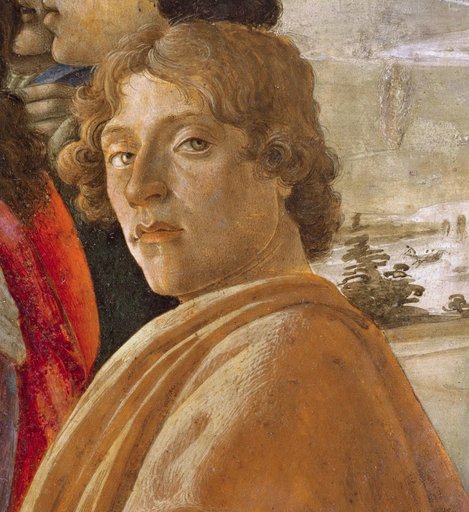
Alessandro di Mariano di Vanni Filipepi, better known as Sandro Botticelli or simply Botticelli, was an Italian painter of the Early Renaissance.