Artwork
Saint Margaret
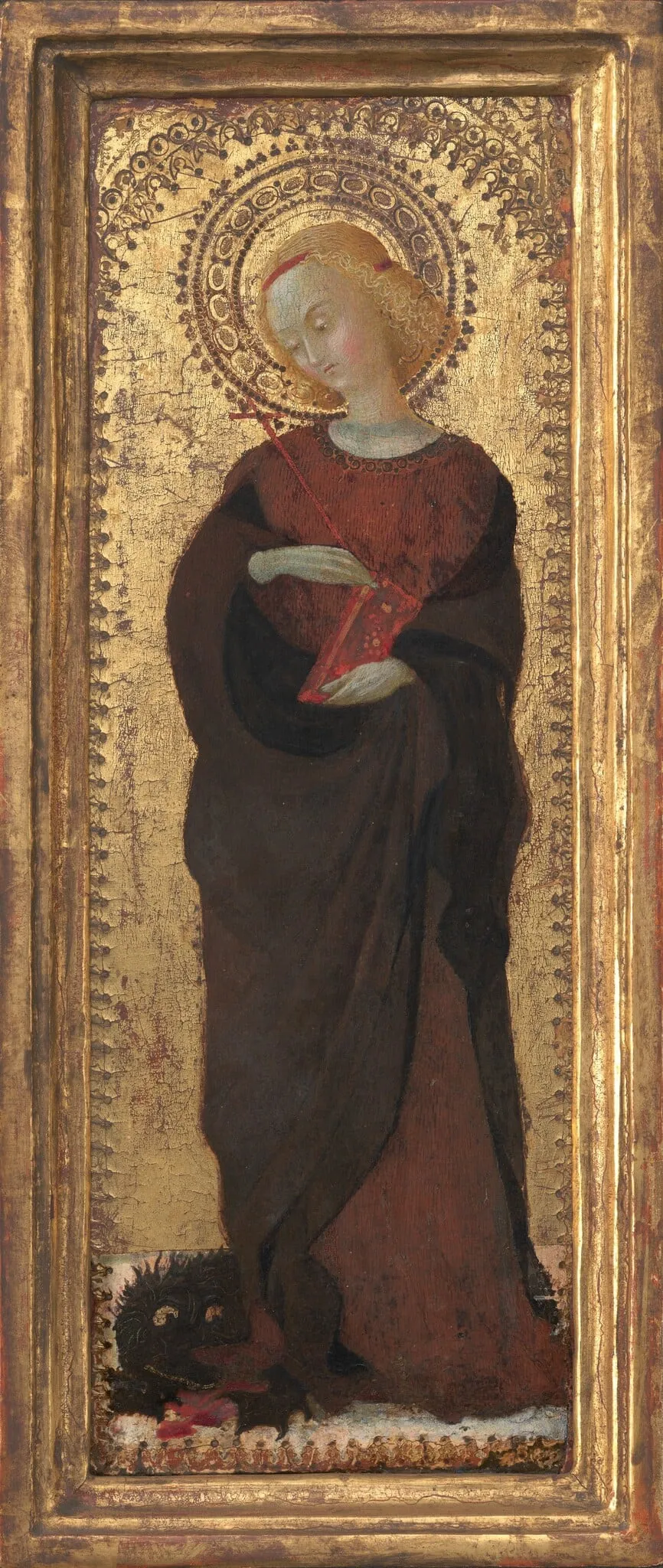
Saint Margaret is a tempera painting by the Early Renaissance artist Sassetta. It dates from 1435 and is held in the collection of the National Gallery of Art.
About this work
Subject & Meaning
The painting depicts Saint Margaret the Virgin, a central figure in religious art.
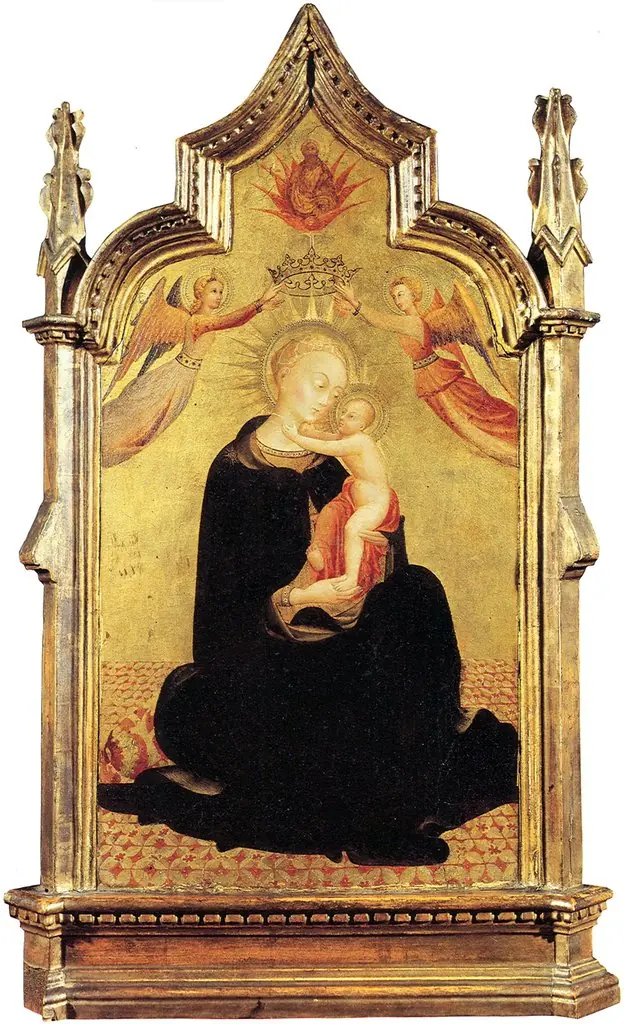
The painting depicts Saint Margaret the Virgin, a central figure in religious art. As a wing of a small portable triptych created in 1435, the work belongs to a devotional format where the central panel featured the Virgin and Child crowned by angels. While the specific iconographic details of Margaret's traditional attributes, such as the dragon, are not explicitly described in the provided records, the subject is identified strictly as the Virgin Margaret.
The piece functions as a component of a larger religious narrative structure, originally surmounted by a gable likely containing additional figures, serving a liturgical or private devotional purpose within the context of 15th-century Italian religious painting.
Technique & Style
Created in 1435 by Sassetta, Saint Margaret is executed in tempera on a poplar panel support. The work measures 28.5 cm in height and 10.6 cm in width, reflecting its original function as one of the wings of a small portable triptych. Stylistically, the painting belongs to the religious genre and depicts the Virgin Margaret.
The panel was likely surmounted by a gable, consistent with contemporary custom for such triptych wings, which may have featured additional painted figures like angels. The medium and support are characteristic of early 15th-century Italian panel painting techniques.
History & Provenance
The Saint Margaret panel, executed in tempera on poplar panel circa 1435, formed the left wing of a small portable triptych whose central panel is now identified as the Virgin and Child Crowned by Angels in the Gemäldegalerie, Berlin. Its early ownership is uncertain, though it may have resided in a German private collection during the nineteenth century. By the early 1900s it was in the possession of Robert Langton Douglas in London, who sold it to Dan Fellows Platt of Englewood, New Jersey in March 1913.
After Platt’s death the work passed to the Trustees of his Estate, which sold it in March 1939 to the Samuel H. Kress Foundation; the Foundation donated the painting to the National Gallery of Art in 1943.
Saint Margaret is held by the National Gallery of Art in Washington, D.C., as part of the Samuel H. Kress Collection. Its accession number is 1943.4.5, having been gifted to the NGA by the Kress Foundation in 1943. The provenance traces back to a possible nineteenth-century German private collection, after which it passed through Robert Langton Douglas in London in the early 1900s.
It was sold to Dan Fellows Platt of Englewood, New Jersey, in March 1913, and then acquired in March 1939 by the Samuel H. Kress Foundation from the Trustees of the Platt Estate before its eventual donation to the gallery.
The panel was originally one of the wings of a small portable triptych, with the central panel now identified as the Virgin and Child Crowned by Angels in the Gemäldegalerie, Berlin. No exhibition history beyond its acquisition and transfer to the NGA is recorded in the available sources.
Overview
Saint Margaret, painted by Stefano di Giovanni di Consolo, known as Sassetta, around 1435, exemplifies the Sienese School's contributions to the early Renaissance. Executed in tempera on a poplar panel, this religious work highlights Sassetta's position as a prominent painter in Tuscany during this period. The painting reflects the era's devotional focus and the developing artistic styles that characterized the transition from late Gothic to early Renaissance aesthetics.
Context
Created during the early Renaissance, Saint Margaret is situated within a period of significant artistic and cultural transformation in Tuscany. The work underscores the enduring importance of religious themes in art, which continued to serve as primary subjects for painters. It also illustrates the evolving stylistic landscape, as artists like Sassetta navigated between established regional traditions and newer trends favoring greater naturalism, contributing to the rich tapestry of Renaissance art.
Artist & collection

Artist
Stefano di Giovanni di Consolo, known as il Sassetta (c. 1392–1450) was a Tuscan painter of the Renaissance, and a significant figure of the Sienese School. While working within the Sienese tradition, he innovated the…

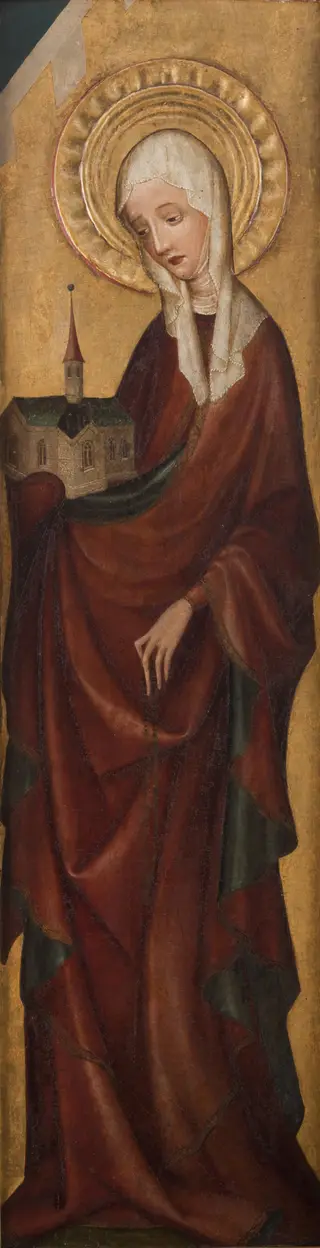 St Hedwig of Silesia. The wing from the altar retable from Trzebunia
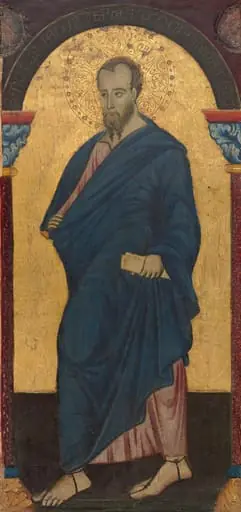 Saint James Minor
 Saint Ursula
 Hl. Paulus Rückseite: Hl. Reinoldus
 Our Lady of Sorrows
 Saint Catherine
 The Mourning Madonna
 The Blessed Andrea Gallerani (died 1251)
 Portrait of Lysbeth van Duvenvoorde
 Mary (after The Ghent Altarpiece)
 Saint Margaret