Artwork
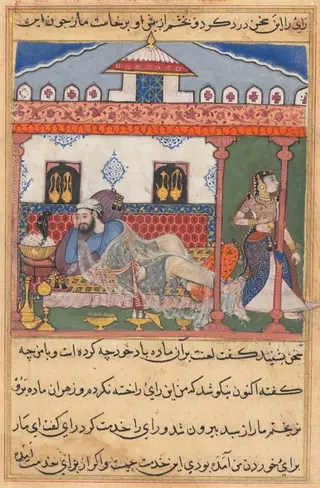
The king dreams of a lady, the personification of wealth, departing from him on account of his purchasing a bowl and a staff from a yogi, from a Tuti-nama (Tales of a Parrot): Thirty-sixth Night
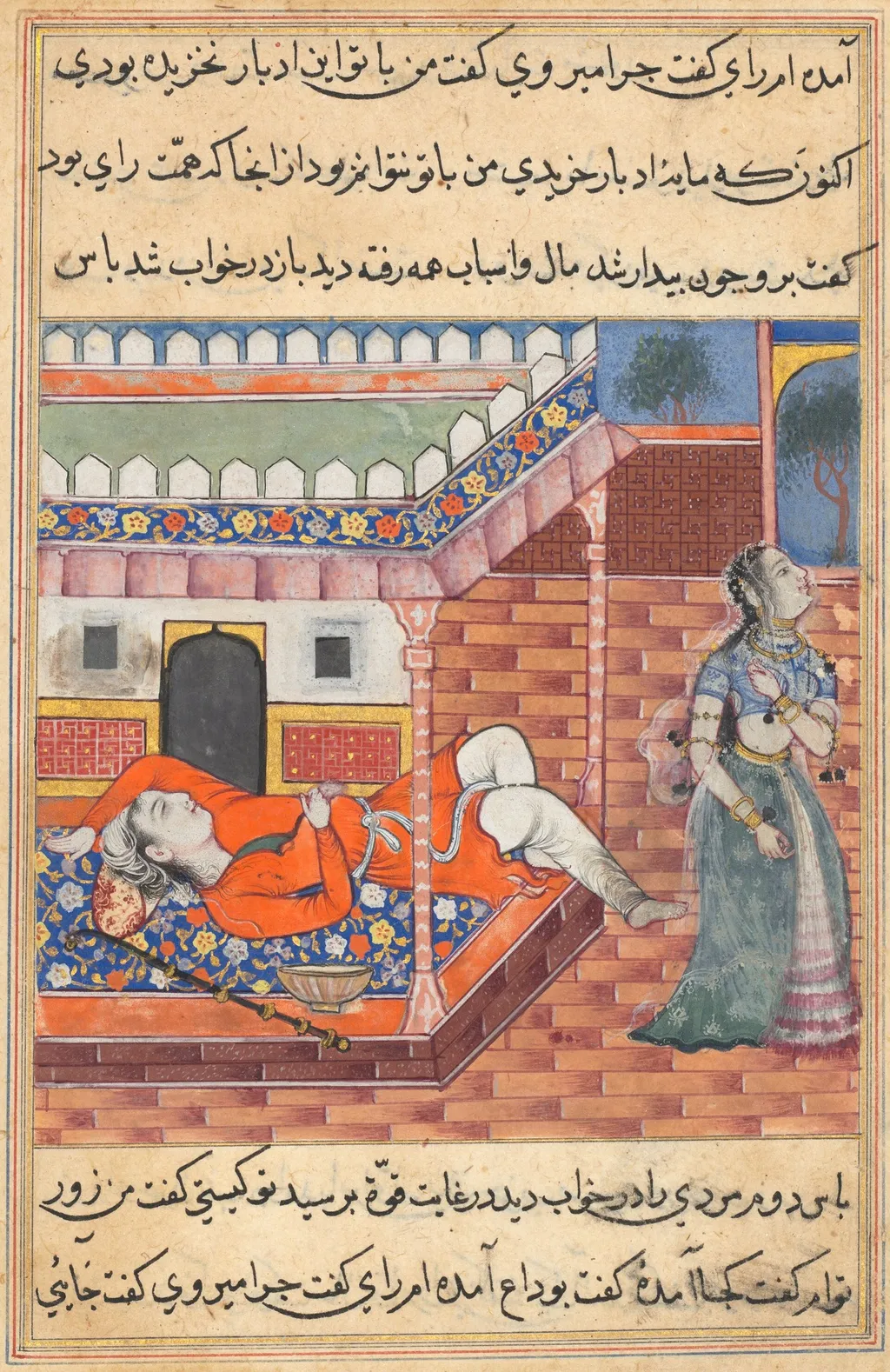
The king dreams of a lady, the personification of wealth, departing from him on account of his purchasing a bowl and a staff from a yogi, from a Tuti-nama (Tales of a Parrot): Thirty-sixth Night is an unspecified painting. It dates from 1560 and is held in the collection of the Cleveland Museum of Art. The work depicts a richly dressed man reclined on a bed, clutching a bowl, while a white elephant stands nearby.
About this work
Subject & Meaning
Her departure is directly tied to the king's actions, specifically his purchase of a bowl and a staff from a yogi.
The artwork illustrates a scene from the thirty-sixth night of the Tuti-nama (Tales of a Parrot). It depicts a king's dream in which a lady, acting as the personification of wealth, leaves him. Her departure is directly tied to the king's actions, specifically his purchase of a bowl and a staff from a yogi.
These objects symbolize the ascetic way of life, and their acquisition by the king signifies a deliberate turn away from worldly riches, which is why the embodiment of wealth abandons him in the vision.
History & Provenance
The painting, dated to 1560, was produced in the Mughal Empire by an unknown artist, likely as part of a manuscript illustration for the Tuti-nama. Its commission and early ownership are not recorded in the available sources. The work entered the Cleveland Museum of Art in 1962, receiving the accession number 1962.279.239.b, and remains in the museum’s collection.
It is classified as a miniature painting. No further details of its provenance prior to acquisition are provided.
Context
The work is part of the early Mughal painting tradition, produced in the mid-sixteenth century during the reign of Akbar when illustrated manuscripts such as the Tuti-nama were created for imperial patronage. The narrative scene depicting a king dreaming of a lady who abandons him after he acquires a bowl and staff from a yogi reflects contemporary moral and symbolic themes surrounding wealth and desire. The painting is attributed to an unknown artist associated with the Mughal court and is housed in the Cleveland Museum of Art, where it is catalogued under the accession number 1962.279.239.b.
Overview
The work depicts a richly dressed man reclined on a bed, clutching a bowl, while a white elephant stands nearby. Above him, a woman dressed in blue and green leans on a balcony, fan in hand, her gesture suggesting departure. Red brick walls and a balcony railing painted with blue‑gold patterns frame the scene, and Arabic calligraphy borders the top and bottom edges.
Technique & Style
Executed in vibrant pigments, the painting employs a flat decorative surface typical of Persian miniature traditions, with bold outlines and stylized figures. The use of contrasting reds, blues, and golds emphasizes the opulent setting, while the linear Arabic script integrates text and image in a unified visual narrative.
Artist & collection

- The king dreams of a lady, the personification of wealth, departing from him on account of his purchasing a bowl and a staff from a yogi, from a Tuti-nama (Tales of a Parrot): Thirty-sixth Night
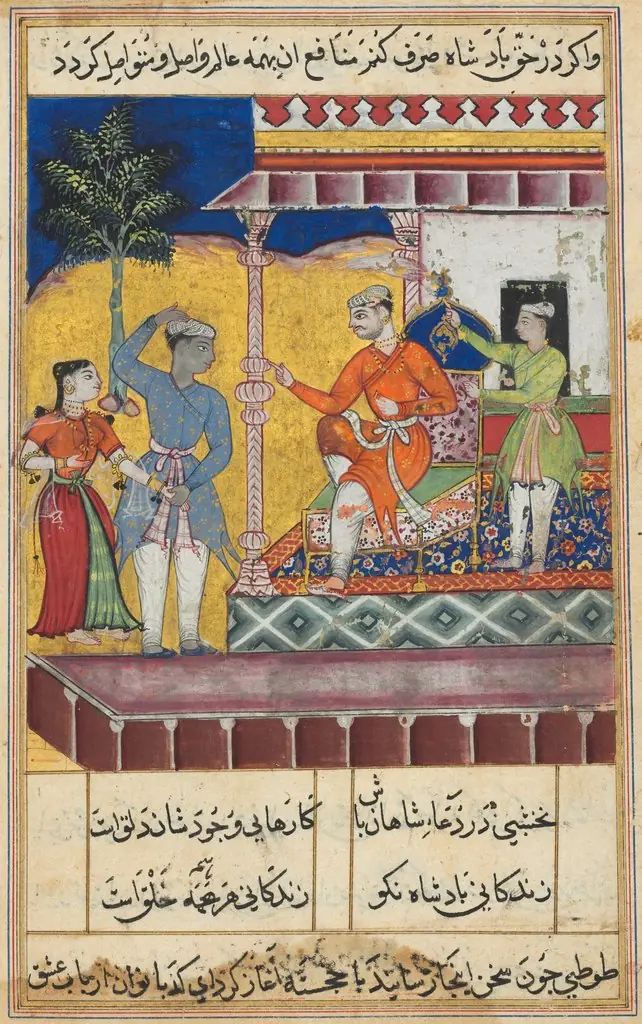 The rejuvenated old man and the daughter of the king of the jinns take leave of the King of Kings, from a Tuti-nama (Tales of a Parrot): Seventh Night
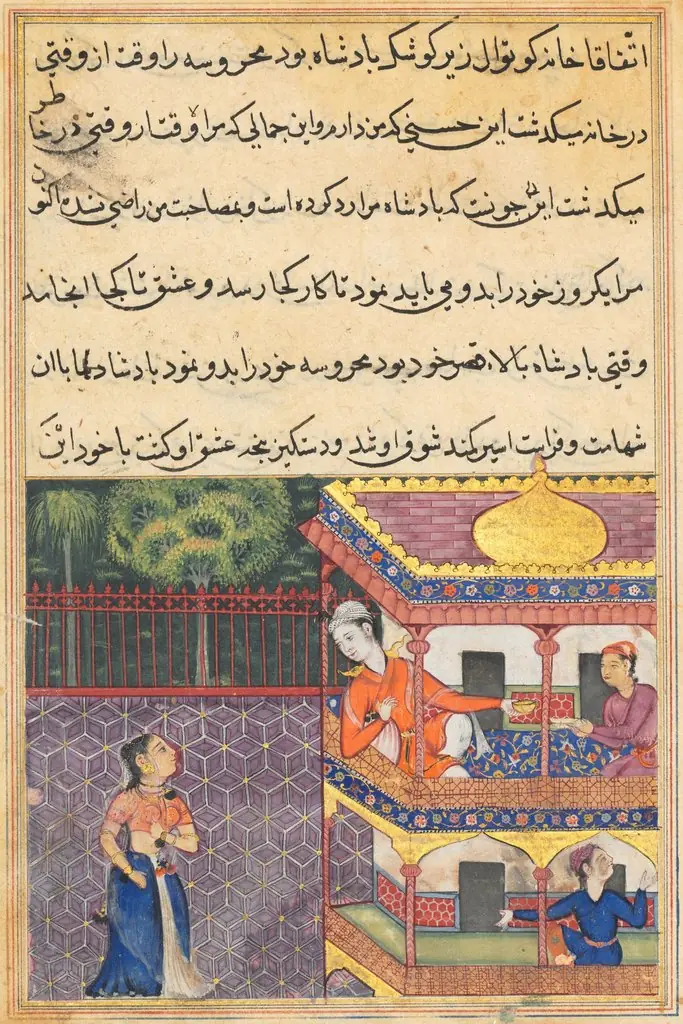 The king of Zabul sees Mahrusa from his palace balcony, from a Tuti-nama (Tales of a Parrot): Thirty-sixth Night
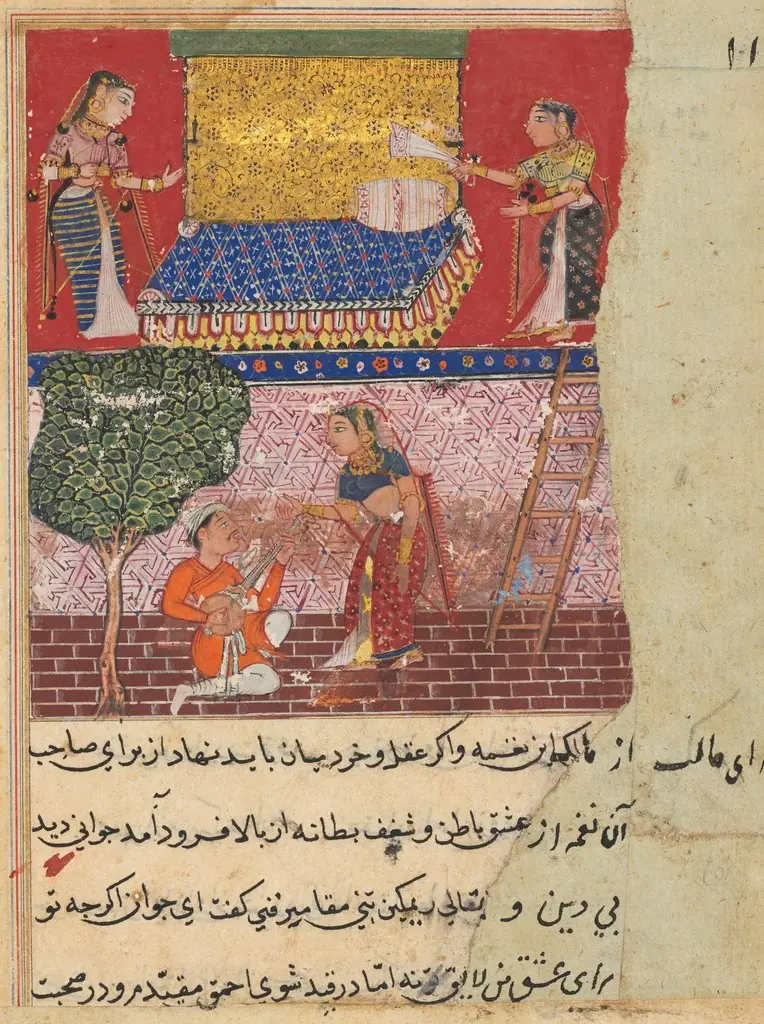 The daughter-in-law of the king of Banaras, charmed by the music of a vagabond, comes down to meet him, from a Tuti-nama (Tales of a Parrot): Sixteenth Night
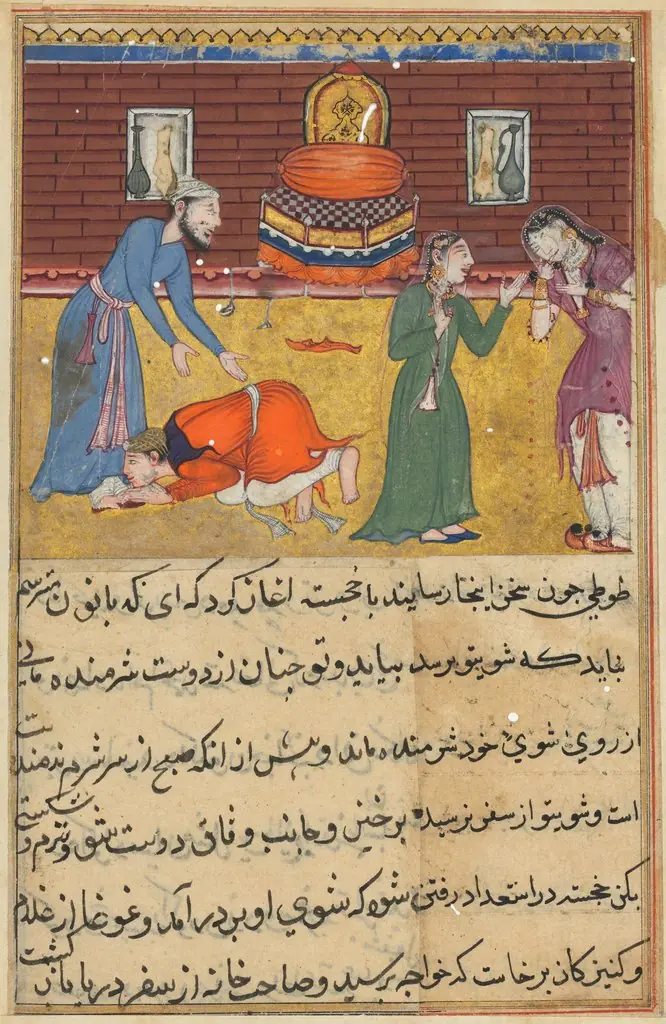 The pious man’s son, now a king, reveals himself to his father; his nurse upbraids his unfaithful mother, from a Tuti-nama (Tales of a Parrot): Fifty-second Night
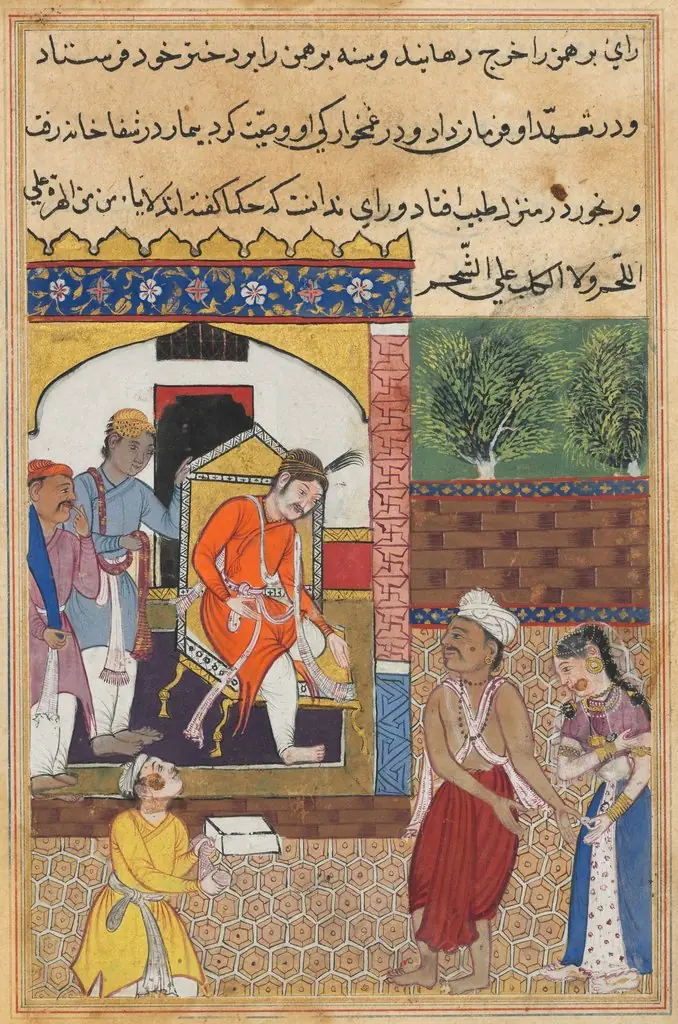 The magician, disguised as a Brahman, visits the king of Babylon, from a Tuti-nama (Tales of a Parrot): Thirty-fifth Night
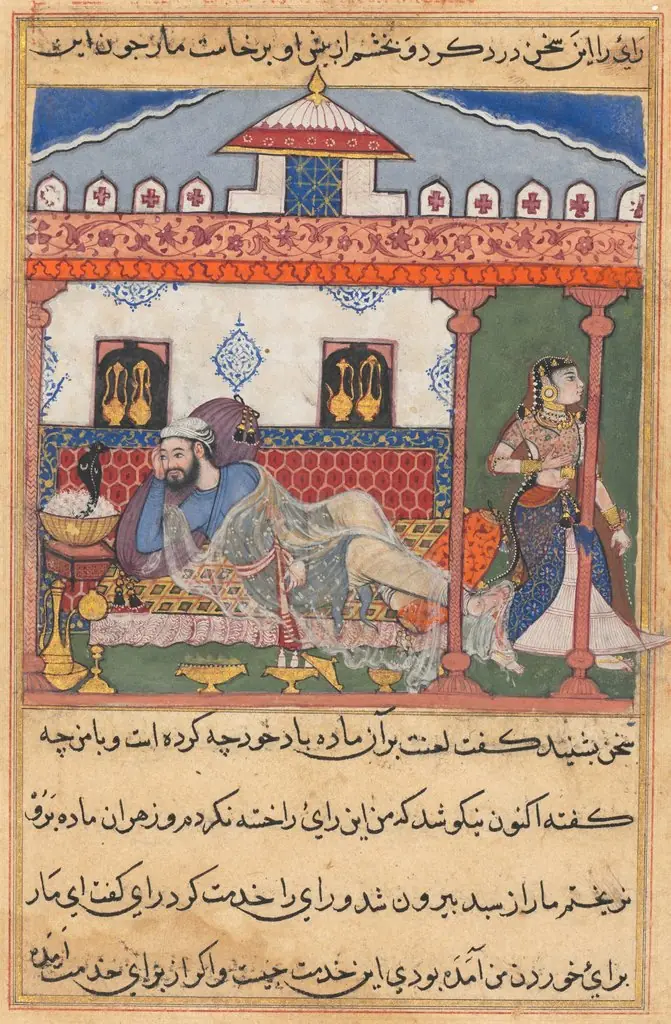 The snake, hidden in a basket of flowers, reveals himself to the Raja who has just sent away his wife, from a Tuti-nama (Tales of a Parrot): Forty-third Night
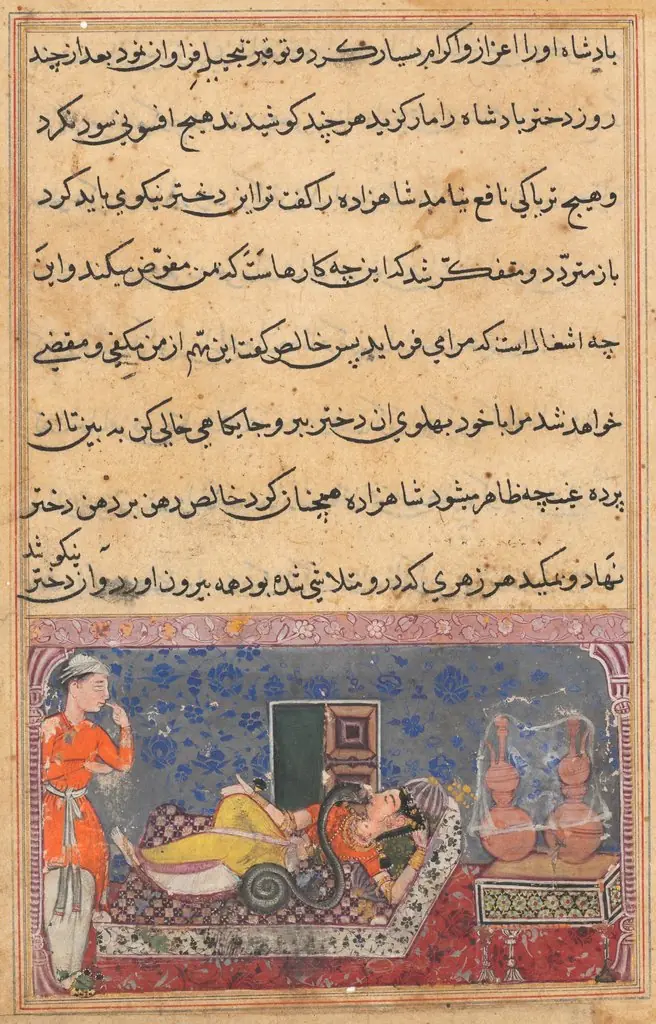 Khalis repays the prince for his kindness by changing into a snake and sucking the poison from the king’s daughter, from a Tuti-nama (Tales of a Parrot): Eighteenth Night
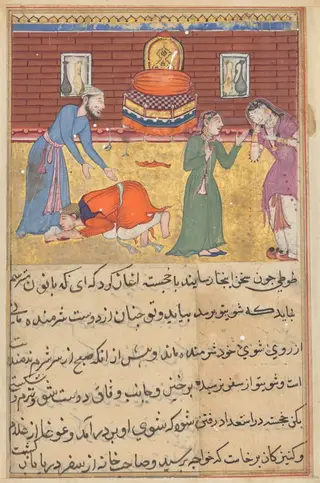 The pious man’s son, now a king, reveals himself to his father; his nurse upbraids his unfaithful mother, from a Tuti-nama (Tales of a Parrot): Fifty-second Night
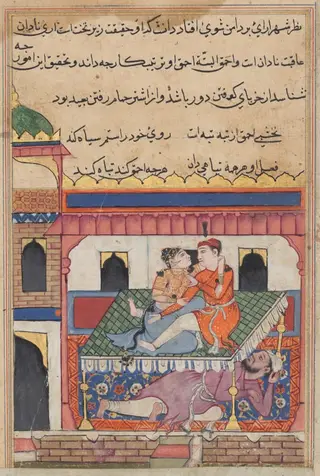 Shahr-Arai and her lover dallying on a bed beneath which is concealed her husband, from a Tuti-nama (Tales of a Parrot): Fortieth Night
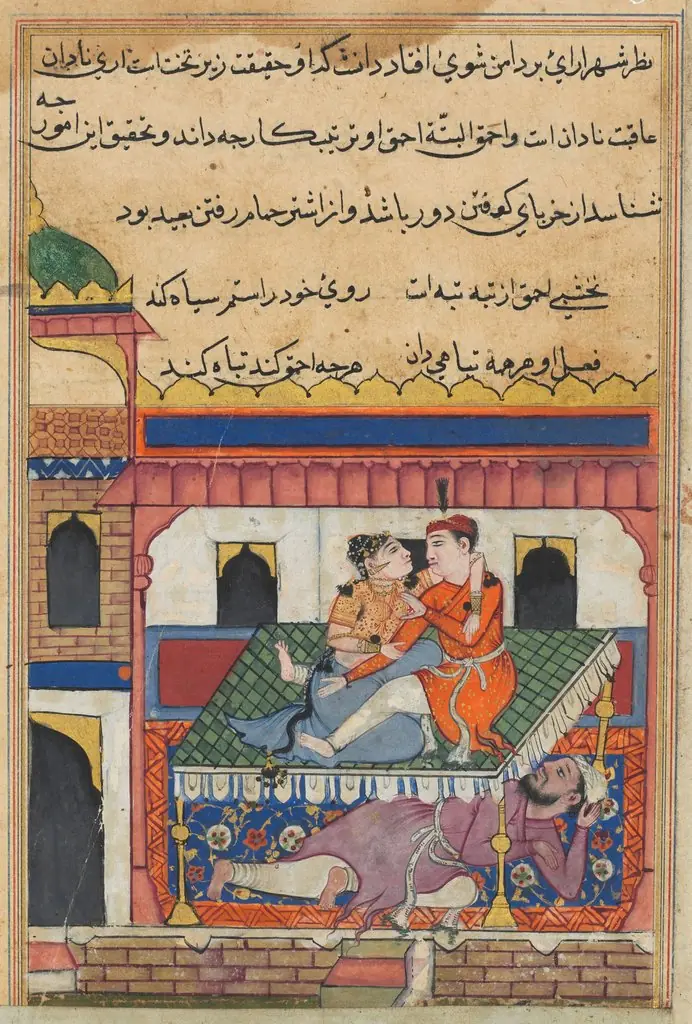 Shahr-Arai and her lover dallying on a bed beneath which is concealed her husband, from a Tuti-nama (Tales of a Parrot): Fortieth Night
 The snake, hidden in a basket of flowers, reveals himself to the Raja who has just sent away his wife, from a Tuti-nama (Tales of a Parrot): Forty-third Night