Artwork
Danaë
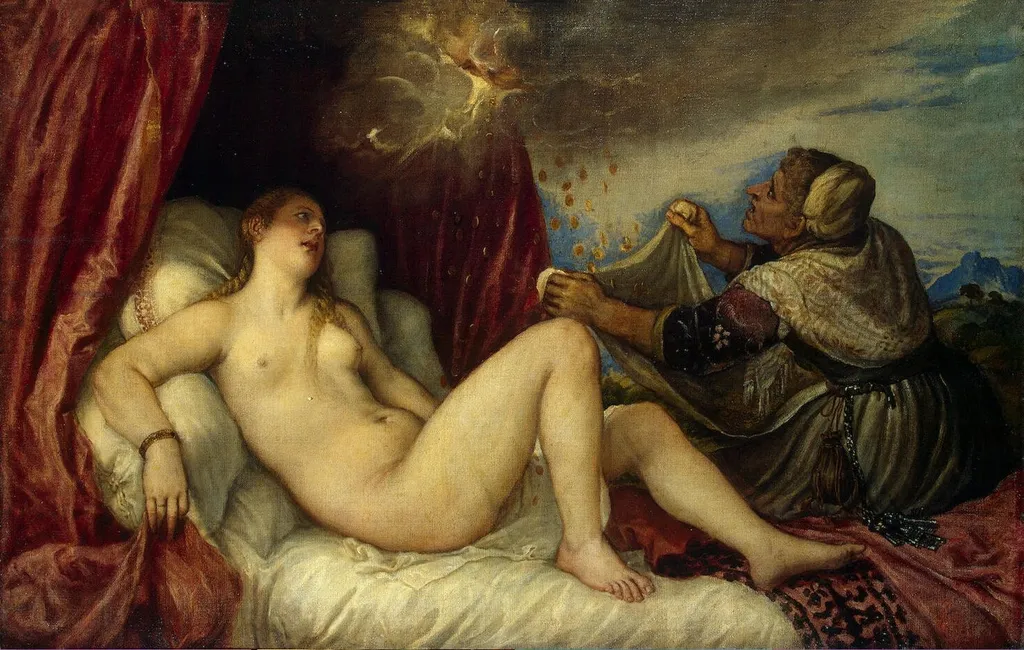
Danaë is an oil painting by the High Baroque Italian artist Titian. It dates from 1554 and is held in the collection of the Hermitage Museum.
About this work
Subject & Meaning
The painting depicts the mythological princess Danaë, who was imprisoned in a tower by her father Acrisius to prevent a prophecy that her son would kill him.
The painting depicts the mythological princess Danaë, who was imprisoned in a tower by her father Acrisius to prevent a prophecy that her son would kill him. The central event shows Zeus, inflamed by lust, descending in the form of a shower of gold to seduce her and impregnate her with Perseus. In the Hermitage version, an elderly maid stands beside the reclining nude, holding a cloth or dish to catch the falling gold coins, creating a visual counterpoint between youth and age, and beauty and loyalty.
This figure often resembles a conventional procuress, highlighting the transactional nature of the encounter. During the Renaissance, Danaë was frequently interpreted as a symbol of the corrupting influence of wealth, capable of tainting moral virtue, while the imagery also drew parallels to the Annunciation.
History & Provenance
Titian painted Danaë in 1554, an oil on canvas measuring 120 × 187 cm. The work was commissioned by Cardinal Alessandro Farnese, then a papal legate in Venice, and executed in both Rome and Venice. It entered the collection of the Hermitage Museum in Saint Petersburg, where it remains on display in hall 221. The painting is one of at least six versions produced by Titian and his workshop between the 1540s and 1560s, reflecting the myth of Danaë as described by Ovid and Boccaccio.
The painting Danaë by Titian is housed in the Hermitage Museum in Saint Petersburg, where it is displayed in Hall 221. Its accession is recorded as part of the museum’s collection of Old Master paintings, though the specific inventory number is not supplied in the available sources. The work was originally commissioned by Cardinal Alessandro Farnese and first exhibited in Rome and Venice before entering the Russian collection.
Since its acquisition, it has been included in major Titian retrospectives at the Hermitage and has appeared in scholarly exhibitions of the artist’s mythological series.
Legacy
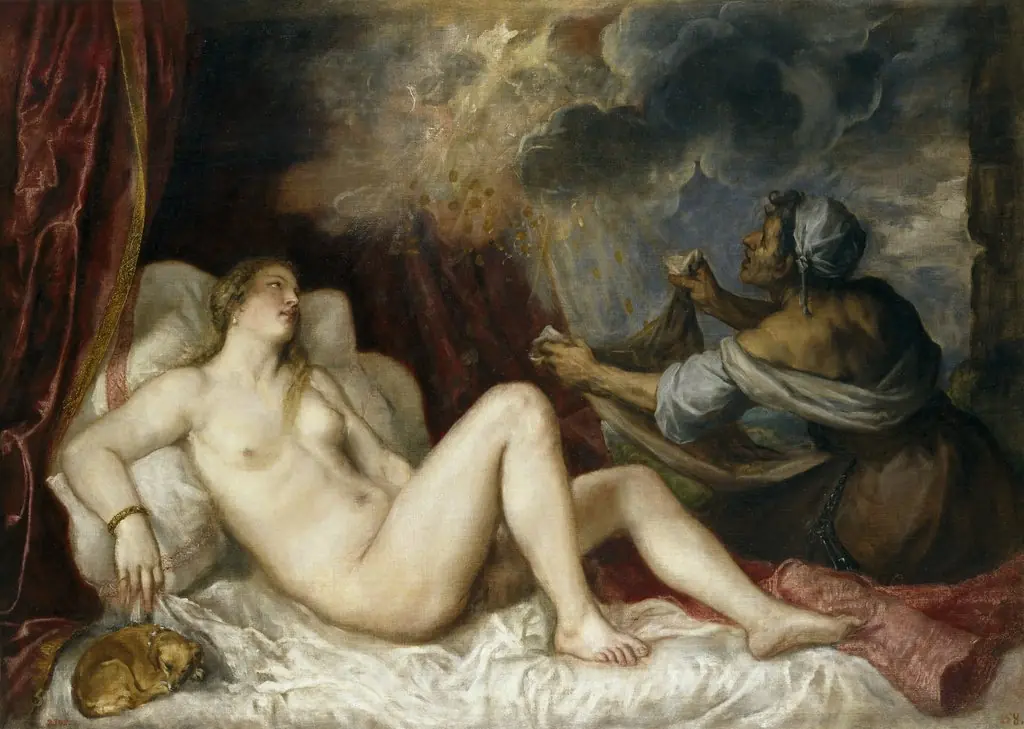
Titian and his workshop produced at least six versions of the Danaë composition between the mid-1540s and the 1560s, a repetition that signals the subject's significant popularity. The series influenced the work of later masters, including Rembrandt, Anthony van Dyck, and Gustav Klimt, who all created their own interpretations of the mythological scene. While the initial version in Naples featured Cupid, subsequent iterations replaced this figure with an elderly maid, a change that introduced thematic counterpoints between youth and age.
Critical reception of the later workshop versions, such as the 1554 painting in the Hermitage, has been mixed; some scholars describe it as a late pastiche with inferior quality compared to the autograph originals, noting distorted features and clumsy execution.
Overview
The Venetian painter Titian and his workshop created a series of paintings depicting Danaë, a figure from classical mythology. Produced between the 1540s and 1560s, these works explore the story of the princess impregnated by Zeus, who appeared to her as a shower of gold. While the central composition remained largely consistent, Titian introduced variations in secondary elements across the numerous versions, which are now housed in major collections worldwide.
Technique & Style
Across the various renditions, Titian consistently rendered Danaë as a voluptuous nude, reclining on a draped bed with her legs partially spread. The paintings are characterized by rich, warm color palettes and a masterful application of chiaroscuro, which enhances depth and volume. This dramatic interplay of light and shadow draws attention to the central figure, whose skin is depicted with realistic shading and texture, contributing to the scene's sensuous atmosphere.
Artist & collection
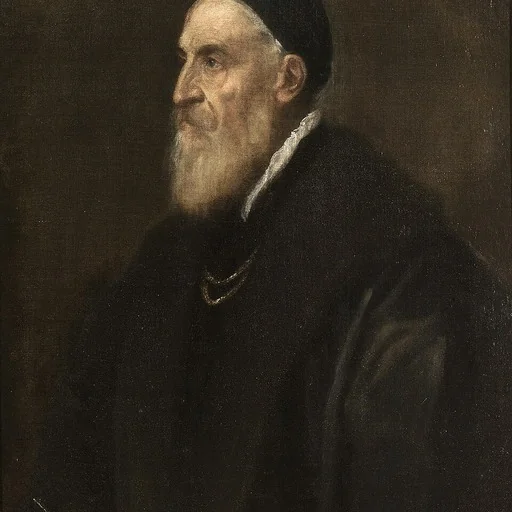
Artist
Tiziano Vecellio (Italian:; c. 1488/1490 – 27 August 1576), Latinized as Titianus, hence known in English as Titian ( TISH-ən), was an Italian Renaissance painter. The most important artist of Renaissance Venetian…