Artwork
Penitent Magdalene
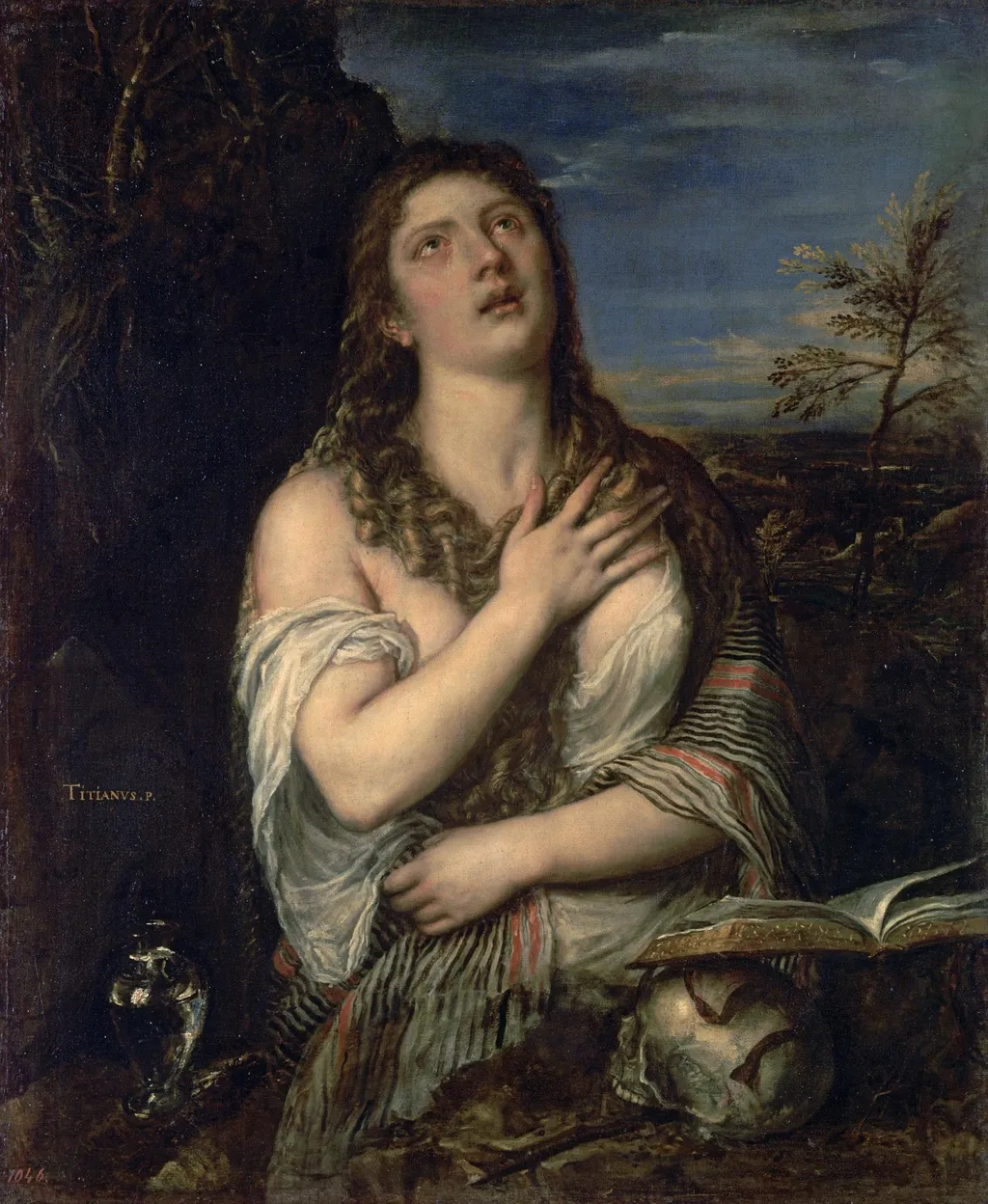
Penitent Magdalene is an oil painting by the Mannerist artist Titian. It dates from 1563 and is held in the collection of the Hermitage Museum.
About this work
Subject & Meaning
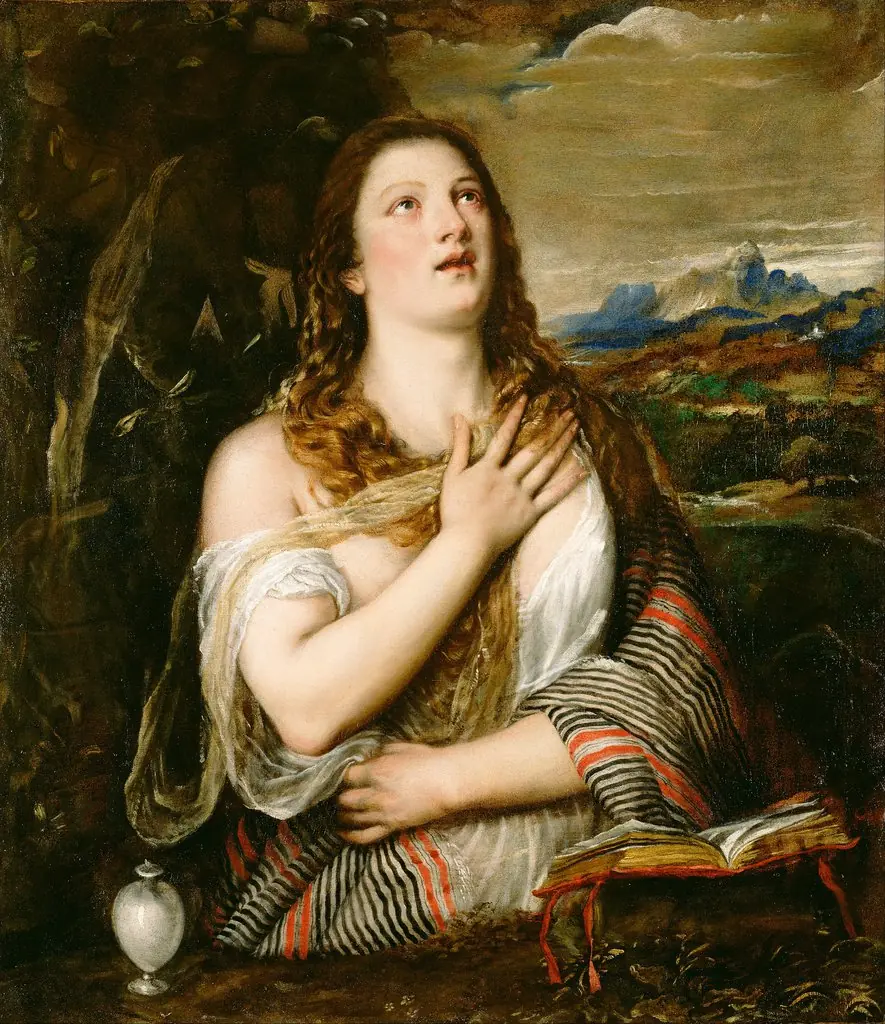
The work depicts Saint Mary Magdalene in a state of deep penitence, having spent years in the desert atoning for her sins.
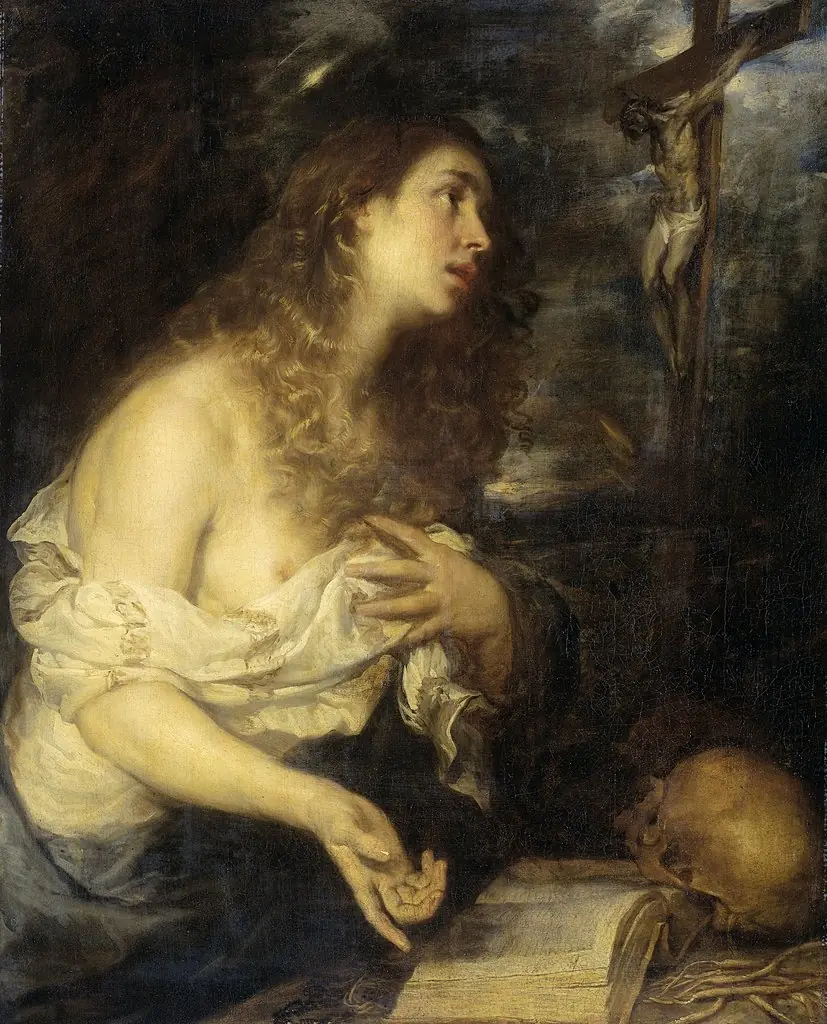
The work depicts Saint Mary Magdalene in a state of deep penitence, having spent years in the desert atoning for her sins. She is shown looking upward with a tearful expression, illuminated against a darkening sky and a contrasting dark rock. Unlike Titian's earlier 1531 treatment of the subject, this version covers the figure's nudity and introduces specific symbolic objects: an open book, a jar, and a human skull.
The skull serves as a memento mori, reminding viewers of mortality and the necessity of spiritual preparation. The composition harmonizes mature coloring with the character's emotional state, while the background features a setting sun and wind-swept trees that underscore the solemnity of her repentance and the theme of mortification of the flesh.
Technique & Style
The Penitent Magdalene is executed in oil on canvas, a rectangular support measuring roughly 119 × 97 cm, typical of Titian's late Venetian practice. The paint layer is applied thinly, allowing subtle glazes that produce a luminous surface and a harmonious palette aligned with the figure's mood. The composition is handled with a dark, receding background; a setting‑sun sky glows on the right while a stark rock anchors the left, creating depth through chiaroscuro.
Formal elements include a covered torso, a vase, an open book and a skull as memento mori, all rendered in mature, balanced colour. The work's condition remains stable, with the canvas support intact and the oil paint layer largely preserved.
History & Provenance
Titian painted the Penitent Magdalene around 1563–1565 in Italy as an oil on canvas religious painting, retaining the work in his own studio rather than executing it on commission. After Titian's death in 1576, his son Pomponio Vecelli sold the painting to the Venetian collector Cristoforo Barbarigo; it remained in the Barbarigo Gallery in Venice until the Hermitage Museum acquired it in 1850, where it has stayed since. The painting is held in the Hermitage Museum in Saint Petersburg and is displayed in Hermitage hall 221.
Context
Titian's Penitent Magdalene, painted around 1563–1565, belongs to the mature phase of the Venetian school and engages with Counter‑Reformation themes of penitence and mortality.
The composition marks a departure from the earlier nude version: Titian covers the figure's nudity and adds a skull, an open book and a vase as memento mori symbols, while the dramatic lighting and harmonious colouring heighten the emotional intensity.
Provenance from Titian's own studio, sale to the Barbarigo family and acquisition by the Hermitage in 1850 has secured its place in the museum's collection and contributed to a consistently positive scholarly assessment of the work as a key example of Titian's late religious subjects.
Overview
Titian's Penitent Magdalene, an oil on canvas painting from approximately the 1560s, is a notable work by the Venetian master. This artwork is currently part of the collection at the Hermitage Museum in Saint Petersburg, where it is also sometimes referred to as Repentant Mary Magdalene. It represents a significant example of religious portraiture from the High Renaissance period.
Own this work as a print
Artist & collection

Artist
Tiziano Vecellio (Italian:; c. 1488/1490 – 27 August 1576), Latinized as Titianus, hence known in English as Titian ( TISH-ən), was an Italian Renaissance painter. The most important artist of Renaissance Venetian…