Artwork
Sisyphus
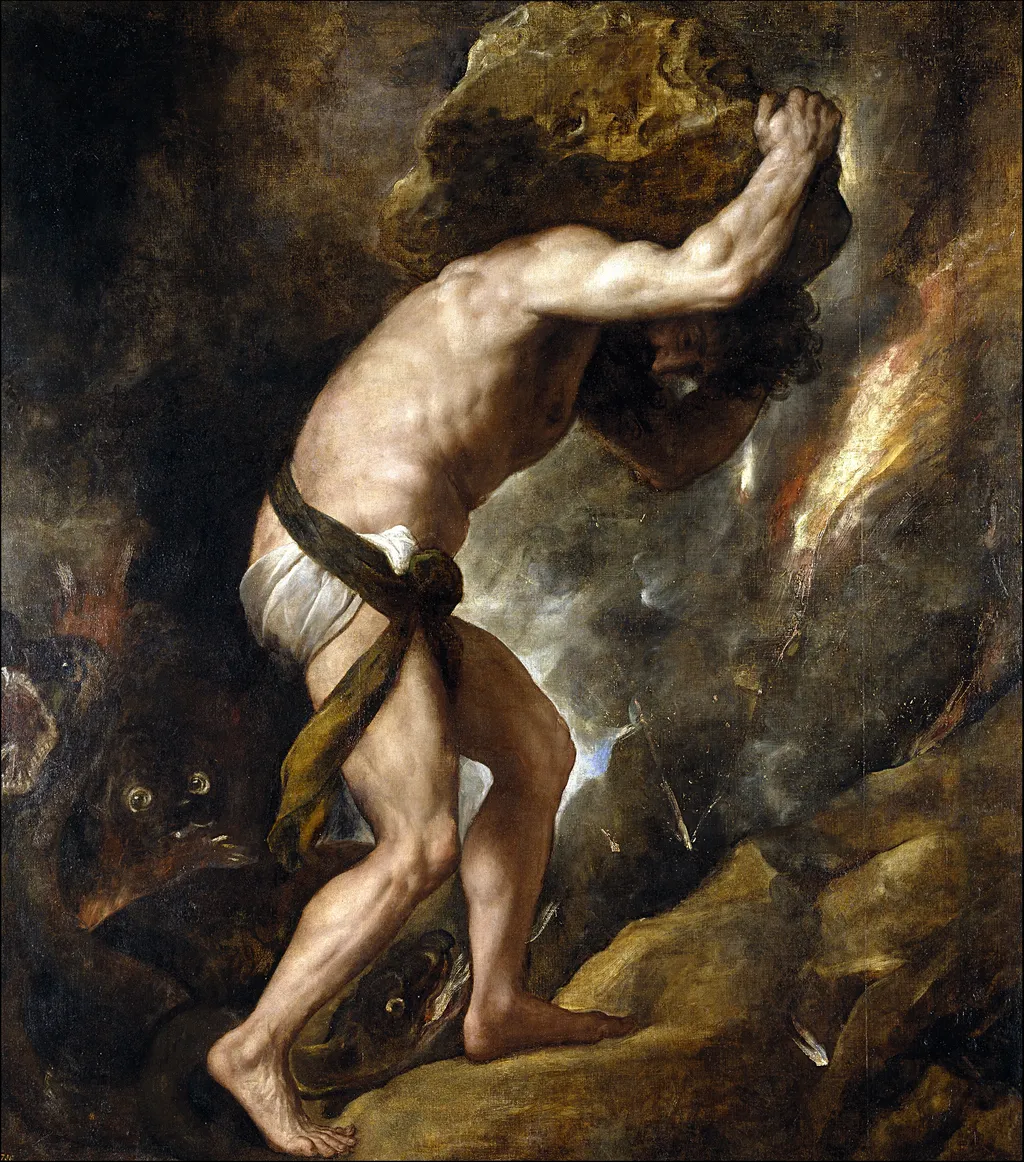
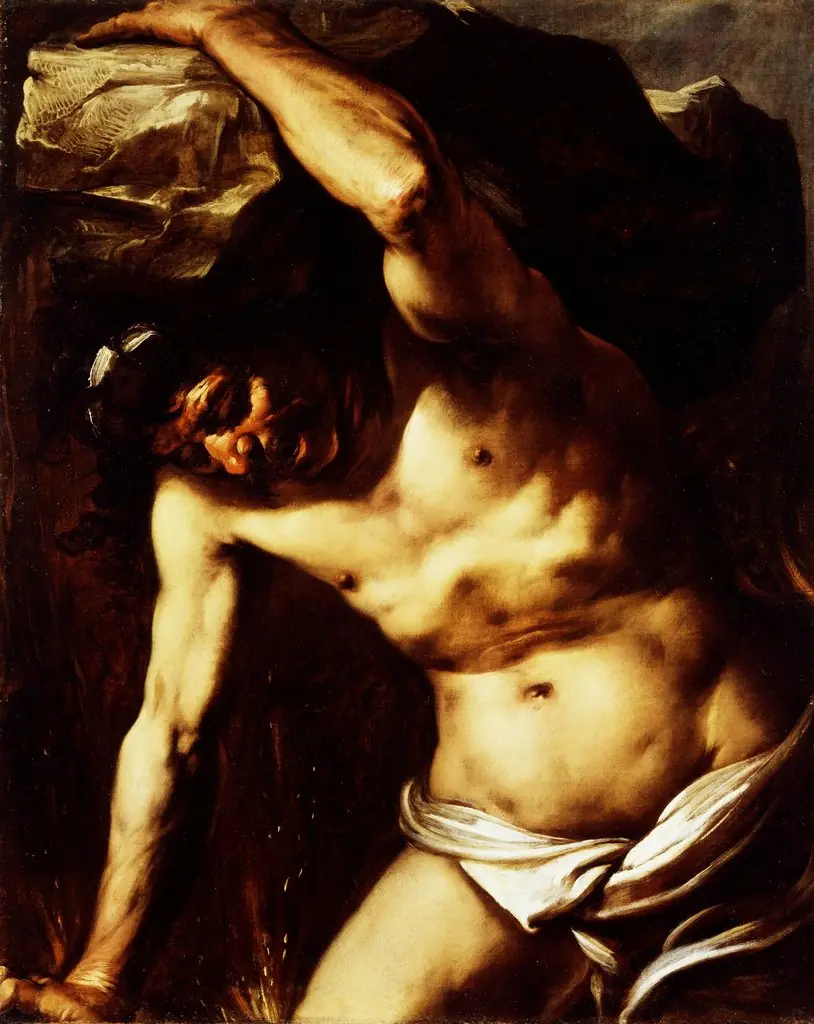
Sisyphus is an oil painting by the Mannerist artist Titian. It dates from 1548 and is held in the collection of the Museo del Prado.
About this work
Subject & Meaning
The iconography integrates Christian influences, utilizing flames and monstrous serpents absent in ancient texts to evoke the horror of the Last Judgment.
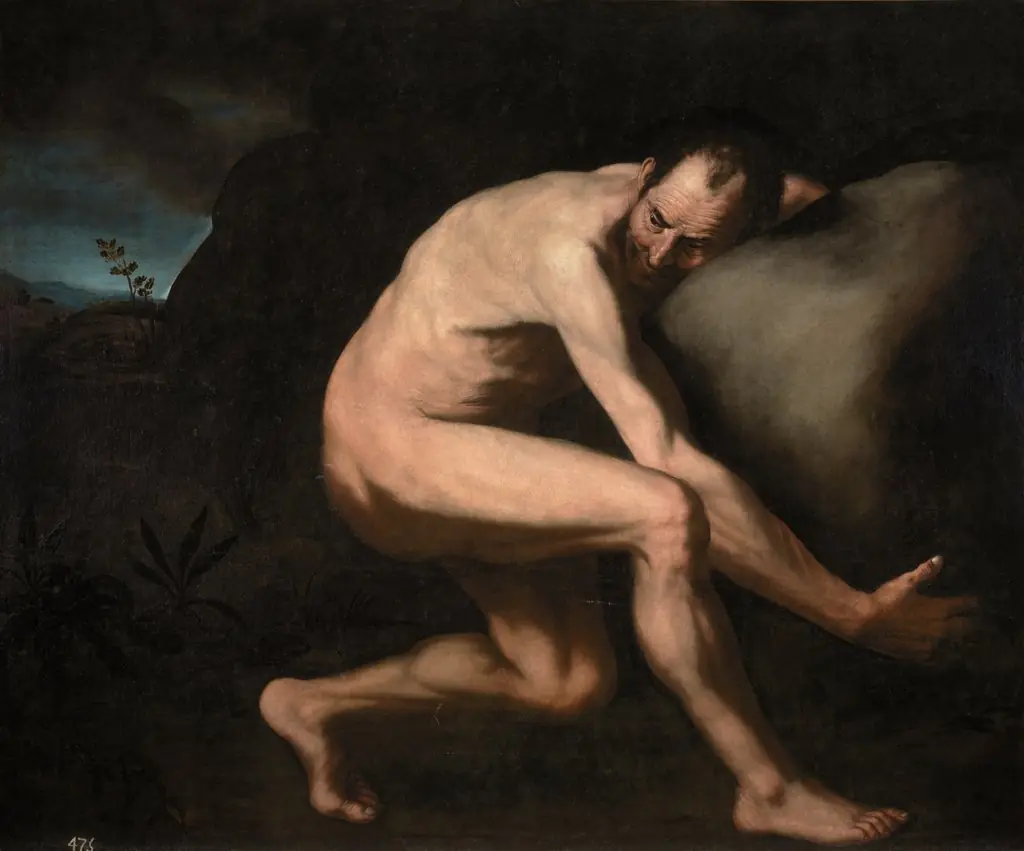
The painting depicts the mythological figure Sisyphus, king of Corinth, condemned in the underworld to eternally push a massive boulder up a steep hill, only for it to roll back down before reaching the summit. This narrative, derived from Ovid's *Metamorphoses* and Homeric tradition, illustrates Sisyphus's punishment for defying the gods by deceiving Death and revealing Zeus's abduction of Aegina. Within Titian's series of mythological punishments, the work functions as an allegory for futile human effort and the struggle of natural forces. The iconography integrates Christian influences, utilizing flames and monstrous serpents absent in ancient texts to evoke the horror of the Last Judgment. Commissioned by Mary of Hungary for the Palace of Binche, the image served as a political warning against rebellion, paralleling the eternal torment of the damned with the consequences of challenging imperial authority.
Technique & Style
Painted in oil on canvas, the work measures 237 × 216 cm. The monumental, single-figure composition presents a nude Sisyphus straining to push his boulder up a mountain, encircled by cliffs with flames of the underworld whipped around him by a whirlwind. The handling is bold and dynamic, with dense touches of red and yellow rendering incandescent flames and molten flows. Charles Ricketts noted that the picture anticipates the more broken, febrile handling of Titian's later decade, while Georg Gronau observed how the dark-coloured body is set against a grand gloomy background. The painting has suffered darkening from smoke damage. The formal qualities align with the Venetian school's emphasis on colour-driven expressivity. Stylistically, the work employs dramatic foreshortening reminiscent of Titian's Santo Spirito Ceilings, and introduces monstrous creatures and serpents, elements drawn from Christian Last Judgement imagery rather than classical sources, to intensify the punitive atmosphere.
History & Provenance
Titian painted *Sisyphus* in 1548, commissioned by Mary of Hungary, sister of Charles V, as part of a series depicting mythological punishments intended for the Great Hall of the Summer Palace of Binche. The series originally included Tantalus, Sisyphus, and Tityus; two of these were completed by the first half of 1549 and installed at Binche by August 1549.
After the palace's destruction in 1554, Mary of Hungary bequeathed the paintings to Philip II in 1558, and they were transferred to the Alcázar de Madrid, where they hung in the Pieza de las Furias. Following the fire of 1734, the surviving works were moved to the New Royal Palace. The painting entered the Museo del Prado in 1819, where it remains today as catalogue number P000426.
The painting Sisyphus by Titian is held in the Museo del Prado in Madrid, where it has been since 1819 and is recorded under inventory number P000426. It was originally commissioned by Mary of Hungary for the Great Hall of the Summer Palace of Binche, where it was displayed by 1549. After Mary of Hungary's death, the collection passed to her son, Philip II of Spain, and was installed in the Alcázar of Madrid. The work remained in the royal palaces until the 18th century, surviving the 1734 fire that destroyed parts of the Alcázar. It was subsequently moved to the Palacio del Buen Retiro before being incorporated into the permanent collection of the Museo del Prado in 1828. The painting has been part of the museum's catalog under the same inventory number since 1819.
Titian created the work between 1548 and 1549 as part of a decorative program for Queen Mary of Hungary, who sought to adorn the Great Hall of the Summer Palace at Binche with mythological scenes depicting eternal punishments in the underworld. The series included Tantalus, Sisyphus, Tityus, and Ixion, all drawn from classical mythology and likely inspired by Ovid's Metamorphoses. The commission formed part of a broader political and symbolic effort to assert imperial authority through imagery of divine retribution. The painting exemplifies Titian's mature style, characterized by dramatic composition, expressive figures, and masterful use of color and chiaroscuro. It reflects the influence of Venetian artistic traditions and anticipates the emotional intensity of later Baroque depictions of mythological suffering. The work has undergone conservation efforts over the centuries, including cleaning and varnish removal, which have revealed the depth of its original palette.
The painting was first documented in the Royal Alcázar of Madrid in 1700 as part of the royal collection, later cataloged as number 3. It remained in the royal palaces until the early 19th century, when it was transferred to the newly established Museo del Prado. Its provenance is well documented through royal inventories and museum records, confirming continuous ownership by the Spanish Crown and eventual donation to the national museum.
Exhibition history includes displays at the Museo del Prado since its founding, with periodic inclusion in thematic exhibitions on Titian, Renaissance mythology, and Spanish royal collections. The work has been featured in major retrospectives of Titian's oeuvre and in exhibitions focusing on 16th-century European decorative programs. It has also traveled to other institutions for special exhibitions, including a 2001 exhibition at the Kunsthistorisches Museum in Vienna, though such movements are rare due to its status as a cornerstone of the Prado's collection.
The painting's iconography centers on the myth of Sisyphus, a figure from Greek mythology condemned by Zeus to roll a boulder up a hill for eternity. Titian's interpretation emphasizes the physical strain and emotional gravity of the punishment, using dynamic movement and dramatic lighting to convey suffering. The composition is part of a larger thematic cycle commissioned by Mary of Hungary, reflecting contemporary anxieties about rebellion and divine justice in the context of Habsburg rule.
Context
Sisyphus belongs to a short series of four mythological punishments Titian painted in 1548-49 for Mary of Hungary, Charles V’s sister, as part of a political program warning against rebellion during the religious and dynastic tensions of mid‑sixteenth‑century Europe. The work was conceived for the Great Hall of Binche Palace, where it hung with Prometheus, Tityus and Tantalus as part of a coherent iconographic scheme linking classical sinners to contemporary political disobedience. After the palace’s destruction in 1554, the surviving canvases entered the Spanish royal collection and were later installed in Madrid’s Alcázar under the name Pieza de las Furias. Critics such as Georg Gronau and Charles Ricketts later defended their attribution to Titian against claims they were copies by Sánchez Coello, praising their bold design, handling and color as among the master’s finest achievements. Scholarship situates Sisyphus within Titian’s late Venetian practice, noting its anticipatory, febrile handling and the integration of Christian infernal motifs, flame, serpents, into antique myth, aligning it with the intensified emotional and formal language of the 1550s.
Legacy
Titian's *Sisyphus* established a significant precedent for the visual representation of eternal punishment, influencing later artistic interpretations of the myth. The painting was historically misidentified as a copy by Alonso Sánchez Coello, a misattribution that art historians Georg Gronau and Charles Ricketts later corrected, affirming its status as an original masterpiece of the Venetian school. The work's legacy is further defined by its role within a specific iconographic program commissioned by Mary of Hungary, which used mythological rebels to symbolize political defiance against imperial authority. Although the companion piece *Tantalus* was lost in the 1734 fire at the Alcázar, *Sisyphus* survived alongside *Tityus* to become a central holding of the Museo del Prado. Its dramatic composition and use of fire to depict the underworld prefigured the febrile handling of Titian's later years and influenced subsequent depictions, such as Franz von Stuck's 1920 painting of the same subject.
Own this work as a print
Artist & collection
Artist
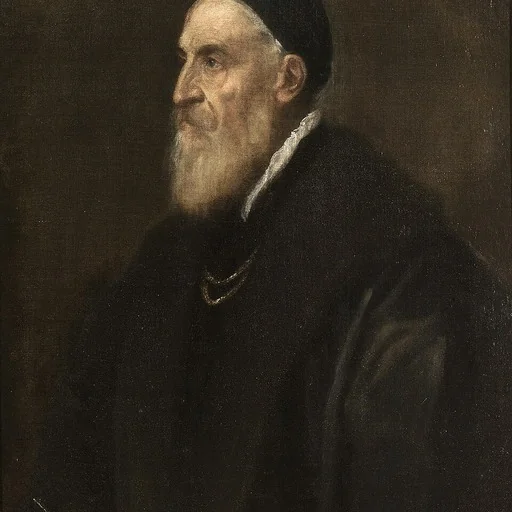
Tiziano Vecellio (Italian:; c. 1488/1490 – 27 August 1576), Latinized as Titianus, hence known in English as Titian ( TISH-ən), was an Italian Renaissance painter. The most important artist of Renaissance Venetian…