Artwork
The Fall of Man
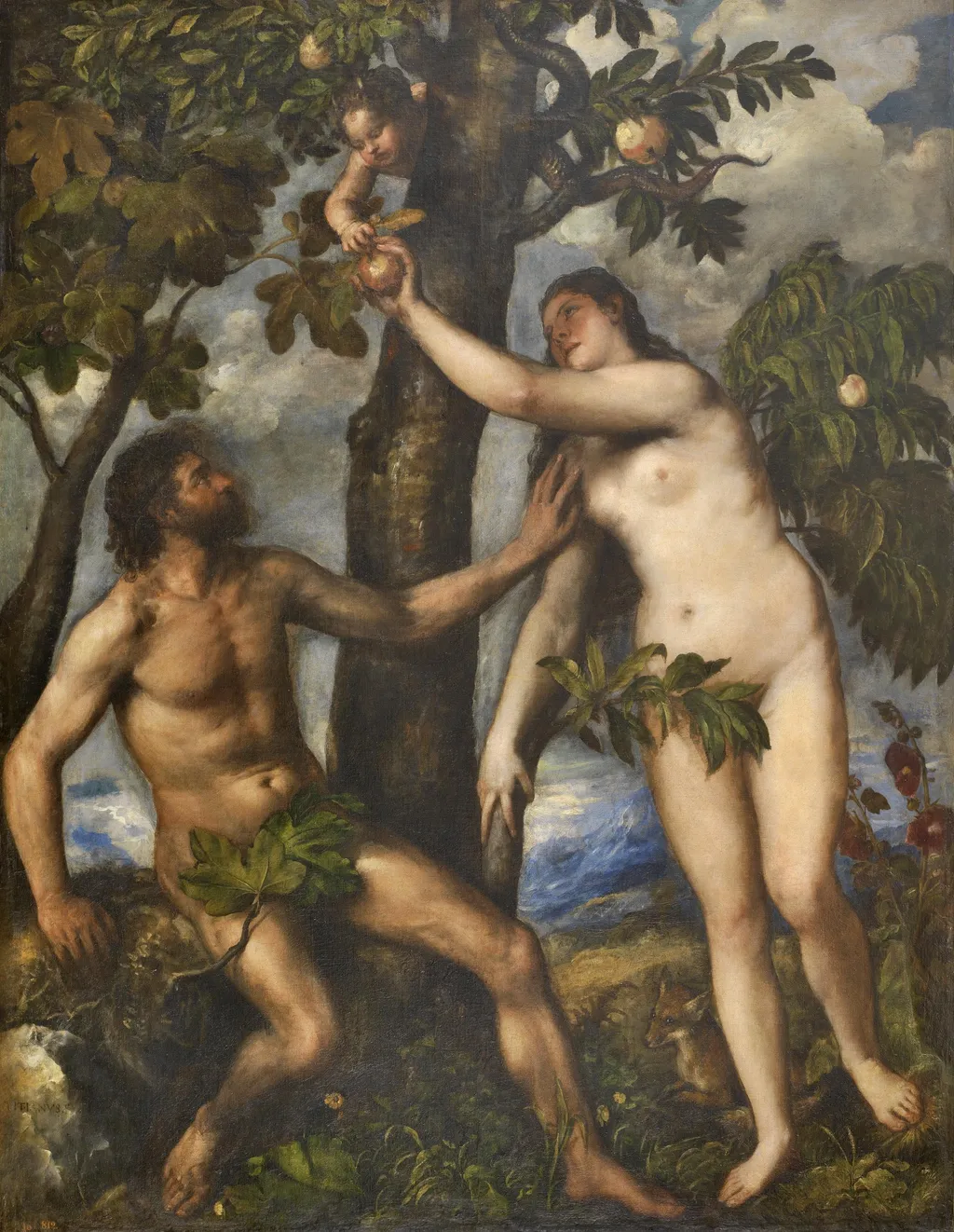
The Fall of Man is an oil painting by the Mannerist artist Titian. It dates from 1550 and is held in the collection of the Museo del Prado.
About this work
Titian's The Fall of Man, an oil from around 1550, shows the biblical story of Adam and Eve. It hangs in the Museo del Prado in Madrid, where it has been for centuries. If it draws you in, look up glazing, Titian's way of building depth with thin, transparent layers of paint.
Subject & Meaning
Titian's iconography includes a navel, beard, and a fox at Eve's feet, symbols of temptation and moral corruption.
The painting portrays Adam and Eve at the moment of the biblical transgression, with Adam on the left of the tree and Eve on the right, a serpent in child form offering the forbidden fruit. The composition follows the Genesis narrative, emphasizing disobedience and the onset of original sin. Titian's iconography includes a navel, beard, and a fox at Eve's feet, symbols of temptation and moral corruption.
The work was inspired by Raphael's fresco in the Stanza della Signatura and Dürer's engraving, and it entered the Spanish royal collection through Antonio Pérez before being copied by Rubens. Its meaning lies in the visual articulation of the Fall as a foundational theological theme.
Technique & Style
Created circa 1550, The Fall of Man is executed in oil paint on a canvas support, characteristic of the Venetian school's material preferences. The composition measures 240 cm in height and 186 cm in width. Stylistically, the work synthesizes influences from Raphael's Vatican fresco, particularly in the poses of a seated Adam and standing Eve, while incorporating smaller details derived from Albrecht Dürer's engravings.
The formal arrangement places Adam to the left of the tree and Eve to the right, with the serpent depicted in the form of a child offering the forbidden fruit. The handling of figures conveys specific emotional states; Adam displays fear and tension as he initially attempts to restrain Eve by placing a hand on her chest. Iconographic elements include a fox at Eve's feet, symbolizing evil and sensuality, set against an overcast landscape that frames the narrative of original sin.
History & Provenance
The Fall of Man was painted by Titian around 1550. The work shows the influence of Raphael's Vatican fresco and Albrecht Dürer's engraving of Adam and Eve. It may have been first commissioned by the father of Antonio Pérez, Philip II's secretary, who later owned the painting.
In 1585 the piece entered the Spanish royal collection and was subsequently displayed in the sacristy of the Alcázar of Madrid. Ownership later passed to Ferdinand VII of Spain before the painting entered the Museo del Prado, where it remains today. Rubens copied the canvas between 1628 and 1629 for his own version of the subject.
Context
Titian's The Fall of Man (c. 1550), an oil on canvas housed in the Prado's Sacristy-reliquary, exemplifies the Venetian school's narrative religiosity and the High Renaissance treatment of the Adam and Eve story. The work was collected by Antonio Pérez and entered the Spanish royal collection in 1585, later inspiring Rubens's 1628–29 copy, underscoring its influence on Baroque reinterpretations. Scholarship, notably Falomir's 2003 catalogue, emphasizes its compositional dialogue with Raphael's Vatican fresco and Dürer's engraving, positioning the painting as a pivotal reference for the iconography of the Fall within European art history.
Legacy
Titian's Fall of Man entered the Spanish royal collection in 1585 and became a touchstone for later artists. Rubens copied it between 1628 and 1629, producing his own version now displayed alongside the original in the Prado's central gallery, facilitating direct comparison. The painting's iconography, Adam's halted gesture, the child-like serpent, and the fox at Eve's feet, entered visual tradition.
Its influence is seen in the sustained pairing of versions by Titian and Rubens in Madrid, reinforcing its legacy as a canonical treatment of the Genesis narrative and a model for religious narrative composition in the Venetian and Flemish traditions.
Overview
Titian's oil painting, The Fall of Man, created around 1550, depicts the biblical narrative of Adam and Eve's transgression. This significant work by the Venetian master is now housed in the Museo del Prado in Madrid, where it has resided for centuries. It showcases the artist's engagement with a foundational story of Western culture.
Own this work as a print
Artist & collection

Artist
Tiziano Vecellio (Italian:; c. 1488/1490 – 27 August 1576), Latinized as Titianus, hence known in English as Titian ( TISH-ən), was an Italian Renaissance painter. The most important artist of Renaissance Venetian…


![The Fall of Man [middle panel]](https://artifactworldgallery.com/img/the-fall-of-man-middle-panel--51048cc74e2325c7-w320.webp)