Artwork
The Tribute Money
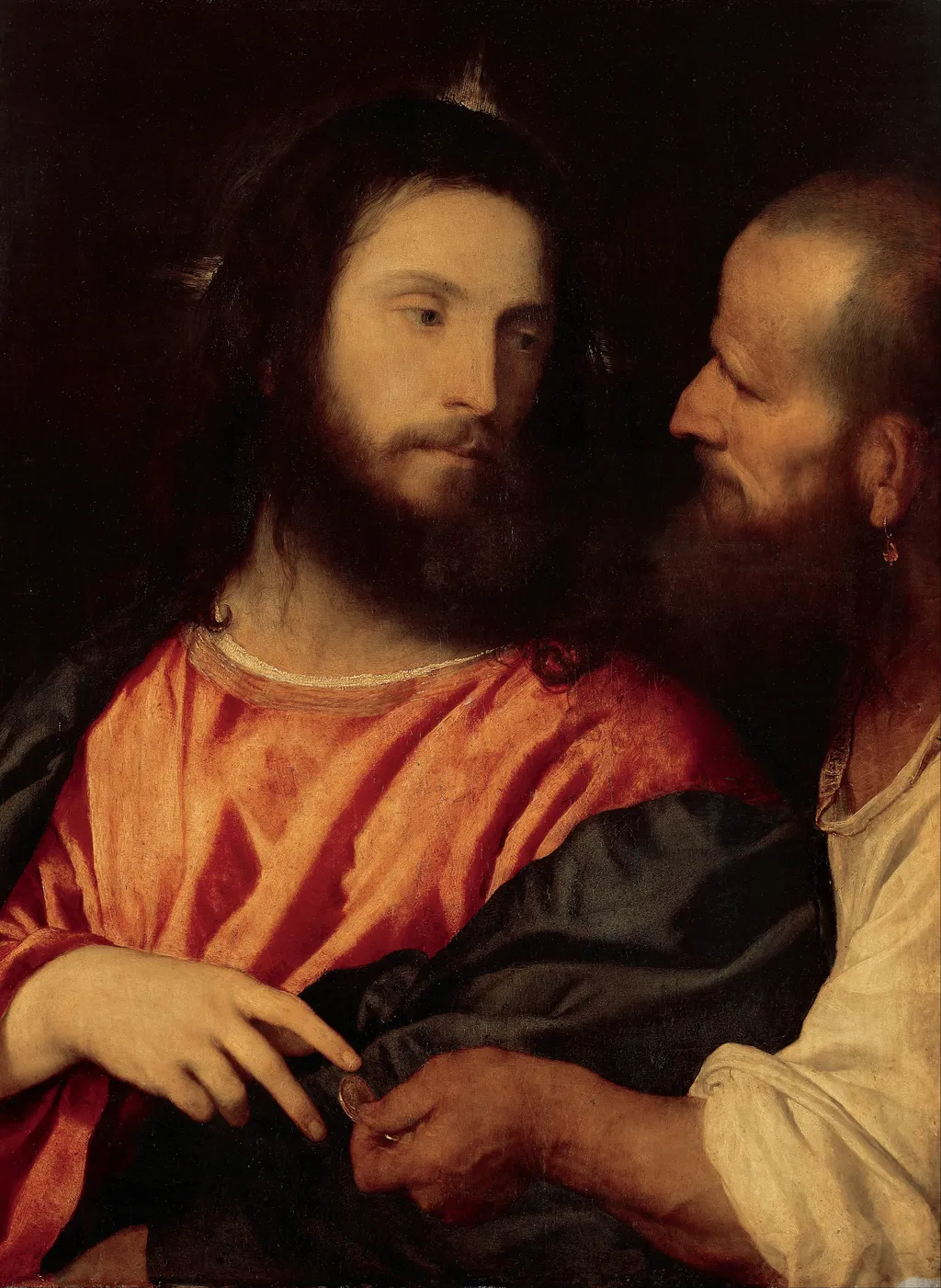
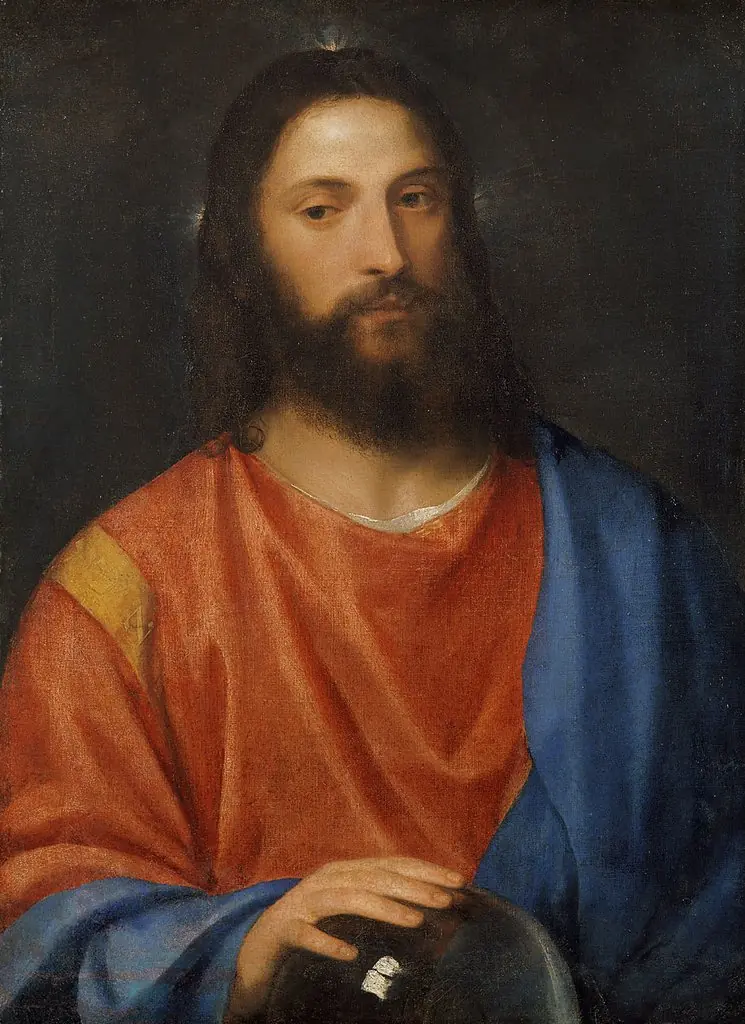
The Tribute Money is an oil painting by the High Renaissance artist Titian. It dates from 1516 and is held in the collection of the Staatliche Kunstsammlungen Dresden.
About this work
The Tribute Money is a panel painting created by Titian in 1516. It's an oil paint work.
The painting depicts a scene from the Gospels. It shows Christ and a Pharisee at a specific moment when Christ is shown a coin.
This scene is based on a well-known phrase. To learn more about the artist who painted this scene, look up the artist: Titian.
Overview
Measuring 75 by 56 centimetres, it depicts Christ and a Pharisee in the biblical episode of the tribute penny, and it is signed Ticianus F.
The Tribute Money (Italian: Cristo della moneta, literally Christ of the coin) is an oil painting on poplar panel by the Italian Renaissance master Titian, dated to 1516. Measuring 75 by 56 centimetres, it depicts Christ and a Pharisee in the biblical episode of the tribute penny, and it is signed Ticianus F.[ecit] on the trim of the Pharisee's collar. Now held in the Gemäldegalerie Alte Meister in Dresden, Germany, the work is considered Titian's earliest signed painting and possibly the first artistic representation of this rare subject. It is also celebrated as one of his most polished early works, praised by Giorgio Vasari and contemporaries for the stupendous and miraculous quality of Christ's head.
Subject & Meaning
The painting illustrates the Gospel of Matthew's account of the tribute money (Matthew 22:15-22), in which the Pharisees attempt to trap Jesus with the question of whether Jews should pay taxes to the Roman emperor. Christ's response, Render unto Caesar the things that are Caesar's, and unto God the things that are God's, is the moral centre of the scene. The composition shows two bearded male figures in close proximity: Christ in a salmon-pink robe with deep red folds over a dark blue garment, his right hand extended toward the coin held by the Pharisee, who appears in profile from the right wearing a white sleeve and dark outer garment. The political resonance of the subject was acute for the patron, Alfonso I d'Este, Duke of Ferrara, whose territories were divided between the Holy Roman Empire and the Papal States. At the time of the commission, Alfonso had been excommunicated and deprived of some territories by an aggressively expansionist papacy; the painting's message that spiritual authority should not overreach into temporal power aligned with his political position. He even inscribed part of the gospel text on his gold coinage.
Technique & Style
The work is executed in oil on poplar panel, an unusual support for Titian, who typically preferred canvas. The panel format was necessitated by the painting's original function as a door. Light enters dramatically from the left, illuminating faces, hands, and fabric while plunging the background into deep shadow, a technique that creates strong plastic relief. The palette is dominated by warm flesh tones, vivid rose drapery, and deep browns and blacks. Brushwork varies across the surface: smooth blending in the flesh areas gives way to more visible texture in the drapery. The overall finish is polished, with particular care devoted to the modeling of hands and the fall of light across fabric. A small clasp is visible at Christ's shoulder. The composition belongs to a Giorgionesque type favoured by Titian in this period, showing two or three tightly cropped half-length figures with faces close together to heighten the drama of dialogue and psychological tension.
History & Provenance
Titian and two assistants or servants stayed at Alfonso's Castello Estense in Ferrara from 22 February to the end of March 1516, during which period the painting was executed. It was created specifically for the door of a cupboard or cabinet in the duke's study that contained his collection of medals and ancient and modern coins. Following the extinction of the Este male line, the painting passed to Modena in 1597 after the death of the last Duke of Ferrara. In 1745, King Augustus III of Poland acquired it through his art agent Bonaventura Rossi for the Saxon collection. It later entered the Gemäldegalerie Alte Meister in Dresden, where it remains on the first floor. After the Second World War, the painting was among masterpieces taken by the Red Army to the Pushkin Museum in Moscow. It had suffered water damage and was painstakingly restored by Russian painter Pavel Korin before being returned to Dresden in 1955.
Context
The Tribute Money occupies a pivotal position in Titian's early career and in Renaissance patronage dynamics. It marks the beginning of a significant relationship between Titian and Alfonso I d'Este, who became one of his most important patrons. The signature's prominent placement on the Pharisee's collar has been interpreted as asserting Titian's independent status rather than that of a court painter, advertising his name in a prominent court beyond Venice. Some scholars have claimed the Pharisee as a self-portrait of Titian in his late twenties, though similar claims have been made for other figures in his narrative paintings. The work exemplifies Titian's ability to merge portraiture with religious narrative, a skill that would define his career. Critical reception was immediate and enduring: Vasari praised Christ's head as stupendous and miraculous, and an envoy of Emperor Charles V reportedly expressed surprise that any artist could compete with Albrecht Dürer so well. Sigmund Freud later wrote of being enchanted by the painting, calling it the only plausible representation of Christ he had seen, while Fyodor Dostoevsky was also an admirer during his visits to the Dresden gallery.
Legacy
The painting's fame led Titian to revisit the subject decades later in a larger composition now in the National Gallery, London, perhaps begun around 1543 though not completed until the 1560s and sent to Philip II of Spain in 1568. X-radiographs of this later version reveal that the gold coin was originally inscribed with Ferrara, linking it back to the original commission. The work has permeated broader culture: George Eliot referenced it in Daniel Deronda (chapter 40), using the contrast between its two figures as a model for describing her own characters. Julian Barnes employed it as a symbolic and thematic element in his biographical novel The Noise of Time about the life of composer Dmitri Shostakovich. The painting also appears in an expanded ancient copy at the Accademia di San Luca in Rome, which shows the original wider format before the side wings were cut down, and another copy attributed to Garofalo in the Uffizi collections.
Own this work as a print
Artist & collection
Artist
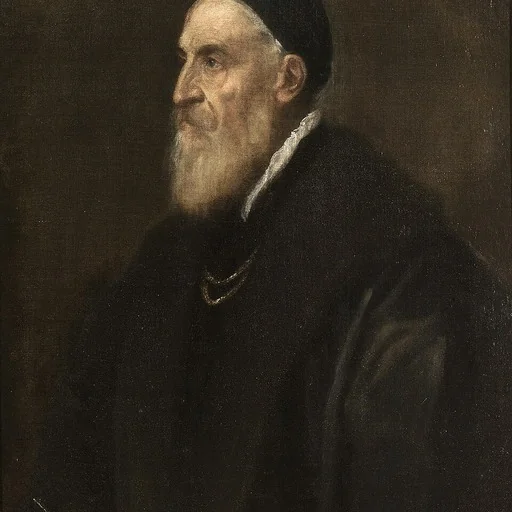
Tiziano Vecellio (Italian:; c. 1488/1490 – 27 August 1576), Latinized as Titianus, hence known in English as Titian ( TISH-ən), was an Italian Renaissance painter. The most important artist of Renaissance Venetian…