Artwork
A House Burgled at Night
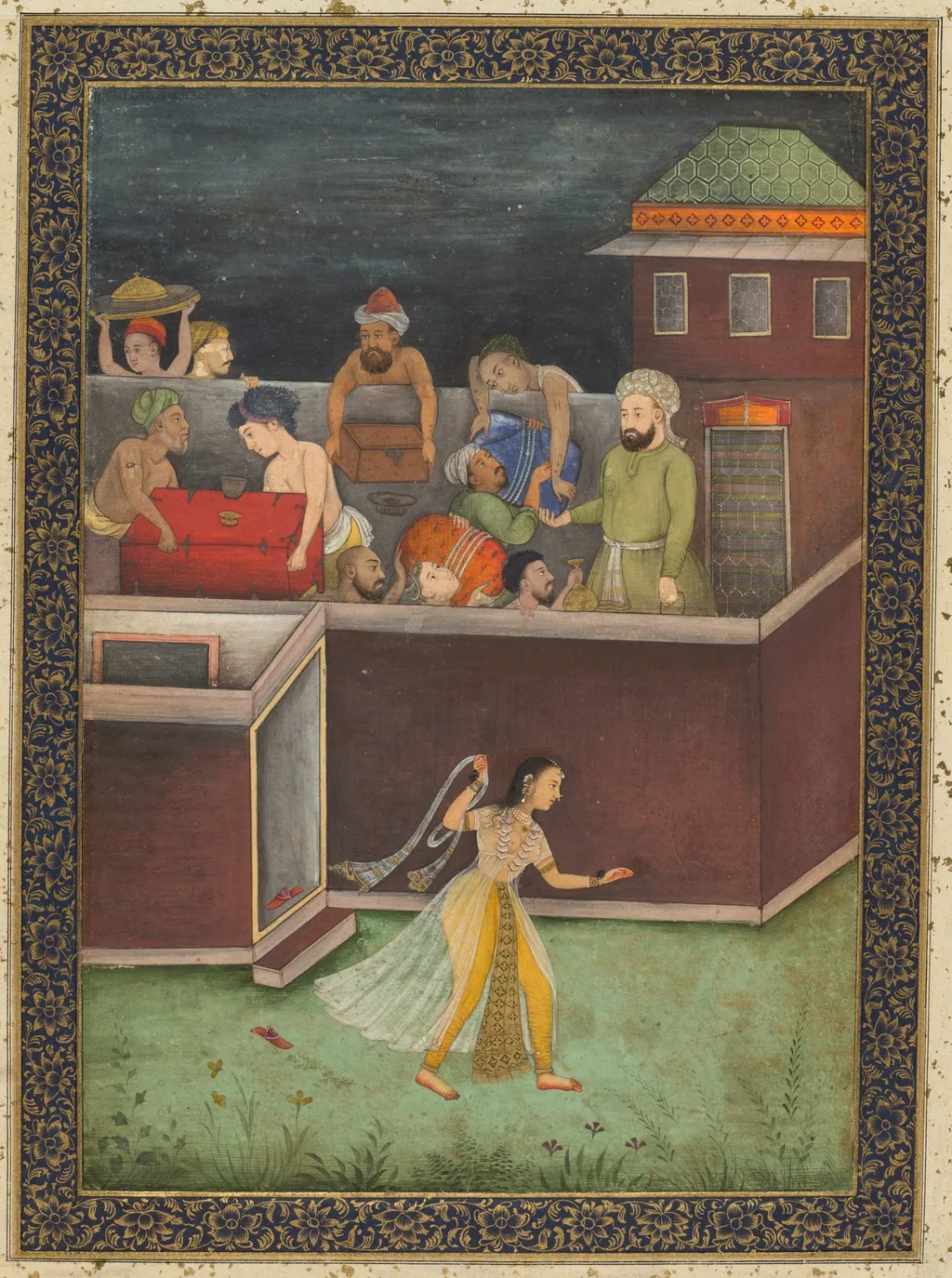
A House Burgled at Night is an unspecified painting. It dates from 1700 and is held in the collection of the Cleveland Museum of Art.
About this work
Subject & Meaning
This symbolic use of light and shadow underscores the psychological impact of burglary, framing the home as both sanctuary and target.
The work presents a dimly lit interior where a window is ajar, suggesting unauthorized entry, while scattered valuables and a broken vase imply theft and disruption. The nocturnal setting and the broken objects convey themes of vulnerability and violation, evoking a sense of intrusion that resonates with historical concerns about domestic security. The painting’s composition uses stark chiaroscuro to heighten tension, reinforcing the narrative of an unseen breach that transforms the familiar space into a site of threat.
This symbolic use of light and shadow underscores the psychological impact of burglary, framing the home as both sanctuary and target.
History & Provenance
A House Burgled at Night is dated to 1700 and is classified as a painting. According to the available records, the work was produced in the Mughal Empire and is held in the collection of the Cleveland Museum of Art, where it is identified by the accession number 2013.333. No further details regarding its commission, earlier ownership, or chain of custody prior to its acquisition by the museum are documented in the provided sources.
The painting is held in the collection of the Cleveland Museum of Art, where it is accessioned under the identifier 2013.333. It has been part of the museum’s exhibition schedule, appearing in displays focused on European and South Asian works.
Overview
A nocturnal scene titled A House Burgled at Night portrays a burglary in progress. A woman in a bright yellow dress slips through a window, clutching a bundle of stolen items, while five men lie within the interior, some asleep, others startled. The composition balances tension with a quiet domestic setting.
Technique & Style
Rendered with meticulous attention, the painting captures fine textures: the sheen of the yellow dress, the red chest, and the green‑tiled roof visible through the window. Small gestures, like a man's head resting on his arm and the precise placement of books on a table, demonstrate a careful, observational approach.
Context
The scene reflects genre painting traditions that depict everyday life moments with narrative depth. By focusing on a nighttime burglary, the artist explores themes of secrecy, domestic space, and the interplay between public crime and private interiors.
Artist & collection

- A House Burgled at Night
 Umar searches for Hamza
 Page from Tales of a Parrot (Tuti-nama): text page
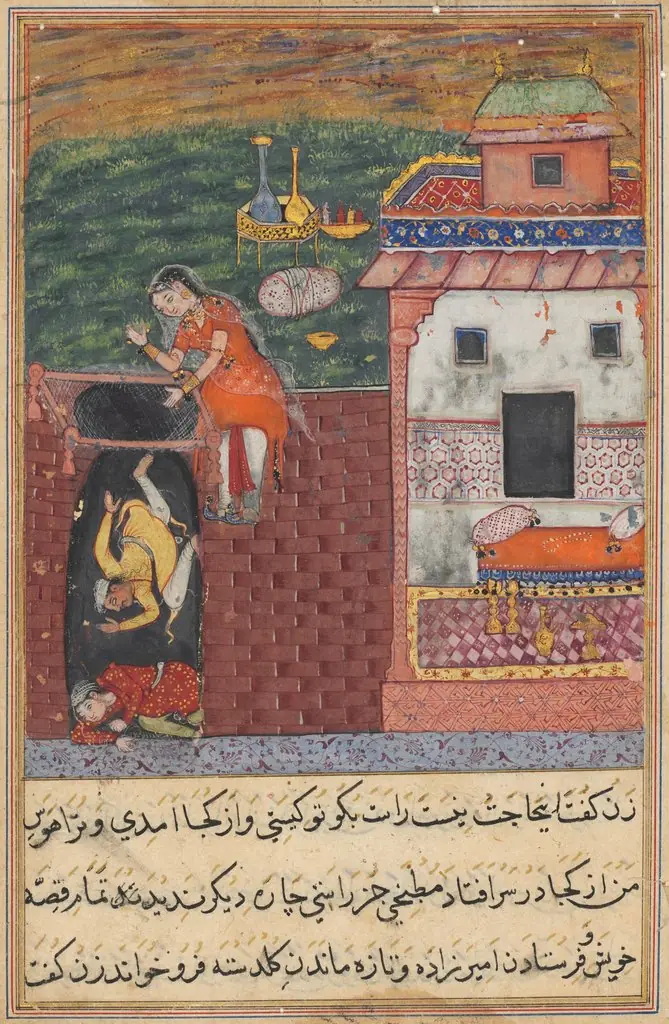 The two cooks, who attempt to seduce the warrior’s loyal wife, are trapped by her in a cellar, from a Tuti-nama (Tales of a Parrot): Fourth Night
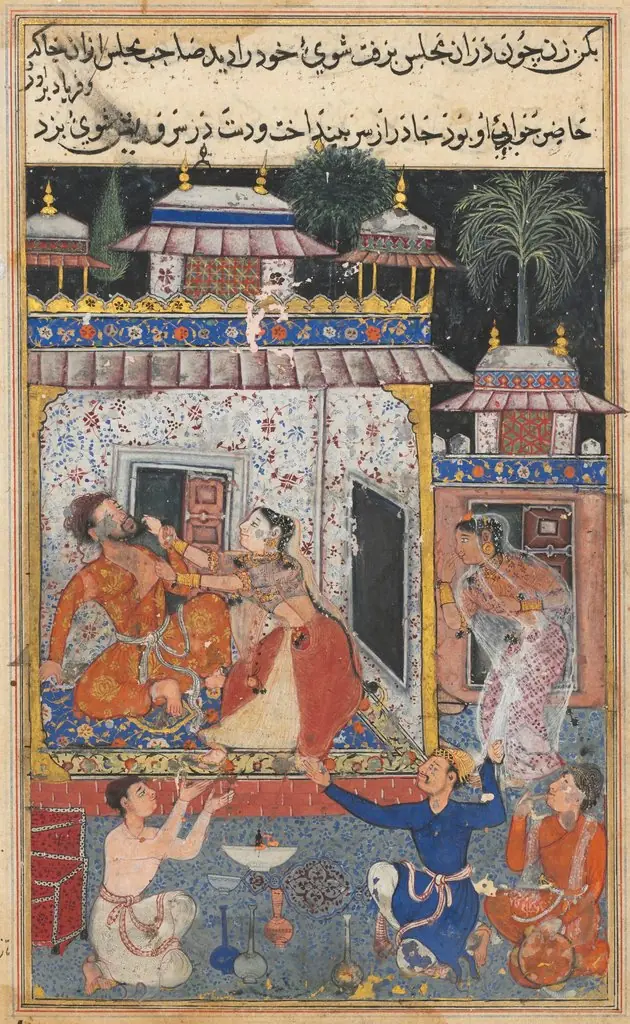 The deceitful wife assaults her erring husband, from a Tuti-nama (Tales of a Parrot): Eighth Night
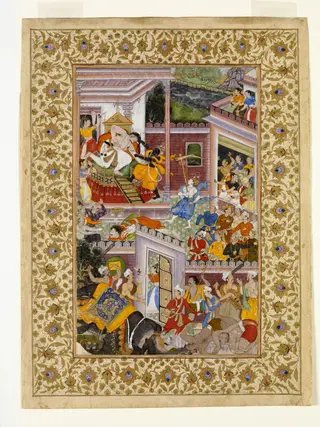 Krishna kills his uncle, the tyrant ruler Kamsa
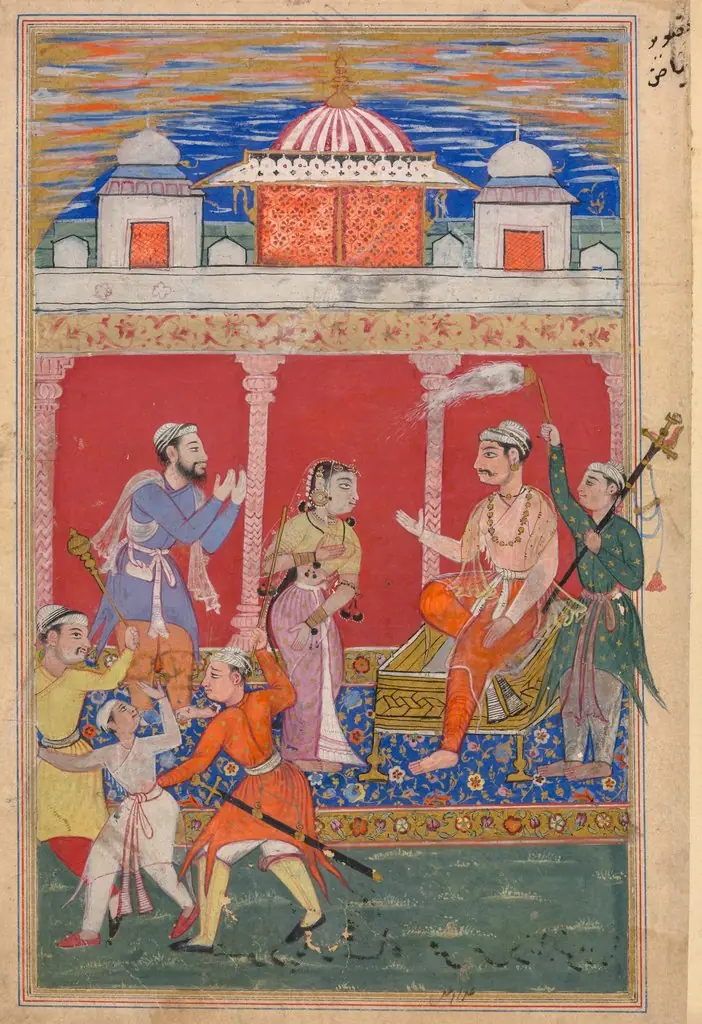 Page from Tales of a Parrot (Tuti-nama): text page
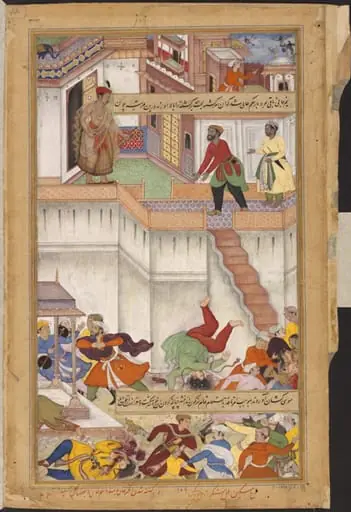 Adham Khan
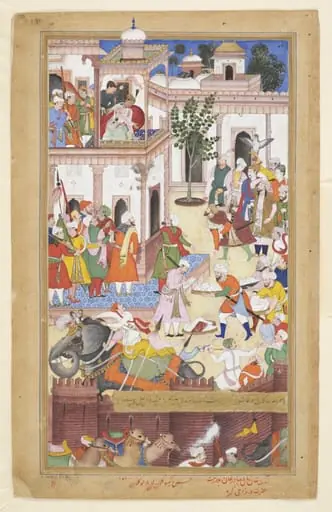 Ali Quli, Bahadur Khan and Akbar
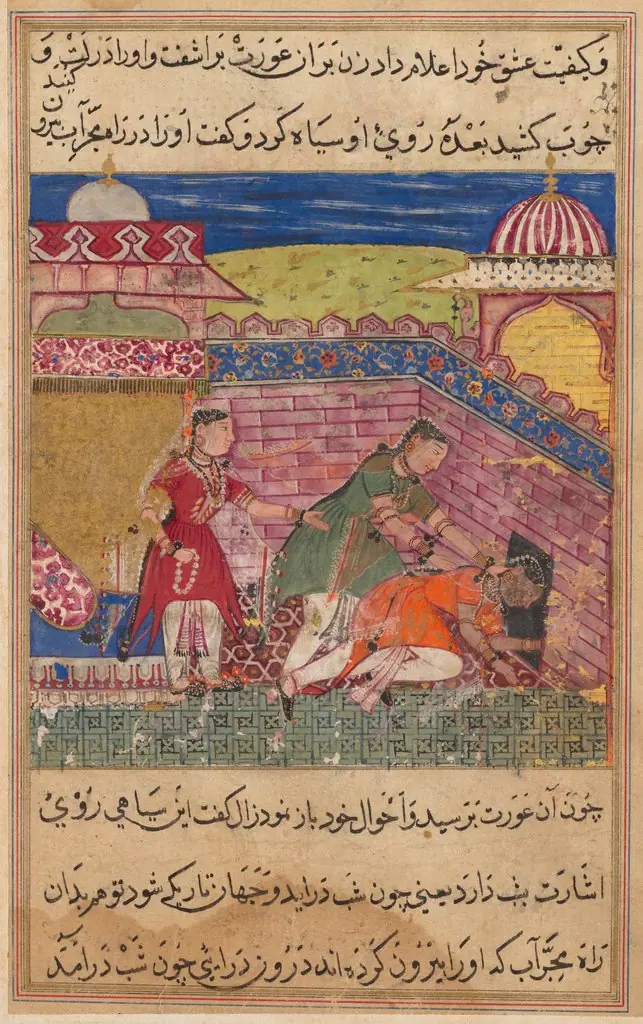 The deceitful wife ejects the procuress after blackening her face, from a Tuti-nama (Tales of a Parrot): Eighth Night
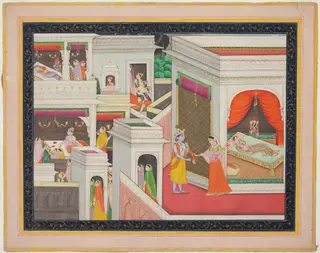 Palace Scene at Night
 Tarkhan Divana and Husain Quli Khan