Artwork
Personification of the chakra of Vishnu
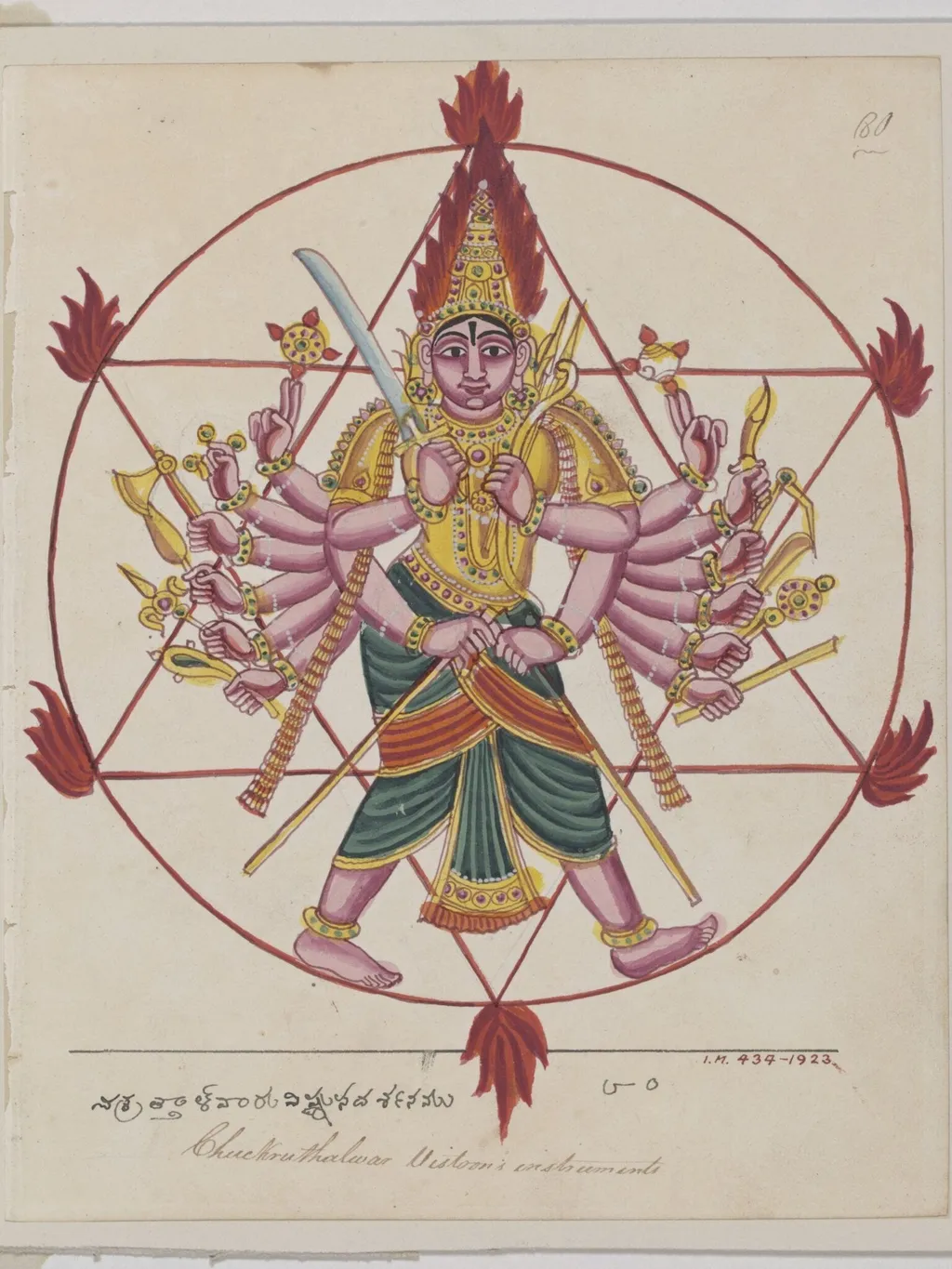
Personification of the chakra of Vishnu is a paint painting by the Romanticist artist Unknown. It dates from 1825 and is held in the collection of the Victoria and Albert Museum. This painting is one of a hundred illustrated depictions of Hindu deities created in South India in 1825.
About this work
Overview
This painting is one of a hundred illustrated depictions of Hindu deities created in South India in 1825. It presents a symbolic representation of Vishnu’s chakra, the discus weapon associated with cosmic order. Rendered in watercolor on paper, the work belongs to a devotional series likely used for ritual or educational purposes, reflecting regional artistic traditions of the early 19th century.
Subject & Meaning
The figure embodies the chakra not as an object but as a divine presence, merging Vishnu’s attribute with a humanoid form.
The figure embodies the chakra not as an object but as a divine presence, merging Vishnu’s attribute with a humanoid form. Its eight arms, each holding distinct implements, sword, drum, wheel, and others, signal multifaceted cosmic functions. The calm expression contrasts with the dynamism of the weapons, suggesting controlled power. The red circle surrounding the figure may represent the cyclical nature of time or divine energy.
Technique & Style
Executed in opaque watercolor, the painting employs bold, flat areas of color, gold, green, and pink, to define the figure’s form and attire. Fine lines outline details, while the absence of background depth focuses attention on the central figure. The crown and striped skirt reflect regional iconographic conventions, and the precise rendering of objects conveys symbolic meaning rather than naturalism.
History & Provenance
The painting originates from a documented series of 100 devotional drawings produced in South India in 1825, possibly commissioned by a temple or patron. It entered the collection of the Victoria and Albert Museum in the 19th century, where it remains part of a larger archive of South Indian religious art. Its survival reflects the continued interest in Hindu iconography among colonial collectors.
Context
This work emerged during a period when South Indian artists were systematically documenting deities and their attributes in illustrated manuscripts. Such series served both religious instruction and cultural preservation, especially as traditional practices faced external pressures. The personification of abstract symbols like the chakra aligns with a broader South Indian tendency to visualize divine qualities through embodied forms.
Legacy
The painting contributes to a rare corpus of 19th-century South Indian devotional illustrations that bridge theological concepts with visual representation. It informs contemporary studies of Hindu iconography and the transmission of religious symbols through art. While not widely exhibited, it remains a key reference for scholars examining the intersection of ritual, symbolism, and artistic practice in colonial-era India.
Artist & collection









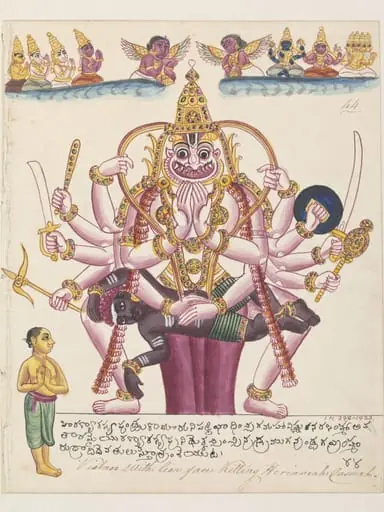
- Narasimha, the fourth avatara of Vishnu.
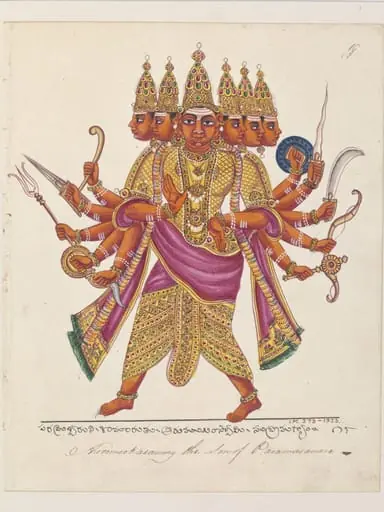 Subrahmanya, with six heads, in his form as Shanmukha (Arumukha)
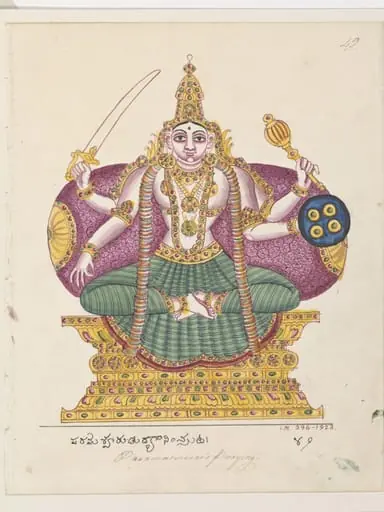 Shiva holding a sword, mace and shield.
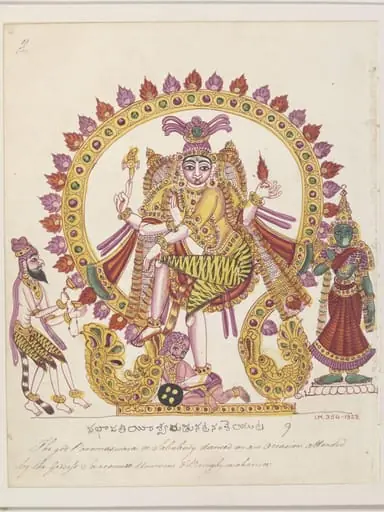 Nataraja (Shiva as lord of the dance)
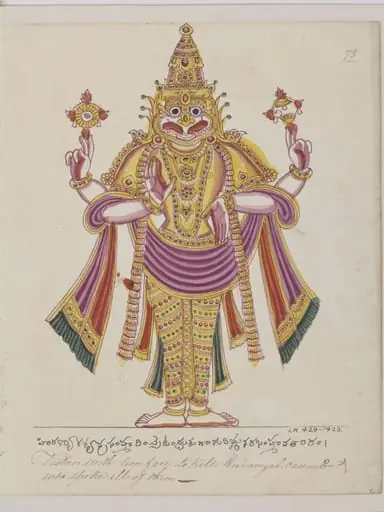 Narasimha, the man-lion, the fourth avatar (incarnation) of Vishnu
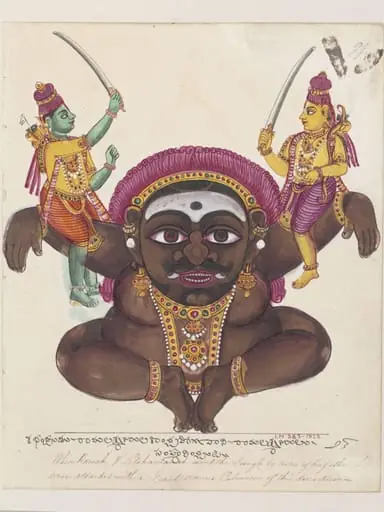 The rakshasa Kabandha supporting Rama and Lakshmana on his arms.
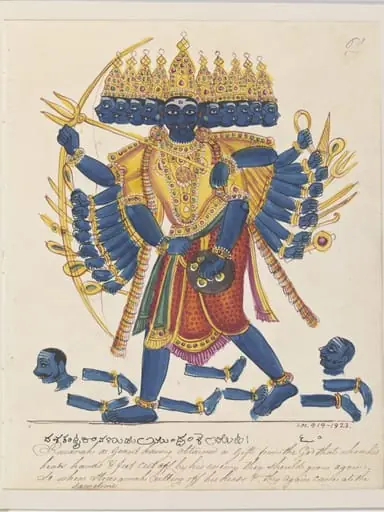 Ravana, King of Lanka, with bow
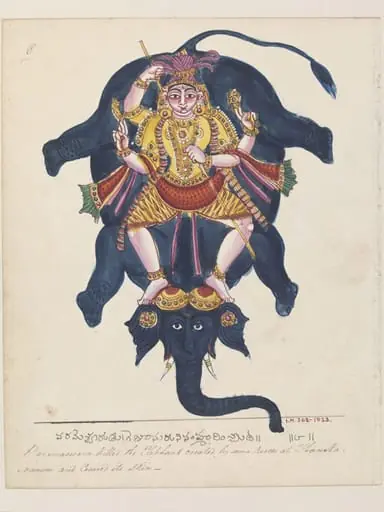 Shiva as the slayer of the elephant demon, Gajasura.
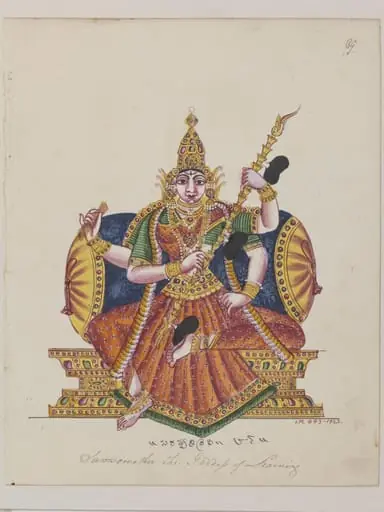 Sarasvati, the goddess of learning, speech and music