Artwork
Portrait of a disabled man
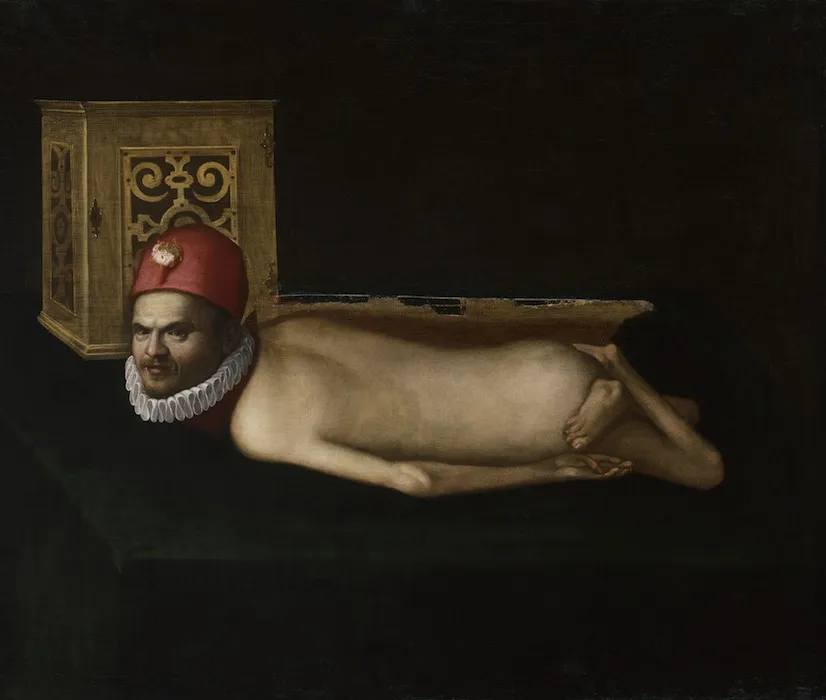
Portrait of a disabled man is an oil painting. It dates from 1600 and is held in the collection of the Kunsthistorisches Museum. The work is an oil painting that presents a nude male figure reclining on his side, directly engaging the viewer's gaze.
About this work
Subject & Meaning
The painting shows a naked man, save for a ruff and hat, reclining on a cushioned liege before a dark background; a decorated cabinet stands behind his head.
The painting shows a naked man, save for a ruff and hat, reclining on a cushioned liege before a dark background; a decorated cabinet stands behind his head. His head is turned in three‑quarter profile, upright and individualized, while his torso, limbs and feet appear limp, atrophied and deformed, creating a stark contrast between the dignified portraiture of the face and the helpless body. This juxtaposition suggests the work was meant either as a scientific study of congenital disability or as a curiosity for a Kunst‑ und Wunderkammer, a possibility reinforced by the original red paper flap that could be lifted to reveal or conceal the figure. Some scholars have noted the resemblance to arthrogryposis multiplex congenita, though the sitter’s identity remains unknown.
Technique & Style
The work is an oil painting on canvas measuring 135 × 110 cm, created circa 1600. It depicts a partially nude man lying on a settee against a dark background; his head is clothed in a ruff, collar and hat, while the exposed torso and limbs appear atrophied, with atrophied muscles, crossed and drawn-up legs, and deformed feet. The head is rendered in three-quarter profile, sharply turned toward the viewer, contrasting with the limp, powerless body below.
A red paper covering likely originally concealed the figure’s torso, and damage to the paint above the back indicates where it was attached. The portrait was probably commissioned for the collection of Archduke Ferdinand II and first appears in a 1666 inventory describing a “counterfeit of a man, with a red cap on the head, naked, covered with red paper, damaged.” It was later catalogued as inventory number 8344 in the Kunstkammer of Schloss Ambras, now part of the Kunsthistorisches Museum Wien.
History & Provenance
The painting dates to the 16th century and is executed in oil on canvas, measuring 135 × 110 cm. It is held in the Kunstkammer at Ambras Castle near Innsbruck, an outstation of the Kunsthistorisches Museum in Vienna, where it is registered under inventory number 8344.
The Ambras picture collection was established by Archduke Ferdinand II (1529–1595) and was conceived from the outset as a museum-style exhibition. Because the furniture and clothing depicted in the painting correspond precisely to the setting in which it still hangs today, scholars consider it a commission made for Ferdinand II and his collection. It may already have formed part of the founding holdings.
The work is not mentioned in the earliest known Ambras catalogue of 1621, nor in an 1882 inventory, though both sources are known to omit individual pieces.
A 1666 inventory of Schloss Ambras describes the painting as "Ain conterfet aines mannß, so ain rotes käpl auf dem haupt, nackehend mit einem roten pappier, so schadhaft bedeckht," noting the red paper covering the sitter's body. The painting was later exhibited at Schloss Ambras from 8 December 2006 to 30 June 2007.
The work is held at Schloss Ambras Innsbruck, an outpost of the Kunsthistorisches Museum Wien, catalogued as Ambras Kunstkammer inventory number 8344.
It was included in the exhibition “Bildnis eines behinderten Mannes” at Schloss Ambras from 8 December 2006 to 30 June 2007.
Context
The portrait’s unsettling realism and ambiguous purpose have shaped its reception. Early modern viewers often framed such images as curiosities; Charles Patin’s 1690 account records “horror” at the sight of similarly “terrifyingly deformed” bodies in the Ambras collection, reflecting a prevalent attitude that distanced disability from dignified representation. Modern scholarship, however, has reappraised the work within the context of Erzherzog Ferdinand II’s Kunst- und Wunderkammer, where art, science, and spectacle intersected.
Recent research, including projects led by Volker Schönwiese, has emphasized the painting’s dual status as both portrait and ethnographic document, challenging its earlier reduction to mere curiosity. Its inclusion in the 2006–2007 Ambras exhibition signals a shift toward critical engagement with disability representation in early modern art, moving beyond historical condescension to consider the subject’s agency and the ethical stakes of display.
Legacy
For centuries, the work remained largely overlooked by scholarship, often referred to by the derogatory title "Bildnis eines Krüppels" (Portrait of a Cripple). Early visitors like Charles Patin in 1690 reacted with horror to the depiction of the "frightfully deformed" body, while later generations debated the painting's suitability for public display. The image was historically concealed from view by a red paper flap attached to the canvas, allowing viewers to lift and drop it at will.
Modern academic engagement with the piece is a recent development, spearheaded by a transdisciplinary research group led by Volker Schönwiese. This renewed interest culminated in a dedicated exhibition at Ambras Castle from December 2006 to June 2007, which placed the portrait at the center of public discourse regarding disability representation. The work is now cataloged under the neutral title "Portrait of a disabled man" within the Kunsthistorisches Museum's collection.
Overview
The work is an oil painting that presents a nude male figure reclining on his side, directly engaging the viewer's gaze. He is topped with a bright red hat bearing a white blossom and a frilled collar encircles his neck. Behind him a wooden piece of furniture, likely a cabinet or table, is visible, its front adorned with decorative carving. The overall composition is set against a deep, shadowed backdrop.
Artist & collection