Artwork
Venus with Cupid stealing honey
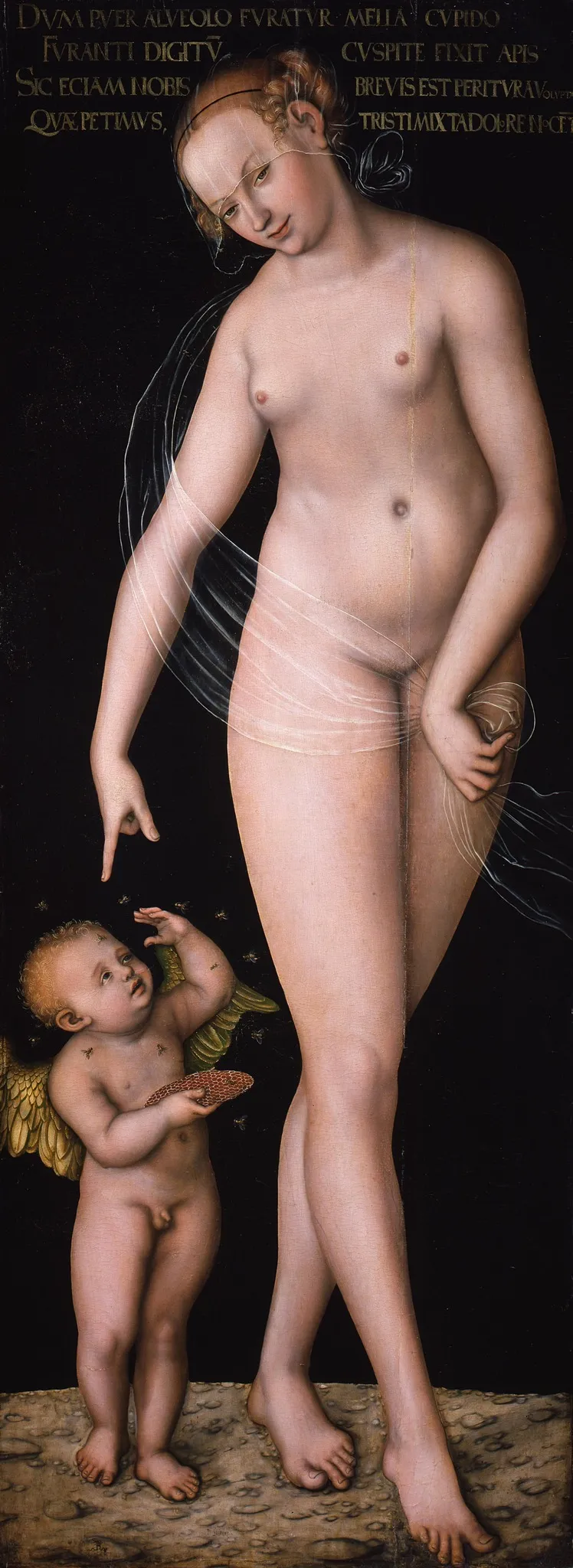
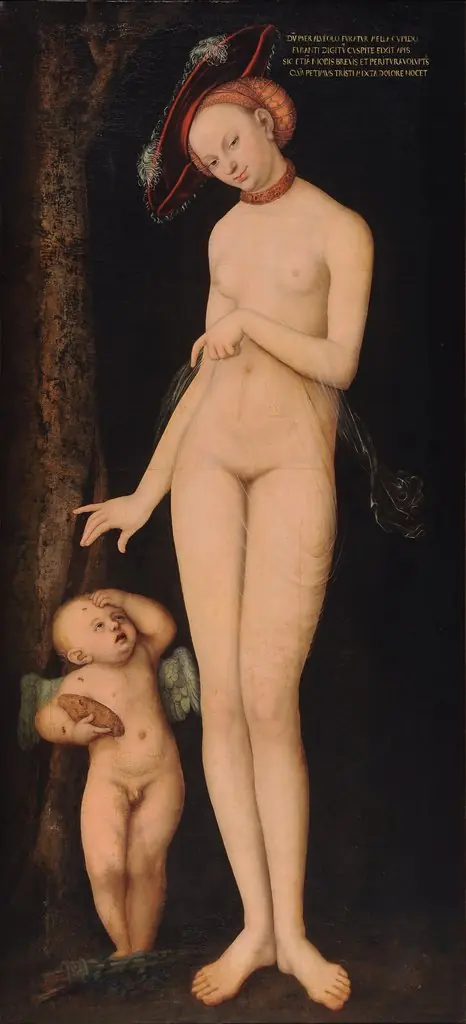
Venus with Cupid stealing honey is a paint painting by the Northern Renaissance artist Lucas Cranach the Elder. It dates from 1537 and is held in the collection of the Gemäldegalerie Berlin.
About this work
Overview
Venus with Cupid Stealing Honey is a mythological painting by Lucas Cranach the Elder, dated to 1537 and held in the Gemäldegalerie, Berlin.
Venus with Cupid Stealing Honey is a mythological painting by Lucas Cranach the Elder, dated to 1537 and held in the Gemäldegalerie, Berlin. Executed in paint on a lime panel measuring 174.5 by 65.5 centimetres, the work is one of numerous versions of this subject that Cranach and his workshop produced from around 1525 onward. The painting exemplifies the artist's engagement with classical literature and his distinctive approach to the female nude within the context of the German Renaissance. It remains a significant work for understanding Cranach's mythological output, his Reformation-era context, and the broader European reception of ancient poetic sources.
Subject & Meaning
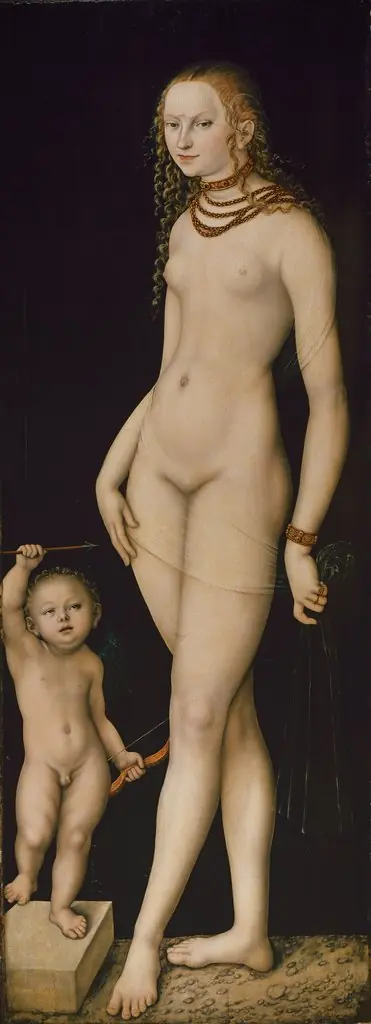
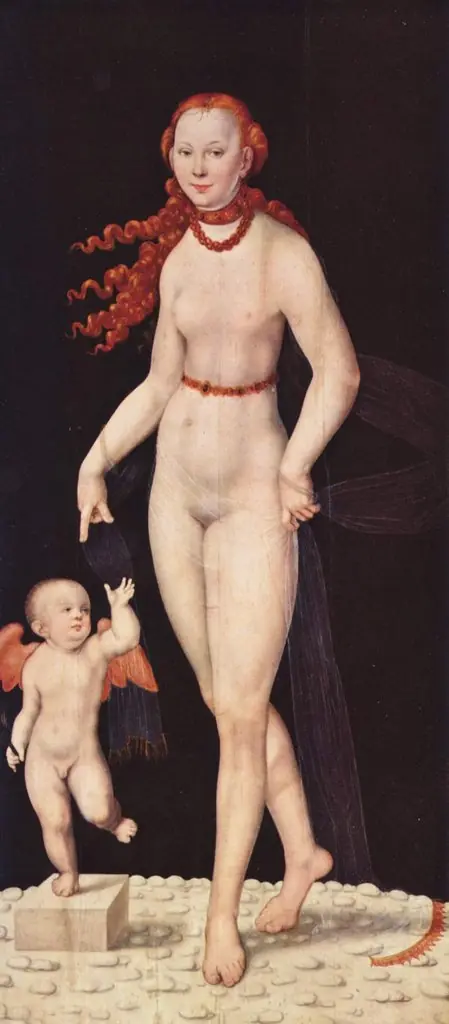
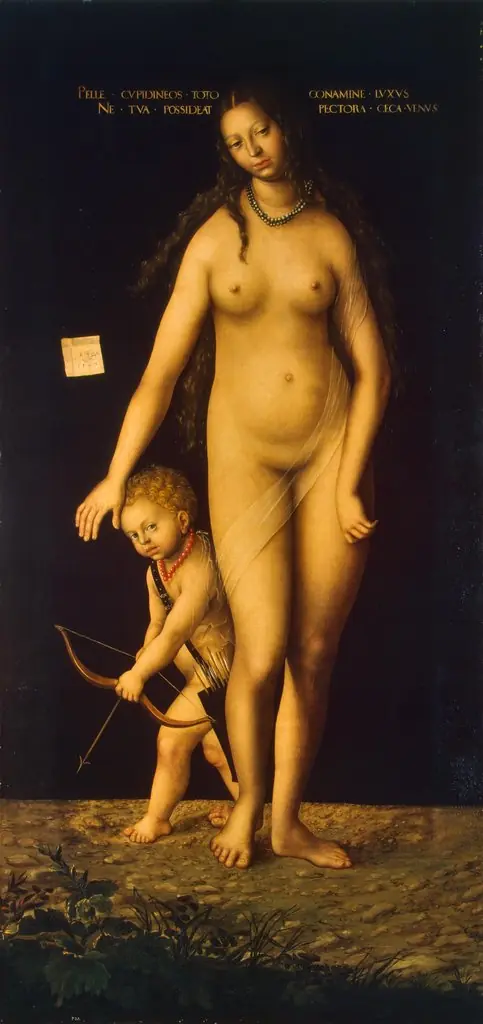
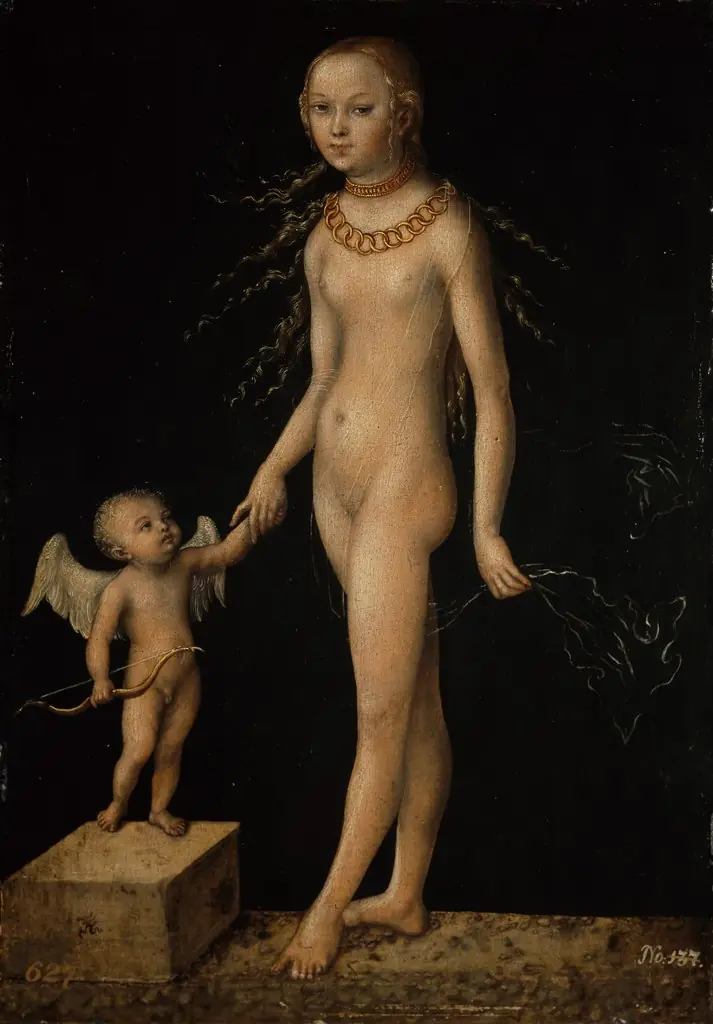
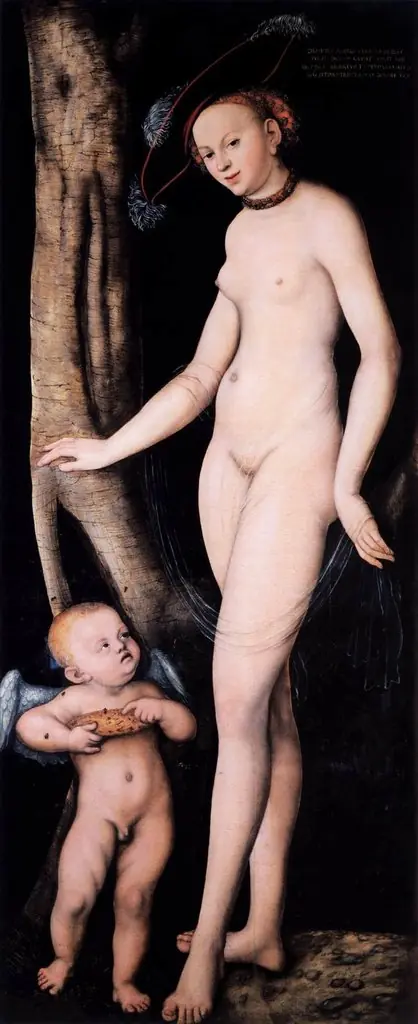
The scene derives from the nineteenth idyll of the Greek poet Theocritus, titled Keriokleptes (The Honey Thief), composed around the third century BCE. The painting depicts Venus, goddess of love, standing nude with a translucent veil wrapped around her hips and draped behind her shoulders, while her son Cupid, a small winged child with golden wings and curly hair, holds a honeycomb and reaches upward. Several bees hover near the child, alluding to the narrative in which Cupid is stung while stealing honey and complains to his mother of the pain. Venus responds that creatures so small can indeed inflict great suffering, just as Cupid's own arrows wound those struck by love. The brief pleasure of love, she implies, is mingled with sharp pain. A Latin inscription in gold lettering across the upper portion of the panel reinforces this moralising reading: "DVM PVER ALVEOLO FURATUR MELLA CUPIDO / FVRANTI DIGITVM SEDVLA PVNXIT APIS / SIC ETIAM NOBIS BREVIS EST PERITVRA VOLVPTAS / QUAE PETIMVS; TRISTI MIXTA DOLORE NOCET" (As Cupid was stealing honey from the hive / A bee stung the thief on the finger / And so do we seek transitory and dangerous pleasures / That are mixed with sadness and bring us pain). This inscription transforms Theocritus's playful narrative into a warning against lust and its destructive consequences, reflecting the moralising tendency of Cranach's treatment of mythological subjects.
Technique & Style
The painting is executed in paint on a lime panel, with the support measuring 174 by 64.9 centimetres according to the Gemäldegalerie's revised 2010 assessment. The surface exhibits fine craquelure throughout and a glossy, precise finish. Cranach renders the flesh with smooth, pale tones and subtle modelling, while the veil is treated with particular attention to its transparency. The figures stand on a flat, earth-toned surface with a pebble-like texture against a uniformly dark, nearly black background. The composition is notably tall and narrow, with Venus's elongated figure dominating the vertical format. The artist's insignia, a winged serpent with dropped wings, appears at the upper left. The handling demonstrates Cranach's characteristic combination of meticulous anatomical detail with a certain stylised elegance, particularly in the depiction of the female form. The restrained palette, dominated by pale flesh tones, the dark background, and the golden lettering, creates a striking visual contrast that focuses attention on the moral message and the sensuous presence of the figures.
History & Provenance
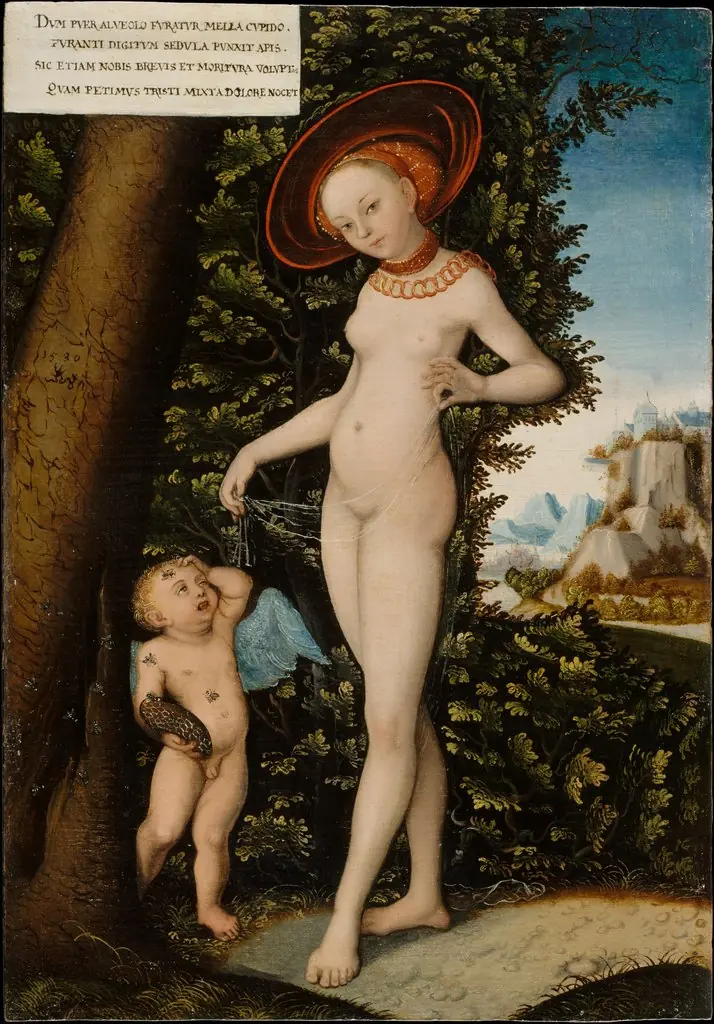
The Gemäldegalerie, Berlin, dates this specific panel to after 1537, though the broader series of variants began around 1525. The painting bears the artist's winged serpent insignia with dropped wings at the upper left. On the reverse of the panel, a later inscription in black paint reads "Lucas / krannick / No 13", along with chalk markings "M 81" and "B123". The work carries labels from the Staatliche Museen Berlin - Gemäldegalerie, including inventory number I, 1338 and catalogue number 1190, as well as a restoration label from 1936 by J. v. Danzas. Additional seals include the Königliche Schlösser Siegel of 1878 and a seal of the Directeur General du Musees d. France. The painting is currently held by the Staatliche Museen zu Berlin, Gemäldegalerie, though its precise provenance chain before entering the museum's collection is not fully detailed in the available sources. At least fifteen versions of this scene are known, with the earliest in the National Gallery, London, and other variants in collections including the Germanisches Nationalmuseum, the Statens Museum for Kunst in Copenhagen, the Musée des Arts Décoratifs, the Metropolitan Museum of Art, and the Burrell Collection in Glasgow.
Context
Lucas Cranach the Elder was court painter to the Electors of Saxony from 1504 until his death, based in Wittenberg, the heart of the emerging Protestant faith. He was a close associate of Martin Luther, producing woodcut illustrations for Luther's German Bible and portraits of the Reformation leader. This painting's classical subject matter, drawn from Greek poetry, exists in productive tension with Cranach's Reformation context. The poem's publication under the name of Philipp Melanchthon, Luther's collaborator who founded Philippism, adds a further layer of significance. Melanchthon devised his own version of Luther's teachings, and his movement became particularly important in Denmark. The moralising inscription on the painting aligns with the Reformers' suspicion of sensual pleasure, even as the image itself luxuriates in the depiction of the female nude. This duality, between classical humanist learning and Protestant moral rigour, characterises much of Cranach's mythological output. The work has been discussed in scholarly literature including studies by Gunnar Heydenreich, Mark Evans, and Pablo Pérez d'Ors, with particular attention to its place within Cranach's series of Venus and Cupid compositions and its intersection with Lutheran image theology.
Legacy
The Venus with Cupid Stealing Honey theme became one of Cranach's most frequently repeated subjects, with the artist and his workshop producing approximately thirty variants from around 1525 onward. This prolific repetition testifies to the subject's popularity among patrons and its commercial viability. The series demonstrates the workshop system's capacity for efficient production of sought-after imagery. The theme's afterlife extends beyond Cranach's own practice: a copy after the artist, dated by the Metropolitan Museum of Art to between 1580 and 1620, indicates continued demand for the composition decades after Cranach's death. This copy, now in the Robert Lehman Collection at the Metropolitan Museum, reproduces the inscription and the winged serpent insignia (with elevated wings and the date 1530 added by the copyist), suggesting that the moralising message remained integral to the work's appeal. The painting's transfer from the Kunstkammer at Gottorp Castle to the Royal Collection in 1759, as part of a larger group that formed the largest Cranach collection outside German-speaking countries, indicates the early institutional recognition of Cranach's significance. Today, the Berlin version remains a key work for understanding the intersection of classical learning, Reformation culture, and the economics of artistic production in sixteenth-century Germany.
Artist & collection
Artist
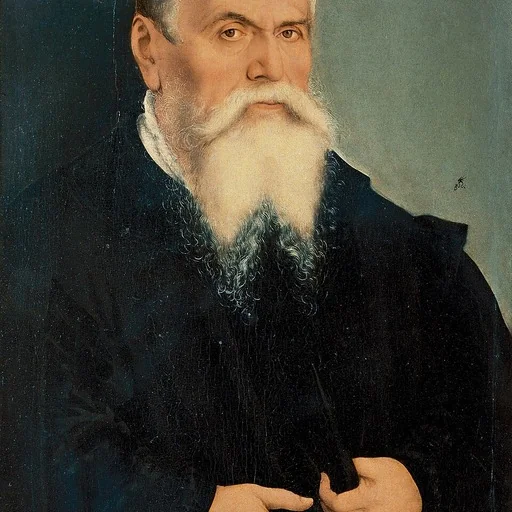
Lucas Cranach the Elder was a German Renaissance painter and printmaker in woodcut and engraving.