Artwork
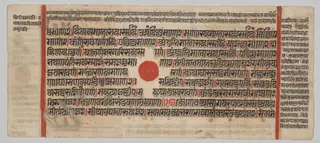
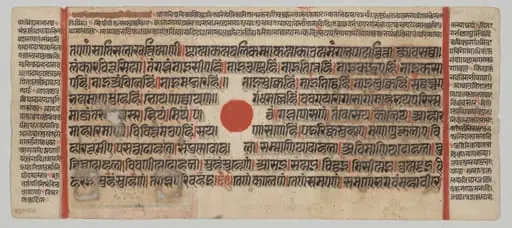
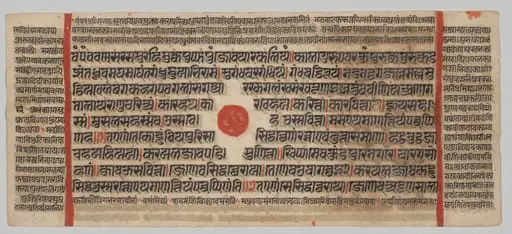
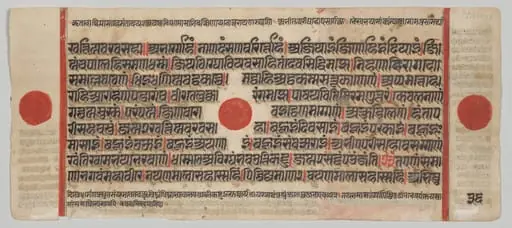
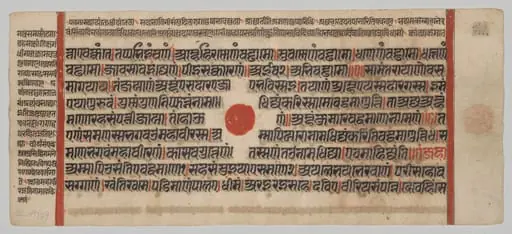
Text, folio 12 (verso), from a Kalpa-sutra
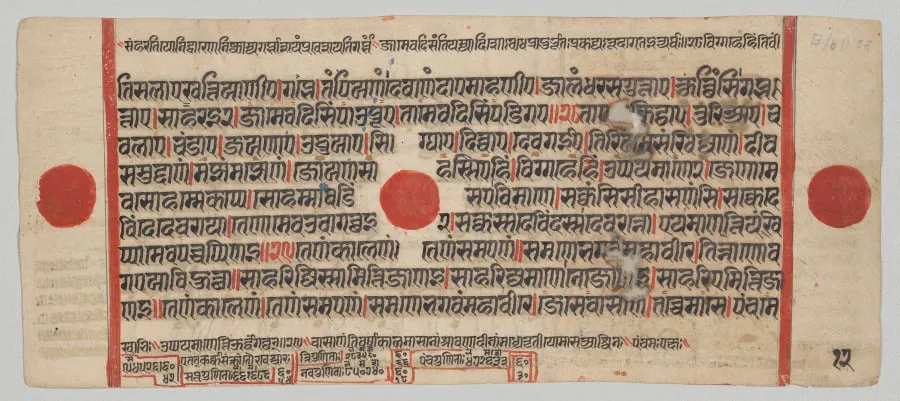
Text, folio 12 (verso), from a Kalpa-sutra is an unspecified painting by the Mughal Painting artist Unknown. It dates from 1488 and is held in the collection of the Cleveland Museum of Art. This folio comes from a manuscript of the Kalpa-sutra, a sacred Jain text detailing the lives of the Tirthankaras.
- Accession no.
- 1932.119.12.b
- Credit line
- Edward L. Whittemore Fund
About this work
Overview
The scene is annotated with brief Sanskrit inscriptions that clarify the narrative, blending text and image into a unified devotional object.
This folio comes from a manuscript of the Kalpa-sutra, a sacred Jain text detailing the lives of the Tirthankaras. The illustration depicts a pivotal moment in the birth narrative of Mahavira, the 24th Tirthankara, rendered in a compact, finely detailed style typical of western Indian miniature painting. The scene is annotated with brief Sanskrit inscriptions that clarify the narrative, blending text and image into a unified devotional object.
Subject & Meaning
The scene illustrates the divine transfer of Mahavira’s embryo from his biological mother, a Brahmin woman, to his foster mother, a queen. A goat-headed deity, associated with fertility and protection, gently cradles the luminous embryo, symbolizing its sacred passage. This act ensures the child’s purity and divine destiny, reflecting Jain beliefs in non-violence and the spiritual preparation of enlightened beings before birth.
Technique & Style
Executed in tempera on paper, the painting employs fine brushwork and mineral pigments to achieve vivid yet restrained coloration. Figures are stylized with delicate lines, and spatial depth is suggested through layered planes rather than perspective. The inclusion of Sanskrit captions, written in precise script beside the imagery, integrates textual authority with visual storytelling, characteristic of Jain manuscript traditions in Gujarat.
History & Provenance
Created in the 15th century in Gujarat, this folio was part of a larger manuscript used in ritual recitations by Jain monks. Such manuscripts were often commissioned by wealthy lay patrons and preserved in temple libraries. The survival of this folio suggests it was carefully maintained, likely within a monastic or scholarly community that valued its doctrinal and aesthetic precision.
Context
Jain manuscripts from western India, particularly Gujarat, flourished between the 12th and 16th centuries as centers of learning and devotion. The Kalpa-sutra, with its biographies of the Tirthankaras, was among the most frequently illustrated texts. These works served both educational and devotional purposes, reinforcing religious narratives through visual means accessible to literate monastic audiences.
Legacy
This folio exemplifies the enduring tradition of Jain manuscript painting, where narrative clarity and spiritual symbolism took precedence over naturalism. Its survival offers insight into how religious stories were transmitted visually in pre-modern India. Similar works continue to inform scholarly understanding of Jain iconography and the role of art in religious practice across centuries.
Artist & collection