Artwork
The Two Immortals of Harmony and Unity
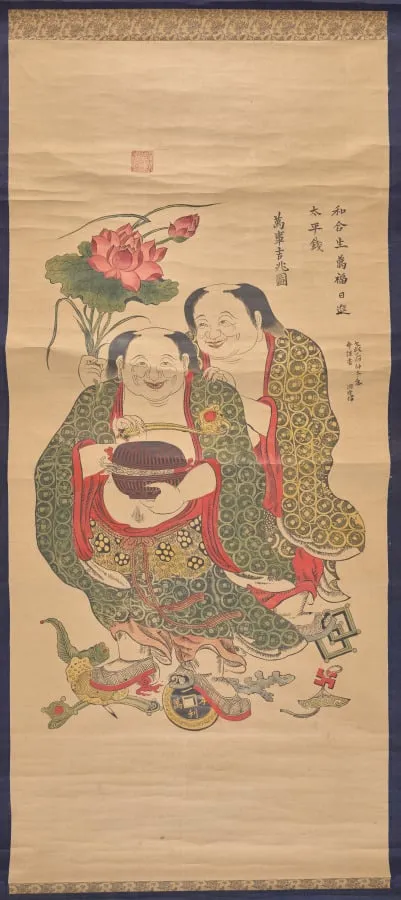
The Two Immortals of Harmony and Unity is a print by the Baroque artist Unknown. It dates from 1766 and is held in the collection of the Cleveland Museum of Art. Color woodblock printing in China flourished during the 17th and 18th centuries, particularly under the Qing dynasty.
- Accession no.
- 2025.31
- Credit line
- Purchase from the J. H. Wade Fund
About this work
The technique let artists layer colors like a stencil, creating bright, crisp images that could be printed over and over.
You see two men in long robes standing under a pine tree, holding scrolls and smiling at each other.
This print was made using separate woodblocks for each color, one block for red, another for blue, and so on. The technique let artists layer colors like a stencil, creating bright, crisp images that could be printed over and over.
To see more prints from this time, look up qing dynasty (1644–1911).
Overview
Color woodblock printing in China flourished during the 17th and 18th centuries, particularly under the Qing dynasty. Artists used multiple carved wooden blocks, each dedicated to a single hue, to build up intricate images through precise layering. This method enabled consistent reproduction of vivid, detailed compositions, making such prints accessible beyond elite circles while maintaining high artistic standards.
Subject & Meaning
The print depicts two figures in flowing robes, standing beneath a pine tree, each holding a scroll and exchanging smiles. The pine symbolizes endurance, while the scrolls suggest scholarly or spiritual exchange. Together, the figures embody harmony and unity, ideals central to Confucian and Daoist thought, presented not as abstract concepts but as a quiet, mutual recognition between individuals.
Technique & Style
Each color in the print was applied using a separate woodblock, meticulously carved to match its designated tone. The process required exact alignment to prevent blurring, resulting in sharp, clean edges and bold, flat areas of color. This technique favored clarity over shading, emphasizing form and symbolic composition rather than naturalistic depth, characteristic of Qing-era decorative printing.
History & Provenance
Produced during the Qing dynasty, this print likely originated in a commercial workshop catering to literati or temple patrons. While its specific origin remains undocumented, similar works were commonly distributed as decorative or devotional objects. Their durability and reproducibility allowed them to circulate widely, preserving artistic conventions across regions and generations.
Context
In 17th- to 18th-century China, woodblock printing thrived alongside the rise of urban culture and print markets. Images like this one reflected values prized by the educated class: harmony, scholarly pursuit, and natural order. Though mass-produced, such prints were not mere commodities, they served as visual expressions of philosophical ideals embedded in daily life.
Legacy
The technical precision and symbolic clarity of Qing color woodblocks influenced later East Asian print traditions. While European techniques eventually transformed printmaking, these Chinese works preserved a distinct aesthetic rooted in craftsmanship and philosophical expression. Surviving examples remain key to understanding how art functioned as cultural transmission in pre-modern China.
Artist & collection