Artwork
Untitled
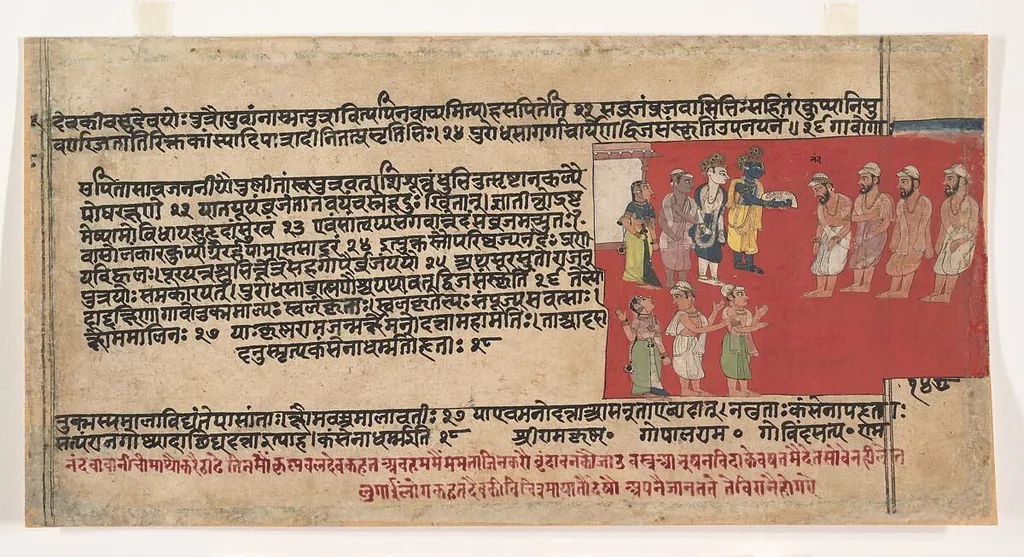
Untitled is a watercolor painting. It dates from 1640 and is held in the collection of the Metropolitan Museum of Art.
- Accession no.
- 1980.527.2a
- Credit line
- Gift of Daniel Slott, 1980
About this work
Subject & Meaning
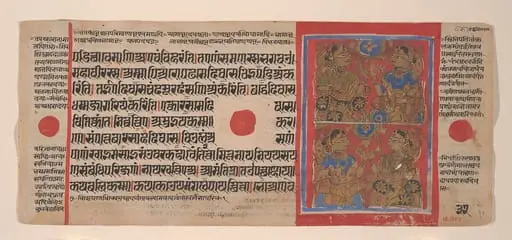
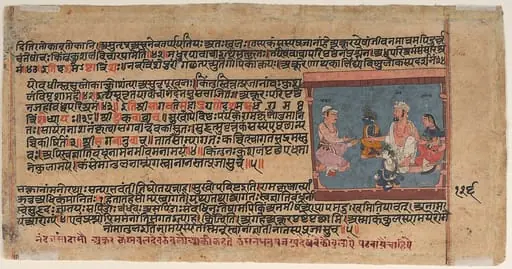
The 1640 ink and opaque watercolor on paper work, classified as a religious painting, portrays the Hindu deity Krishna alongside a male and female figure, a composition that situates the imagery within Indian devotional traditions. The inclusion of Krishna, a central deity associated with love and divine play, alongside mortal participants suggests a narrative drawn from mythological episodes that emphasize relational themes. As part of the Metropolitan Museum of Art's collection, the piece reflects the transmission of South Asian religious art to Western institutions, maintaining its symbolic resonance as a visual exegesis of spiritual stories.
Technique & Style
Executed in ink and opaque watercolor on paper, this 1640 work employs the layered pigment application characteristic of Indian miniature painting traditions.
Executed in ink and opaque watercolor on paper, this 1640 work employs the layered pigment application characteristic of Indian miniature painting traditions. The horizontal format, measuring 16.5 by 33.3 centimetres, supports a religious composition depicting Krishna alongside male and female figures. The use of opaque watercolor over ink-drawn outlines on a paper support is consistent with the manuscript and album-leaf practices of mid-seventeenth-century India, where the artist built up color in successive washes to achieve saturated, flat areas of tone.
History & Provenance
This untitled painting, executed in ink and opaque watercolor on paper, was created in India in 1640. The work is attributed to an anonymous painter and belongs to the religious genre, depicting Krishna alongside a man and a woman. It is held in the collection of the Metropolitan Museum of Art, accessioned as 1980.527.2a, and was acquired by the museum in 1980.
Overview
This 1640 work, titled Untitled, is a Rajasthani painting executed in ink and opaque watercolor on paper. It depicts the Hindu deity Krishna, identifiable by his distinct blue skin, playing the flute while surrounded by a gathering of men and women in vibrant attire. The composition employs the characteristic flat perspective of the region's school, utilizing soft, unmodulated colors and ink outlines without the application of chiaroscuro or shadow.
Created for the private collection of a local ruler, the piece reflects the devotional artistic traditions of Rajasthan during the mid-seventeenth century. The scene captures a moment of divine interaction, emphasizing the deity's role as a pastoral figure and object of worship. Stylistically, the work aligns with the regional aesthetic that prioritizes narrative clarity and decorative color over naturalistic depth, serving as a visual expression of Bhakti devotion within a courtly context.
Context
This painting emerged from the artistic centers of Rajasthan, a region in India renowned for its distinctive painting schools. While the specific artist remains unidentified, the work was likely commissioned for the personal enjoyment of a local ruler or noble. Such private commissions were common, reflecting the patrons' devotion and their appreciation for narrative and devotional art. The style aligns with broader artistic trends found in areas such as Mewar within Rajasthan.
Artist & collection

 Untitled
 Untitled
 Untitled
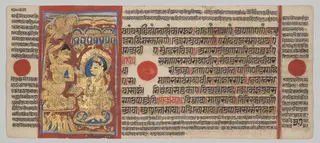 Mahavira's Initiation Tonsure, Folio 37 (verso), from a Kalpa-sutra
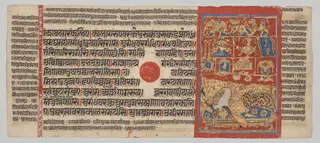 The Fourteen Dreams of Queen Trishala, folio 14 (recto), from a Kalpa-sutra
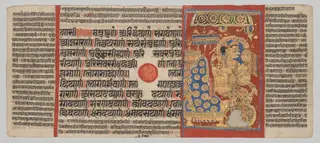 Indra Venerates the Embryo of Mahavira, Folio 7 (recto), from a Kalpa-sutra
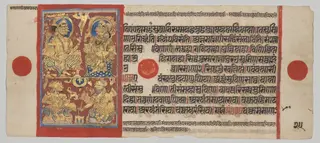 King Siddhartha and Queen Trishala with the Dream Interpreters, Folio 25 (verso), from a Kalpa-sutra
 Untitled
 Untitled
 Untitled