Artwork
A Fisherman's Daughter
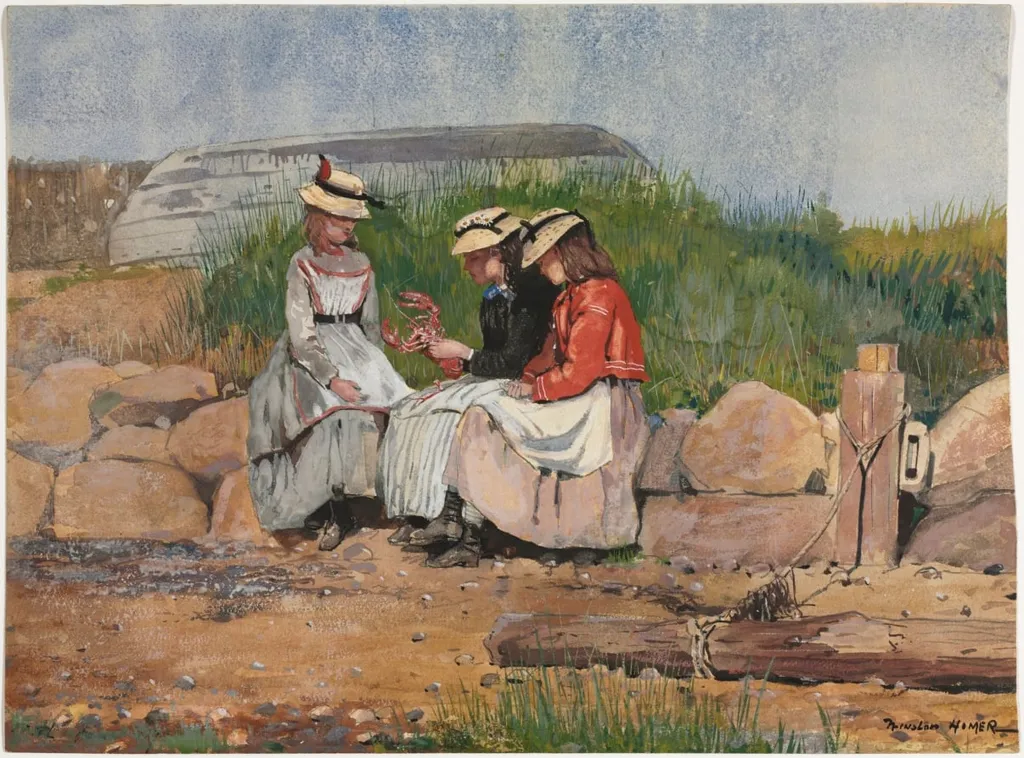
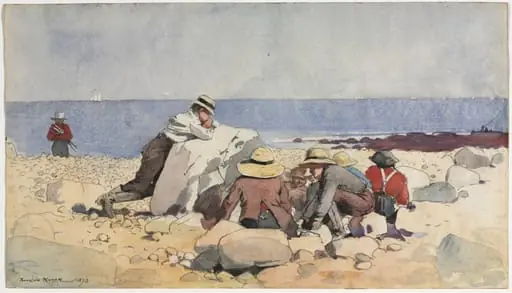
A Fisherman's Daughter is a drawing by the Impressionist artist Winslow Homer. It dates from 1873 and is held in the collection of the Cleveland Museum of Art.
- Accession no.
- 1943.660
- Credit line
- Purchase from the J. H. Wade Fund
About this work
To see how he turned water and paper into sunlight, look up Winslow Homer (American, 1836–1910).
Three girls sit on a sunny beach, playing with a lobster while waves lap nearby. Their dresses are simple, their faces quiet.
Homer painted this in Gloucester, a fishing town where men often vanished at sea. The girls’ calm feels heavy, maybe they’re waiting for fathers who might not come home. It’s one of his first watercolors, but you’d never guess; the light looks effortless.
To see how he turned water and paper into sunlight, look up Winslow Homer (American, 1836–1910).
Overview
Created in Gloucester, Massachusetts, this early watercolor by Winslow Homer depicts three young girls seated on a sun‑lit beach, quietly handling a lobster as gentle waves lap the shore. The composition is anchored by an overturned boat on the dunes, a subtle visual echo of a coffin, underscoring the precarious existence of the town’s fishing community.
Subject & Meaning
The girls’ subdued expressions and simple attire convey a mood of restrained anticipation, reflecting the routine of waiting that defined families in a harbor where men often spent weeks at sea and sometimes never returned. The lobster serves as a modest plaything, while the capsized vessel hints at loss and the ever‑present threat of the ocean.
Technique & Style
Executed in watercolor, the work demonstrates Homer’s nascent mastery of the medium, employing transparent washes to render the bright sunlight and the delicate texture of sand and sea. The light appears effortless, yet the controlled layering of pigment creates a luminous surface that captures both the physical environment and its emotional undercurrents.
History & Provenance
Painted during Homer’s first sustained period of watercolor production, the piece belongs to a series created while he was residing in Gloucester. It marks a pivotal moment in his artistic development, transitioning from oil to a medium that would later define much of his celebrated output. The drawing remains in a public collection, illustrating the early phase of his career.
Artist & collection
Artist
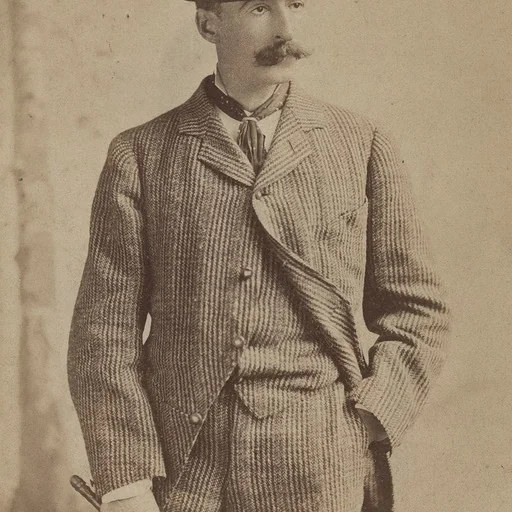
Winslow Homer (February 24, 1836 – September 29, 1910) was an American landscape painter and illustrator, best known for his marine subjects.