Artwork
Entombment of Christ
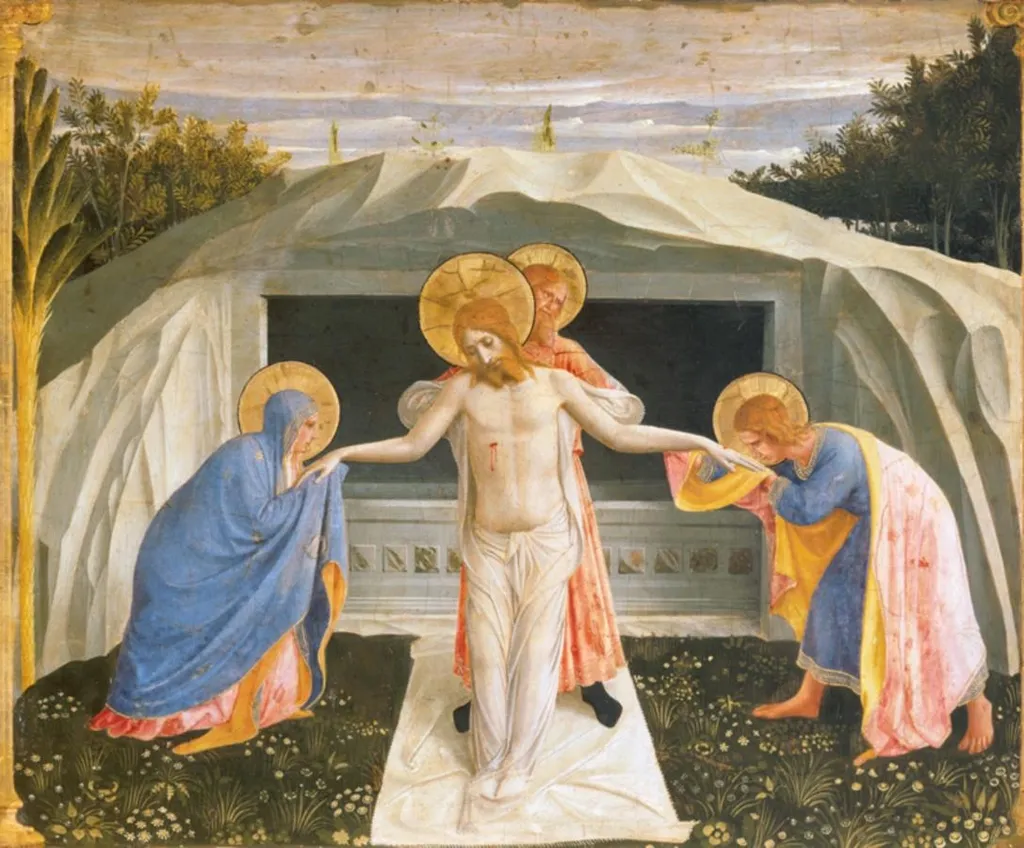
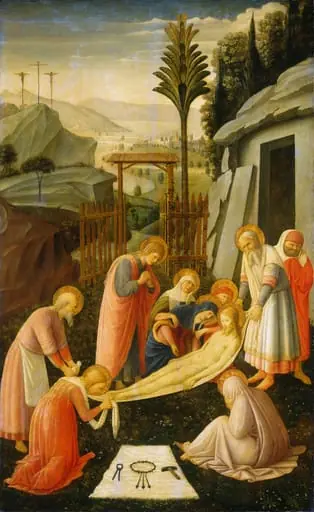
Entombment of Christ is a tempera painting by the High Renaissance artist Fra Angelico. It dates from 1438 and is held in the collection of the Bavarian State Painting Collections.
About this work
Subject & Meaning
John the Evangelist flank the dead Christ, holding and kissing his hands or bathing them with tears, while his body retains the posture of the Crucifixion.
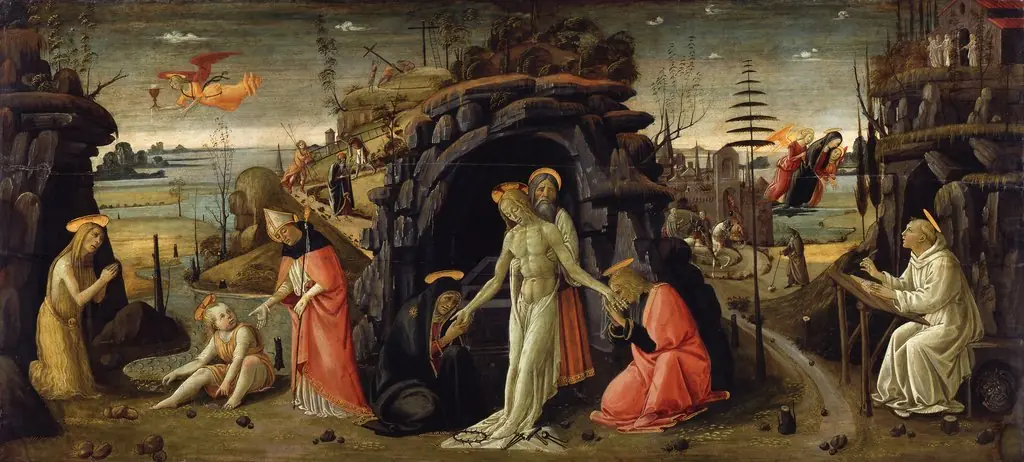
The panel depicts the Entombment of Christ, set before the open cave of the Holy Sepulchre. Nicodemus drags Christ's anatomically rendered body, whose legs recede in foreshortening, into the tomb. The Virgin Mary and St. John the Evangelist flank the dead Christ, holding and kissing his hands or bathing them with tears, while his body retains the posture of the Crucifixion.
The rectangular void of the open tomb silhouettes Christ's corpse, and the shroud below forms a foreshortened rectangle whose folds and delicate shadow reach a refined realism.
A stylized palm appears at the left as a symbol of martyrdom, and the flowering, grassy mantle and surrounding wood emphasize the natural setting. Crystalline, diaphanous light from a low angle on the right unifies the scene and models the volumes through chiaroscuro, illuminating the torso and the upturned palms. John Pope-Hennessy characterized the composition as "an incomparable combination of logic and feeling," and the arrangement was later copied in the 1450s by Rogier van der Weyden in his Deposition now at the Uffizi.
Technique & Style
The Entombment of Christ is executed in tempera on a poplar wood panel, a typical support for Fra Angelico’s predella paintings. The paint is applied with fine, controlled brushwork that renders Christ’s body with anatomical precision and foreshortened legs, while the surrounding landscape, flora and sky are described with meticulous detail. Light enters from a lower right, creating a unifying, diaphase illumination that models volumes through subtle chiaroscuro and gives the drapery a delicate, realistic texture.
The panel has remained in good condition; it was spared the disastrous 18th‑19th‑century restoration that affected other parts of the altarpiece and is presently regarded as being in ottime or molto buone state.
History & Provenance
The Entombment of Christ (c. 1438) was commissioned as part of the San Marco Altarpiece for the high altar of the Dominican church of San Marco in Florence, a project spearheaded by Cosimo de’ Medici. The altarpiece’s removal of an earlier Gothic Coronation of the Virgin (1402) by Lorenzo di Niccolò in 1438, and its replacement with Fra Angelico’s new work, is documented in a 1438 letter from Prior Cipriano, who donated the old panel to the Dominican community at Cortona in 1440.
The altarpiece’s predella, including this panel, was likely completed by 1443. After the suppression of religious houses between the 18th and 19th centuries, the altarpiece was dismantled; the Entombment entered the Bavarian State Painting Collections and is now in the Alte Pinakothek, Munich.
The painting is currently held in the Alte Pinakothek in Munich, Germany, as part of the Bavarian State Painting Collections. It originally served as the central panel of the predella for the San Marco Altarpiece, commissioned for the high altar of the church of San Marco in Florence. Following the suppressions of the eighteenth and nineteenth centuries, the altarpiece was dismantled and dispersed, with this specific panel eventually entering the Munich collection while other sections of the predella were distributed to museums in Washington, Dublin, Paris, and Florence.
Context
John Pope‑Hennessy praised the Entombment of Christ as 'un'incomparabile combinazione di logica e sentimento', highlighting its balance of rational structure and emotional depth【3】. Subsequent scholarship, notably Guido Cornini’s monograph on Beato Angelico, has continued to examine the work’s technique and iconography within the artist’s oeuvre【3】.
The panel formed the central element of the predella of the San Marco Altarpiece, commissioned by Cosimo de’ Medici for the Dominican convent of San Marco in Florence and executed circa 1438–1443【3】. As a product of the Italian Renaissance, it displays meticulous landscape rendering, diaphane light and chiaroscuro that unify the figures【2】【3】. Its composition was later copied by Rogier van der Weyden in his Deposition (Uffizi), underscoring its influence beyond Florence【3】. Today the painting resides in the Alte Pinakothek, Munich【2】.
Legacy
Fra Angelico’s Entombment of Christ exerted a formative influence on Northern European painting when Rogier van der Weyden adapted its composition around 1450 for his Deposition in the Uffizi, creating a visual echo that traveled across artistic centers. Within Italian Renaissance practice, the panel’s integration into the San Marco Altarpiece’s predella underscored the programmatic role of devotional imagery in Florentine Dominican contexts, a model later echoed in sacra conversazione structures. Its survival in Munich’s Alte Pinakothek, despite the dispersal of the San Marco ensemble after the eighteenth–nineteenth-century suppressions, allowed the work to be studied and reproduced, securing its place in art-historical narratives as a touchstone of fifteenth-century religious painting’s synthesis of naturalistic detail and affective piety.
Overview
Fra Angelico, an Italian Dominican friar active during the Early Florentine Renaissance, completed Entombment of Christ in 1438. This painting on wood portrays the solemn moment of Jesus Christ's burial. The artwork is presently housed in the collection of the Alte Pinakothek, offering insight into the religious art prevalent in 15th-century Florence.
Artist & collection

Artist
Fra Giovanni da Fiesole (born Guido di Pietro; c. 1395 – 18 February 1455), known posthumously as Fra Angelico ( FRAH an-JEL-ik-oh, Italian: ), was an Italian Dominican friar and painter active during the early…