Artwork
Thetis Receiving the Weapons of Achilles from Hephaestus
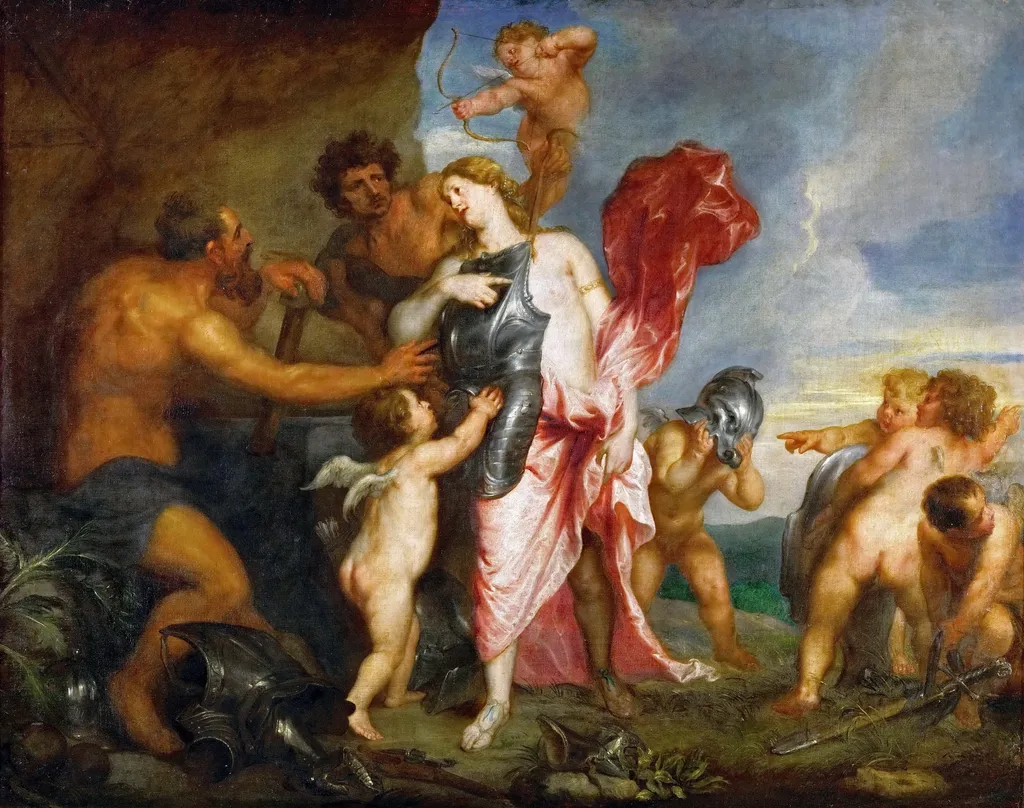
Thetis Receiving the Weapons of Achilles from Hephaestus is an oil painting by the Flemish Baroque painting artist Anthony van Dyck. It dates from 1630 and is held in the collection of the Kunsthistorisches Museum.
About this work
Subject & Meaning
The armor’s intricate decoration, including scenes of war and cosmic order, reflects Hephaestus’s divine skill and foreshadows Achilles’s fate at Troy.
The painting depicts an episode from Homer’s Iliad (Book 18, lines 478–608) in which the sea-nymph Thetis, mother of Achilles, travels to the workshop of Hephaestus to request new armor for her son after the death of Patroclus. The scene centers on Hephaestus’s act of crafting and presenting the weapons, while Thetis receives the completed shield, helmet, and sword. The armor’s intricate decoration, including scenes of war and cosmic order, reflects Hephaestus’s divine skill and foreshadows Achilles’s fate at Troy.
The inclusion of transvestite elements, such as Thetis’s draped attire and Hephaestus’s artisan’s garb, emphasizes the myth’s blend of the heroic and the quotidian, underscoring the divine and mortal realms’ intersection.
Technique & Style
Executed between 1630 and 1632, this mythological work is an oil painting on canvas produced within the workshop of Anthony van Dyck. The composition illustrates a specific episode from Book 18 of the Iliad, depicting Thetis requesting replacement armor, including a shield, helmet, and sword, from Hephaestus for her son Achilles. The visual narrative incorporates elements of transvestism alongside the detailed rendering of body armor.
Measuring 112 cm in height and 142 cm in width, the panel serves as a formal interpretation of classical literature through Flemish Baroque aesthetics.
History & Provenance
The painting was executed in the workshop of Anthony van Dyck between 1630 and 1632, as documented by contemporary records and stylistic analysis. It was likely commissioned by Archduke Leopold Wilhelm of Austria, who acquired the work soon after its creation. The piece entered the Imperial collection and has been part of the Kunsthistorisches Museum in Vienna since that time.
Executed in oil on canvas, the work measures 112 × 142 cm and depicts the mythological scene of Thetis receiving weapons for Achilles from Hephaestus. Its provenance reflects a continuous ownership chain from the artist’s workshop to the archduke and finally to the museum.
The painting is held in the collection of the Kunsthistorisches Museum in Vienna. It entered the museum's holdings after being acquired by Archduke Leopold Wilhelm of Austria. While specific inventory numbers are not detailed in the provided texts, the work is accessible through the museum's image database under artifact ID 650. The sources do not contain information regarding specific exhibitions or a detailed loan history for this artwork.
Overview
This oil painting, titled "Thetis Receiving the Weapons of Achilles from Hephaestus", was created between 1630 and 1632 within the workshop of the Flemish artist Anthony van Dyck. The work depicts a pivotal moment from Homer's Iliad, specifically the eighteenth book, where the sea goddess Thetis seeks new armaments for her son, the hero Achilles. It offers a dramatic interpretation of a classical narrative.
Own this work as a print
Artist & collection
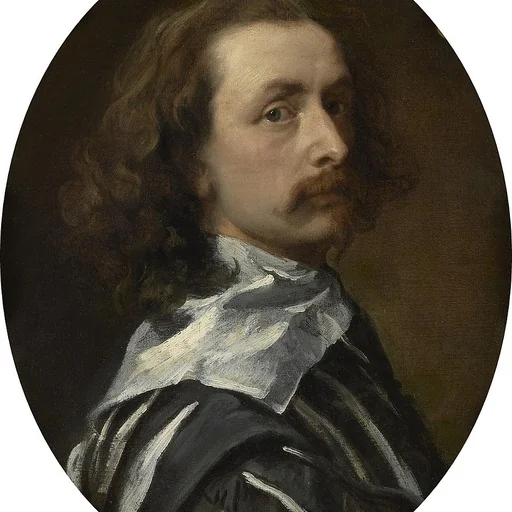
Artist
Sir Anthony van Dyck (; Dutch: Antoon van Dijck; 22 March 1599 – 9 December 1641) was a Flemish Baroque artist, who became the leading court painter in England after success in the Spanish Netherlands and Italy.