Artwork
The Immaculate Conception of Los Venerables
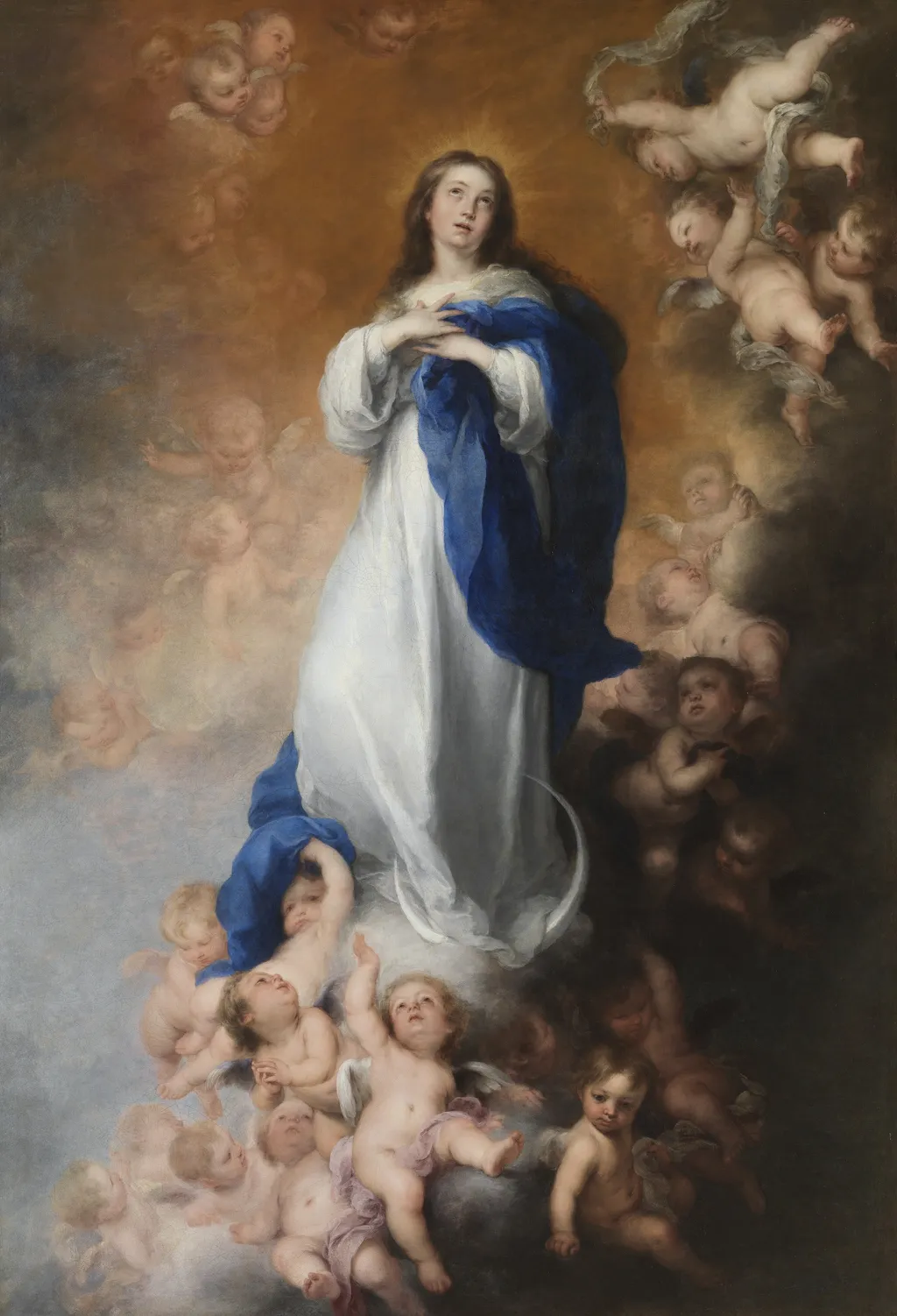
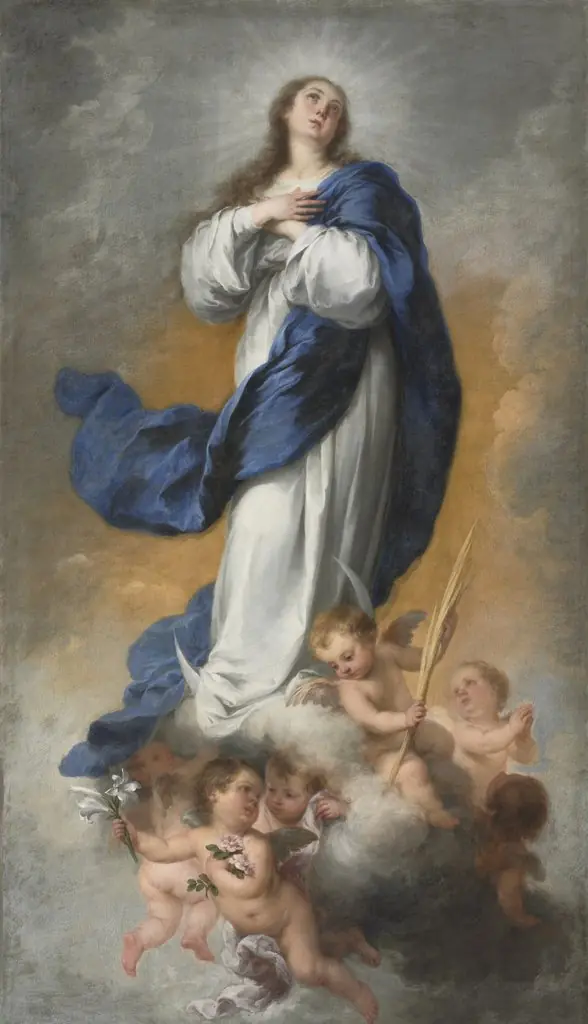
The Immaculate Conception of Los Venerables is an oil painting by the Baroque artist Bartolomé Esteban Murillo. It dates from 1660 and is held in the collection of the Museo del Prado.
About this work
Subject & Meaning
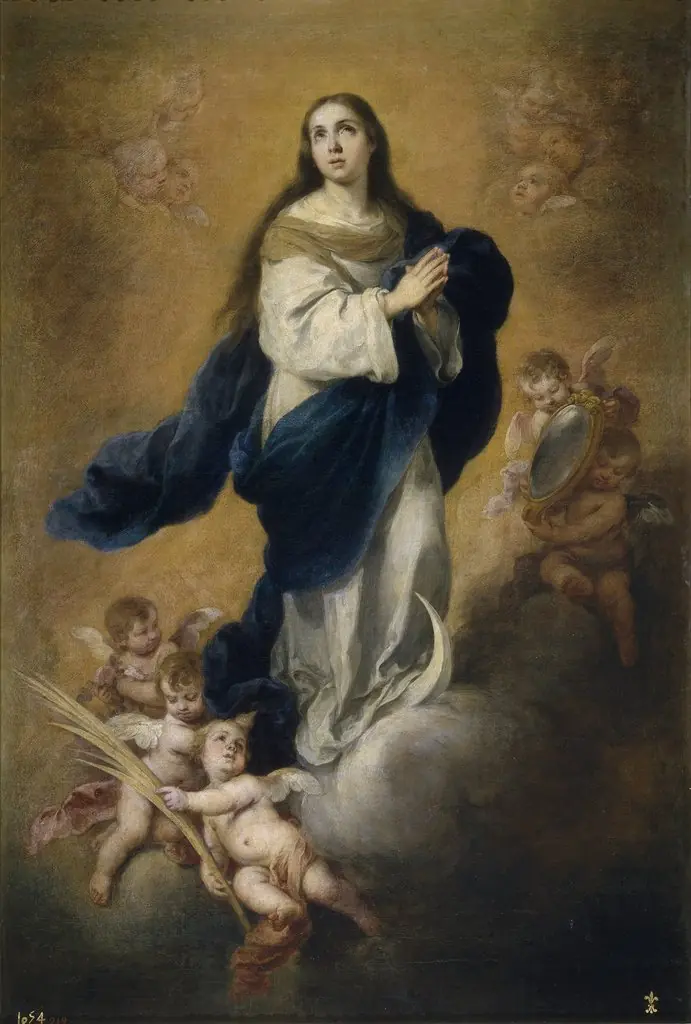
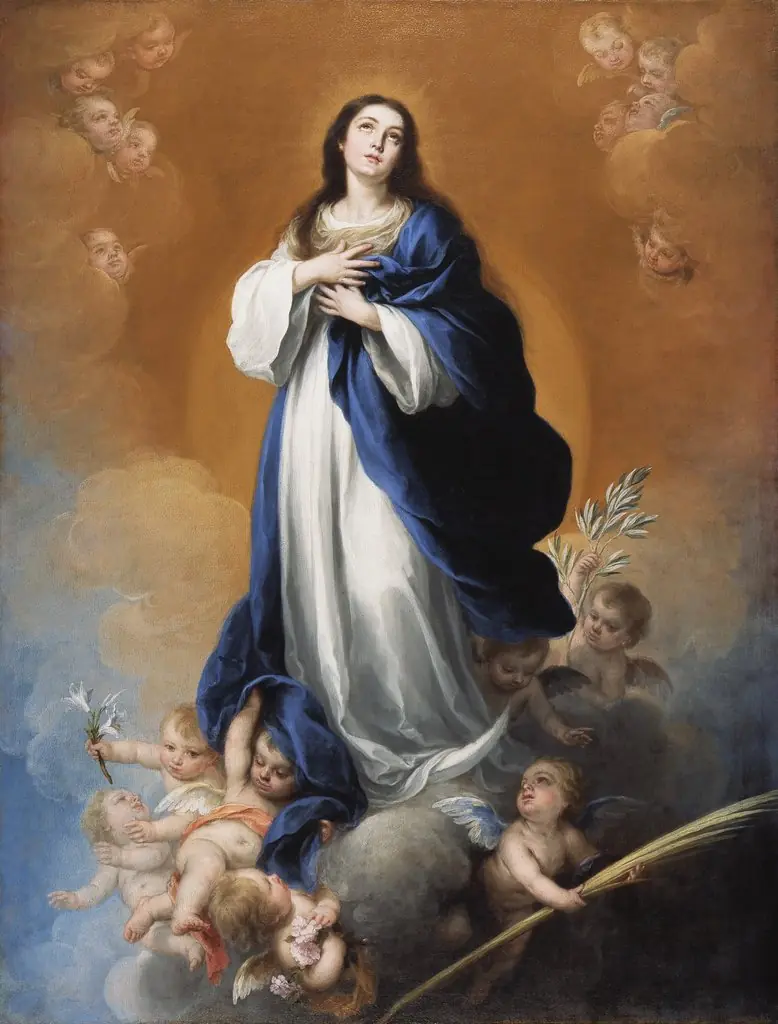
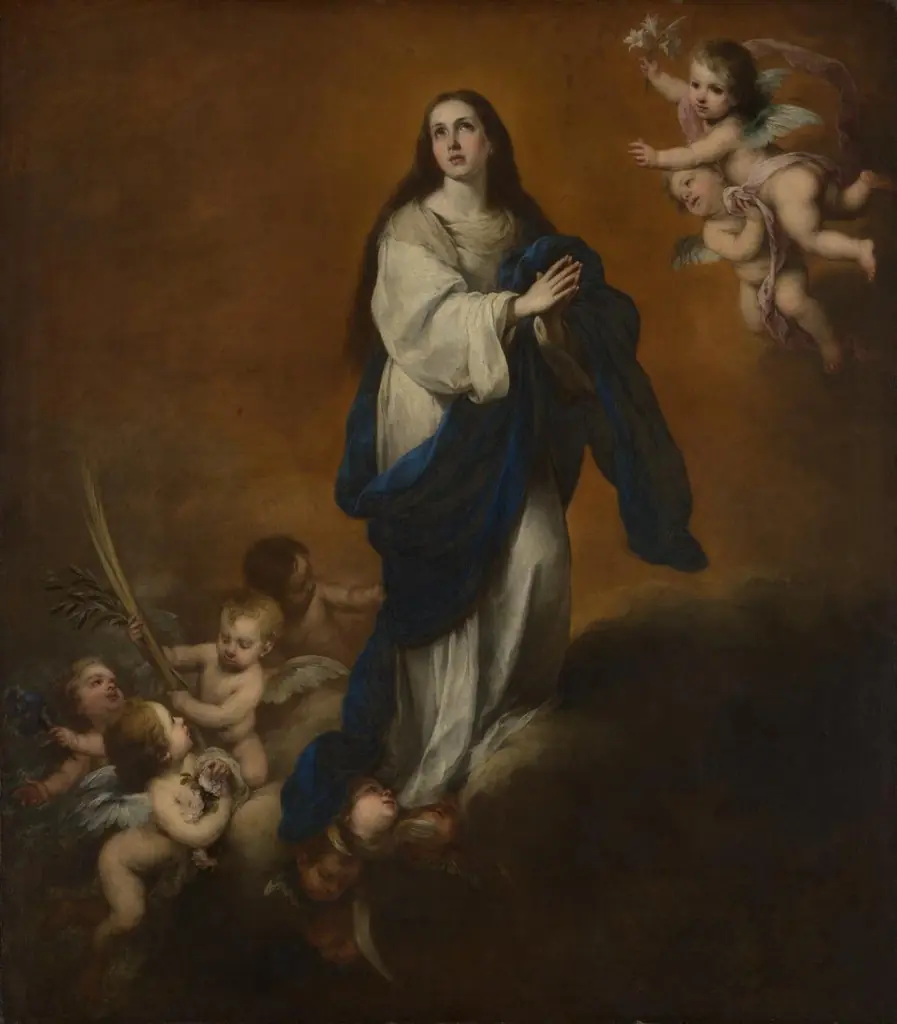
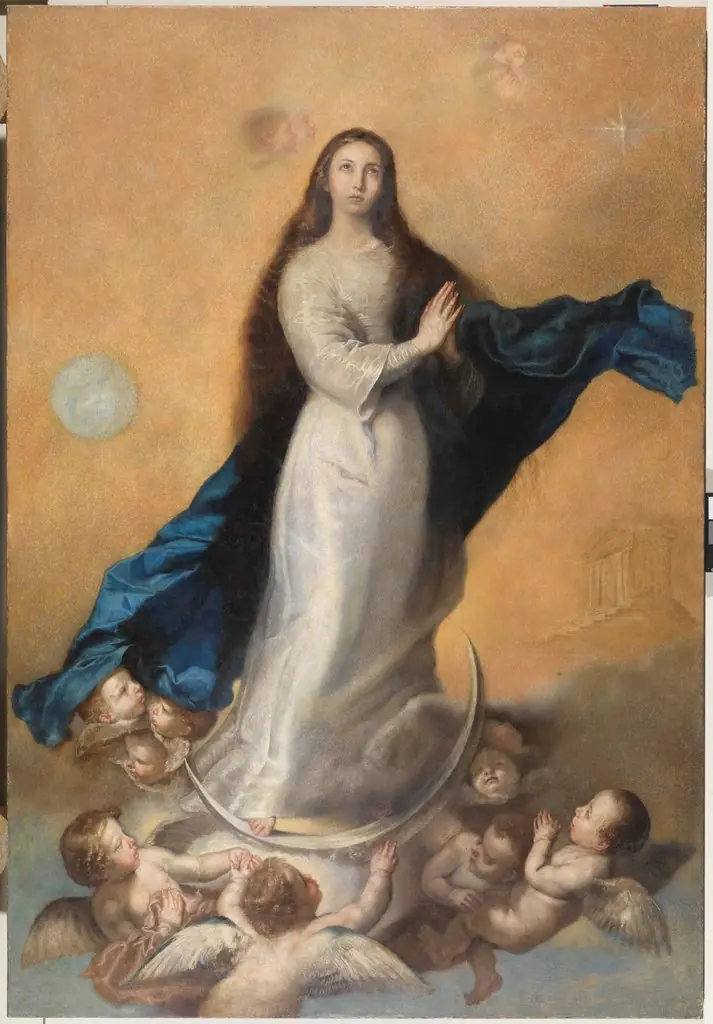
Murillo portrays the Virgin Mary standing on a crescent moon, dressed in a white robe symbolizing purity and a blue mantle representing eternity.
The work depicts the Immaculate Conception of Mary, a subject central to Spanish Catholic devotion in the 17th century. Murillo portrays the Virgin Mary standing on a crescent moon, dressed in a white robe symbolizing purity and a blue mantle representing eternity. Her hands are crossed over her chest, and her gaze is directed upward toward heaven, embodying a triumphant and ascensional tone.
The composition unites the iconography of the Immaculate Conception with that of the Assumption, utilizing a cloud of angels to create a sense of divine movement. Unlike many traditional depictions, the painting omits specific symbolic attributes such as the Tower of David or the serpent; these elements were instead carved into the original frame, which remains in the hospital where the work was first displayed. The figure is rendered with realistic features yet idealized, surrounded by a golden atmosphere that signifies she is clothed in the sun.
Technique & Style
Executed in oil on canvas, this large-scale Baroque painting measures 274 cm in height and 190 cm in width. Created during the artist's late period, the work features a composition defined by a strong ascensional impulse, utilizing light to guide the viewer's eye from the bottom right toward the top left. The Virgin Mary is depicted with a contrapposto stance, dressed in a white robe and a dark blue mantle, surrounded by a celestial atmosphere of clouds and angels.
Murillo employs a loose, dissolved brushstroke technique for the surrounding figures, effectively blending them into the luminous sky while rendering the faces with a realistic yet idealized quality. This handling creates a sense of movement and ethereal light, distinguishing the work through its triumphant tone. The painting has undergone significant conservation, including a superficial restoration in 1981 and a more complex intervention in 2009.
History & Provenance
The Immaculate Conception of Los Venerables was commissioned in 1678 by canon Justino de Neve for the Hospital de los Venerables in Seville and donated there in 1686. Marshal Jean-de-Dieu Soult looted the painting during the Peninsular War in 1813 and took it to France; it remained in his collection until his death in 1851. The work was auctioned in 1852 and purchased by the Louvre for 615,300 francs, then exchanged in 1941 by the Vichy regime for Velázquez's Portrait of Mariana of Austria, returning to Spain and entering the Museo del Prado in 1941. A superficial restoration was performed in 1981 and a more extensive restoration took place in 2007.
The Immaculate Conception of Los Venerables has been held by the Museo del Prado in Madrid since 1941, following its return from France as part of a wartime art exchange. Initially commissioned for the Hospital de los Venerables in Seville, the painting was looted by Marshal Jean-de-Dieu Soult during the Peninsular War in 1813 and taken to France. After Soult’s death in 1851, it was acquired by the Louvre in 1852 for 615,300 francs, the highest price paid for a painting at the time, where it remained until its transfer to Spain.
The work’s accession number at the Prado is not specified in the sources, but it has undergone restoration twice: first in 1981 for a Murillo exhibition, and again in 2007–2009 for a more comprehensive treatment. Its exhibition history includes prolonged display at the Louvre and subsequent inclusion in major retrospectives at the Prado.
Context
Murillo’s late Immaculate Conception of Los Venerables (c. 1678) belongs to a prolific series of around two dozen treatments of the subject, yet it stands apart for its emphatic upward momentum and radiant, triumphant tonality. Scholars note how the artist’s late style shifts from the hieratic solemnity of earlier versions toward a more intimate, atmospheric celestial space densely populated by angelic figures, aligning the Immaculate Conception with the Assumption in a single vision of ascent.
The painting’s history intersects with broader European political and cultural currents. Looted by Marshal Soult during the Peninsular War (1813) and later sold to the Louvre for 615,300 francs in 1852, it became a symbol of Napoleonic spoliation and a record-breaking auction price. By 1941 the Vichy regime exchanged it back to Spain in a state-level deal, reflecting shifting national valuations of Murillo’s religious imagery during the nineteenth and early twentieth centuries.
Within Murillo’s oeuvre, the work exemplifies his mature Sevillian Baroque synthesis of tenebrism and luminous grace, consolidating his reputation as the preeminent exponent of the Immaculate Conception in Spanish art.
Legacy
The Immaculate Conception of Los Venerables became one of Murillo’s most celebrated works, repeatedly invoked in later accounts of Spanish Baroque art. Its prominence grew after it was looted by Marshal Jean-de-Dieu Soult in 1813 and taken to France, where it was purchased by the Louvre in 1852 for the unprecedented sum of 615,300 francs. Honoré de Balzac later singled it out in his writings as a masterpiece worthy of remembrance, underscoring its cultural cachet in 19th‑century Europe.
Its reputation shifted during the 19th and early 20th centuries as Murillo’s style fell from favor relative to Velázquez and Goya. This decline in esteem culminated in its inclusion in a 1941 exchange brokered by the Vichy regime, which returned the painting to Spain in exchange for Velázquez’s Portrait of Mariana of Austria. Since its reinstallation at the Museo del Prado, the work has been treated as a touchstone of Murillo’s late period and a key example of Spanish religious painting, undergoing major restorations in 1981 and 2007–2009 in preparation for exhibitions dedicated to the artist.
Overview
Created around 1678, this large oil canvas by Bartolomé Esteban Murillo measures roughly 274 by 190 centimeters. It depicts a serene female figure in a white mantle and blue cloak, suspended above a gathering of cherubic angels. The composition is dominated by a luminous glow that contrasts with a darker backdrop, emphasizing the central figure’s ethereal presence.
Own this work as a print
Artist & collection
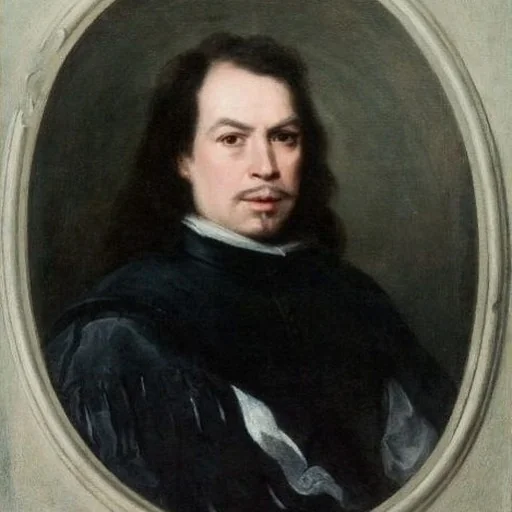
Artist
Bartolomé Esteban Murillo ( mure-IL-oh, m(y)uu-REE-oh, Spanish:; late December 1617, baptised 1 January 1618 – 3 April 1682) was a Spanish Baroque painter.