Artwork
The Infant Saint John Playing with a Lamb
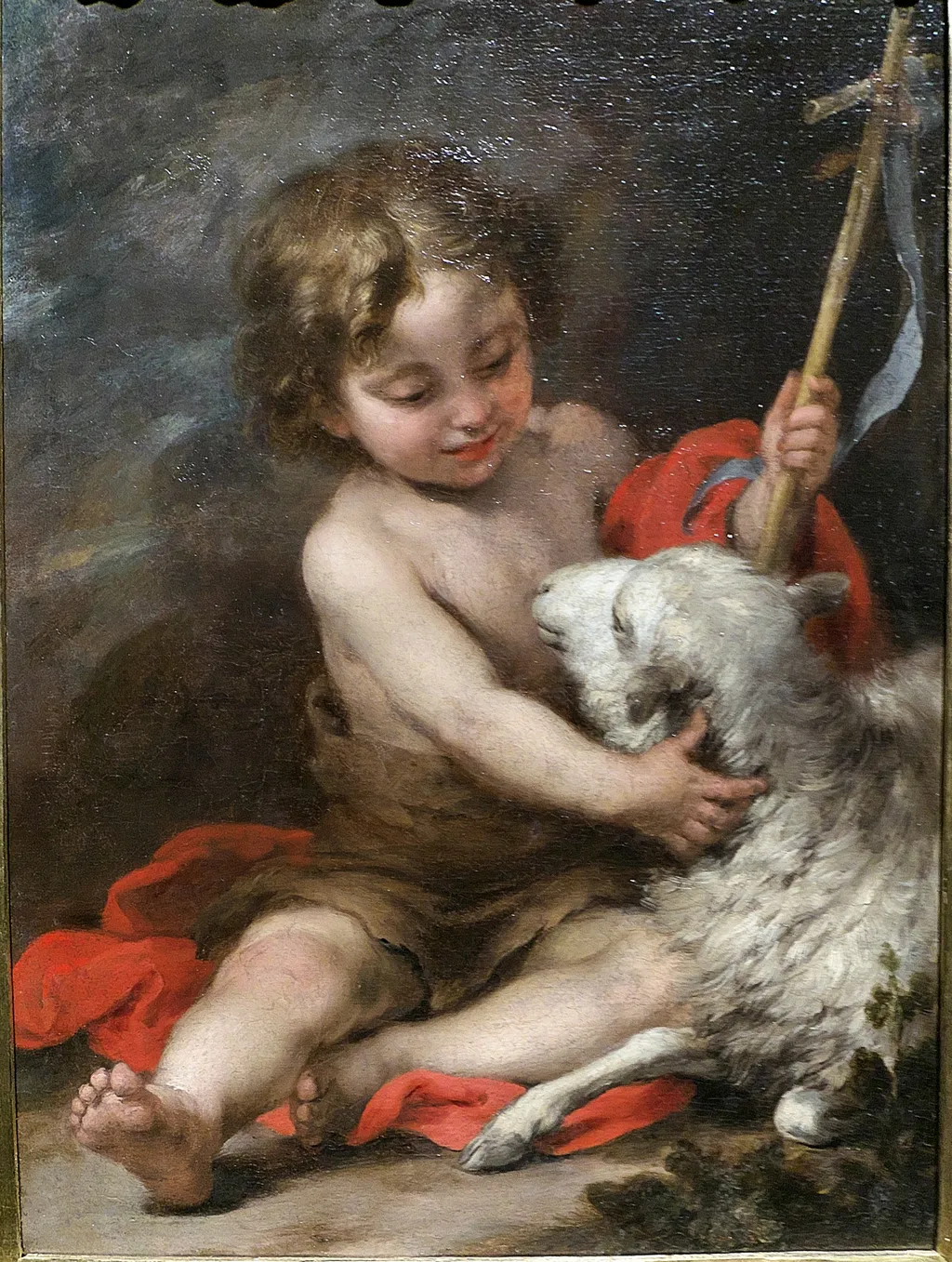
The Infant Saint John Playing with a Lamb is an oil painting by the Spanish Baroque Tenebrist artist Bartolomé Esteban Murillo. It dates from 1675 and is held in the collection of the National Gallery of Ireland.
About this work
Overview
The painting is held in the collection of the National Gallery of Ireland in Dublin, having previously been owned by Grigory Kushelev-Bezborodko.
The Infant Saint John Playing with a Lamb is an oil painting on canvas by the Spanish Baroque artist Bartolomé Esteban Murillo, dated to 1675. Measuring 61 by 44 centimetres, the work depicts the young Saint John the Baptist seated on the ground embracing a lamb, holding a staff topped with a small cross. The painting is held in the collection of the National Gallery of Ireland in Dublin, having previously been owned by Grigory Kushelev-Bezborodko. The work exemplifies Murillo's celebrated ability to merge tender human sentiment with profound religious symbolism, a quality that made his images among the most popular in Catholic Europe and beyond during the seventeenth century and for centuries thereafter.
Subject & Meaning
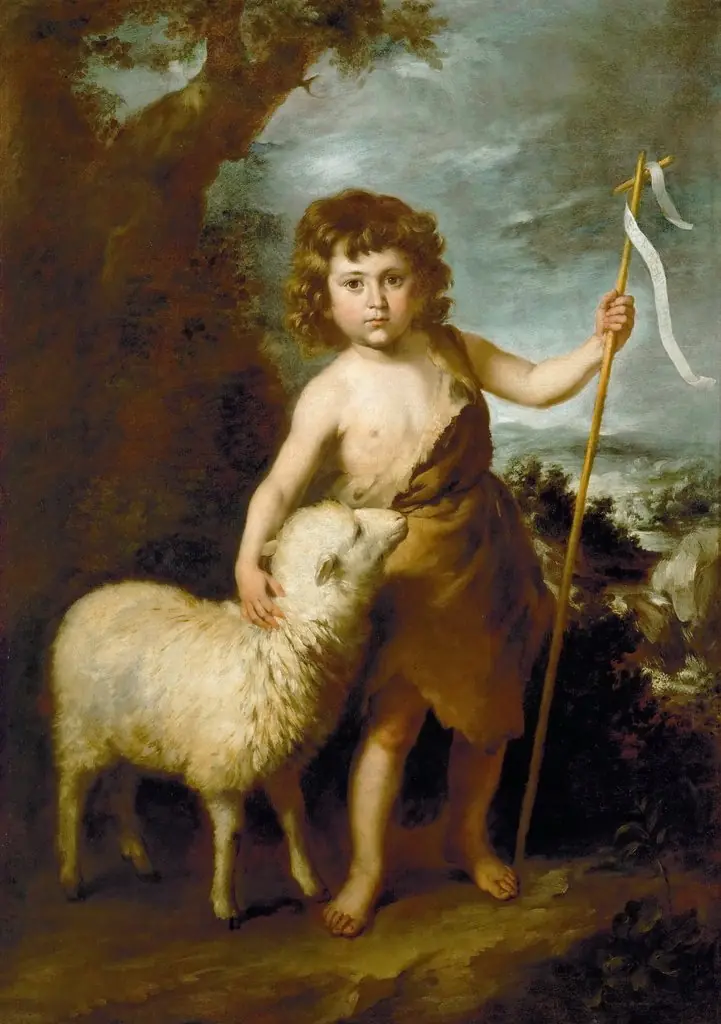
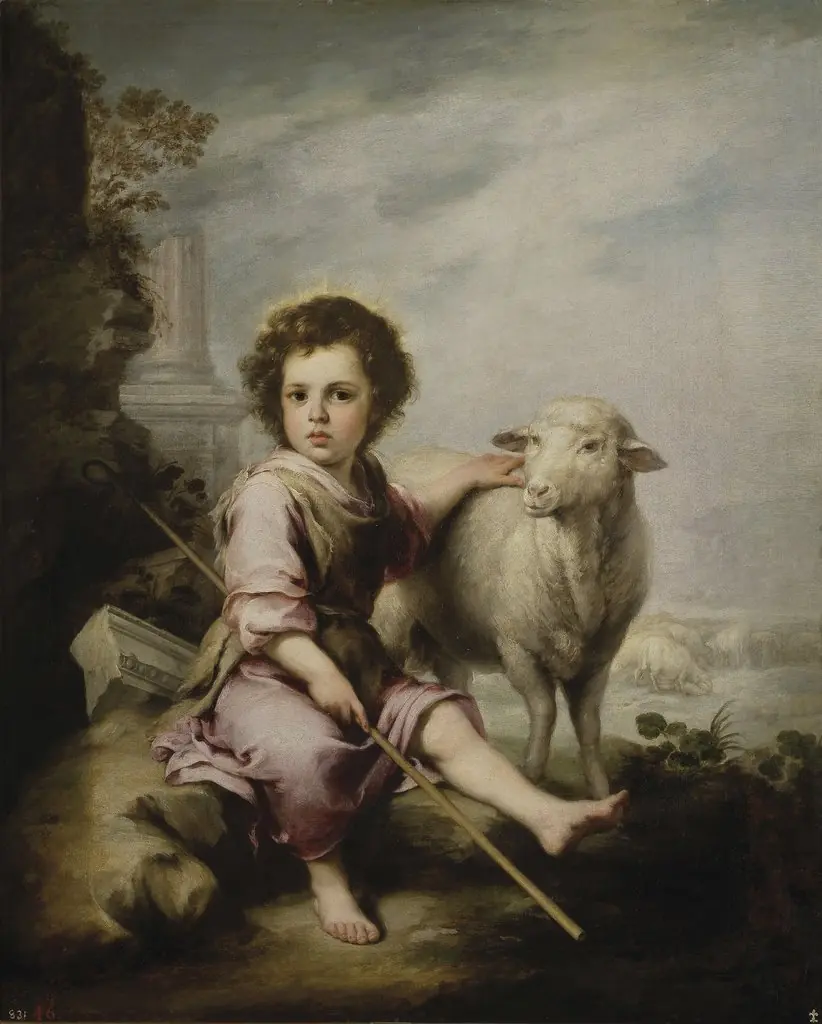
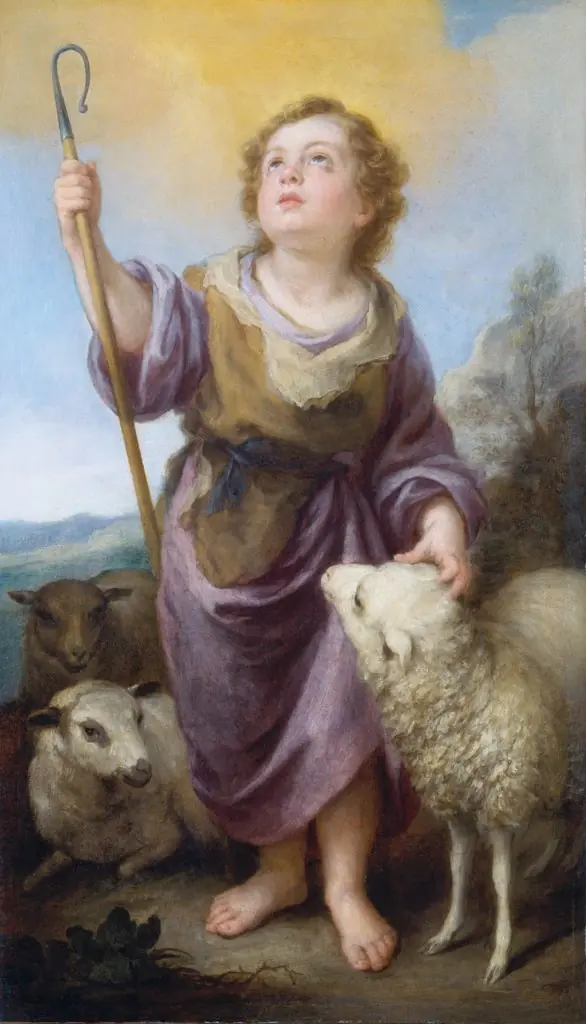
The painting portrays the infant Saint John the Baptist in a wilderness setting, identifiable by his traditional attributes and the rocky, indistinct landscape that surrounds him. He wears a brown animal-skin loincloth and a vivid vermilion cloak that drapes across his lap and falls onto the ground. In his left hand he grasps a wooden staff, described in some sources as bamboo, fashioned in the form of a cross. His right arm encircles the neck of a white lamb that nestles beside him. The lamb carries multilayered significance in Christian iconography: it represents Christ in his sacrificial role, alluding to the Gospel of John where the Baptist declares, 'Behold the Lamb of God, which takes away the sin of the world.' This proclamation, inscribed in Latin on ribbons in related works, establishes the spiritual bond between the two figures. The scene thus foreshadows both John's future role as herald of Christ and the passion that both would eventually endure. Murillo's treatment transforms a doctrinally complex theme into an intimate, emotionally accessible image of childhood innocence charged with eschatological meaning.
Technique & Style
Murillo executed the painting in oil on canvas, working with the smooth, blended brushwork characteristic of his mature style. The flesh tones are rendered with careful modulation between light and shadow, while the lamb's wool and the background receive looser, more textured handling. A bright red cloth provides the principal chromatic accent against the muted brown and gray tones of the landscape and the warm flesh palette. Soft light enters from the upper left, illuminating the child's face and shoulder and the lamb's back, creating gentle shadows beneath the figures. The paint surface exhibits fine craquelure throughout, consistent with its age. The overall finish is polished, with transitions carefully controlled to achieve an idealised naturalism. This combination of tangible physical presence and spiritual atmosphere typifies Murillo's approach, which the Museo del Prado has noted made him a forerunner of eighteenth-century painting techniques in his rich tonalities and fluid paint application.
History & Provenance
The painting is dated to 1675, placing it in Murillo's mature period when he had already established his reputation as one of Spain's foremost painters. The work was formerly owned by Grigory Kushelev-Bezborodko, a Russian diplomat and collector, before entering the collection of the National Gallery of Ireland, where it remains today. Its relatively modest dimensions, 61 by 44 centimetres, suggest it was likely intended for private devotional use rather than as a large altarpiece. This accords with Murillo's broader practice of creating religious images that suited the luxurious interiors of wealthy and devout Sevillian patrons. While specific exhibition history for this particular canvas is not recorded in the available sources, Murillo's works of this type circulated widely and were frequently reproduced in engravings, contributing to his international fame. The National Gallery of Ireland's online collection database documents the work as part of their permanent holdings.
Context
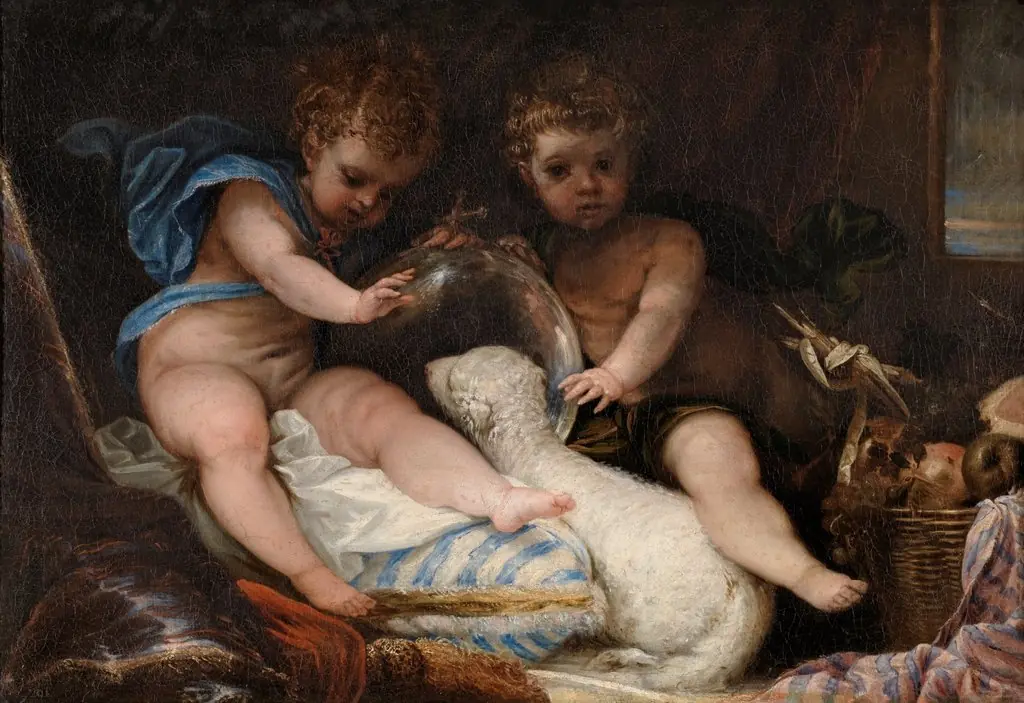
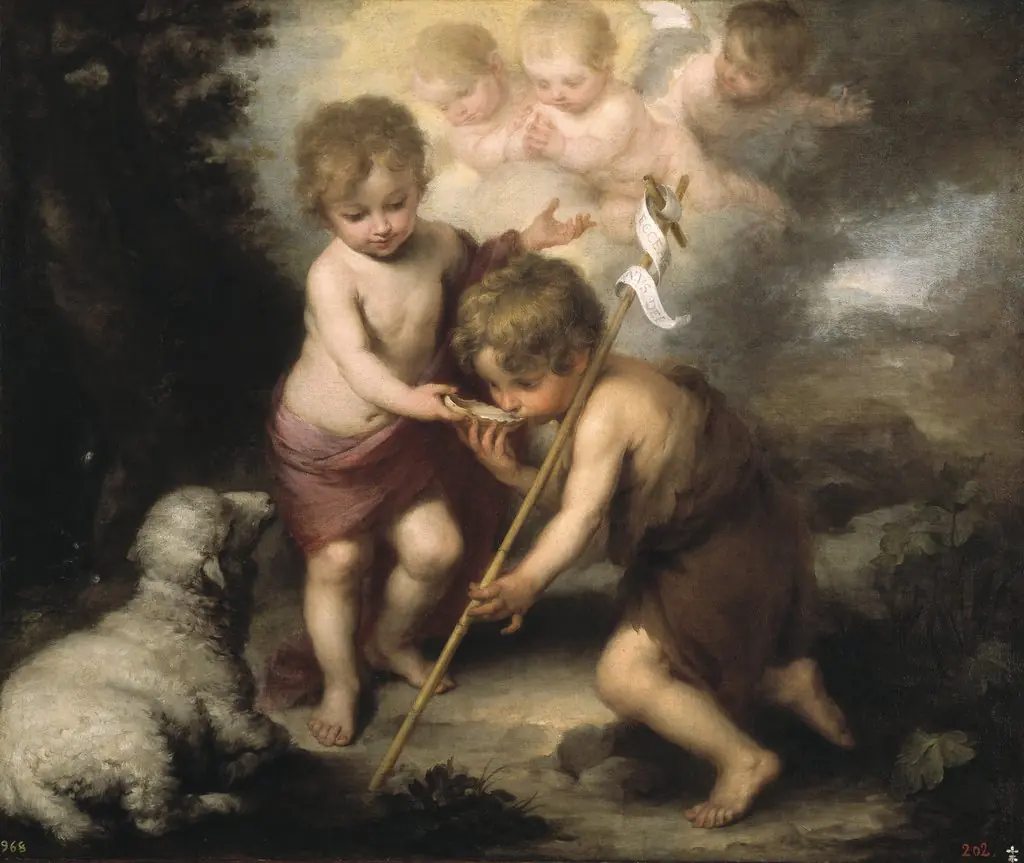
Murillo worked in Seville during the height of the Spanish Golden Age, a city marked by fervent Catholic devotion and significant social inequality. The Counter-Reformation Church actively encouraged art that fostered affective piety, inviting believers to meditate on the humanity of Christ and the saints. Scenes of sacred childhood, including images of the infant John the Baptist, served this purpose perfectly by presenting divine figures in familiar, emotionally accessible situations. Murillo's particular gift lay in his ability to render complex theological concepts in immediately comprehensible and sincere images that appealed directly to human emotions. His style was enormously attractive to cultivated travellers; as Joseph Townsend recorded, 'no other Spaniard has equalled him in expression and sweetness.' The subject of the infant John with a lamb, while not strictly biblical, had become established in Catholic devotional practice. Francisco Pacheco, in his 1649 treatise El arte de la pintura, noted that Christ and John the Baptist did not actually meet until adulthood, yet the popularity of such childhood scenes reflected a broader devotional desire to imagine the human lives of sacred figures. Murillo's treatment of this theme must be understood alongside his related compositions, including the celebrated Infant Christ and Saint John the Baptist with a Shell in the Museo del Prado, which similarly combines childhood intimacy with profound sacramental meaning.
Legacy
Murillo's images of sacred childhood, including The Infant Saint John Playing with a Lamb, achieved extraordinary popularity from their creation and remained influential for centuries. The Catholic Church utilised his images for three centuries following his death, testament to their effectiveness as devotional tools. His works were collected by major patrons such as Justino de Neve, canon of Seville Cathedral, and Nicolas Omazur, and their appeal extended far beyond Spain. The numerous engravings after his compositions attest to their wide circulation and the demand they generated among international collectors and devotees. This particular painting's subsequent ownership by Grigory Kushelev-Bezborodko illustrates the reach of Murillo's reputation into Russian aristocratic collecting circles. Today, the work's placement in the National Gallery of Ireland ensures its continued accessibility to scholars and the public, preserving its place within the broader narrative of European Baroque painting. Murillo's legacy rests on his unique capacity to make the mysteries of faith approachable through tenderness and beauty, a quality that continues to define his significance in the history of art.
Own this work as a print
Artist & collection
Artist
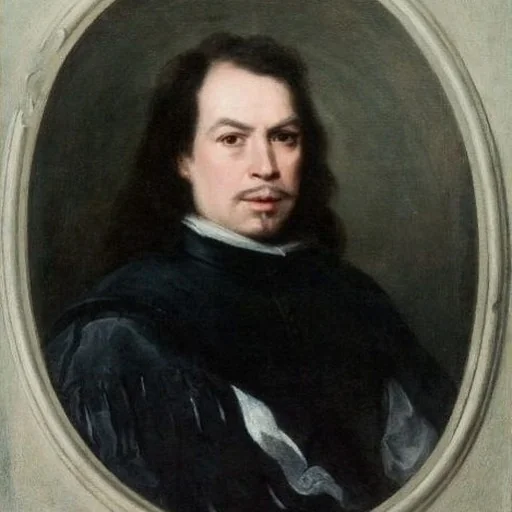
Bartolomé Esteban Murillo ( mure-IL-oh, m(y)uu-REE-oh, Spanish:; late December 1617, baptised 1 January 1618 – 3 April 1682) was a Spanish Baroque painter.