Artwork
The Handsome Dance - Goo-a-give
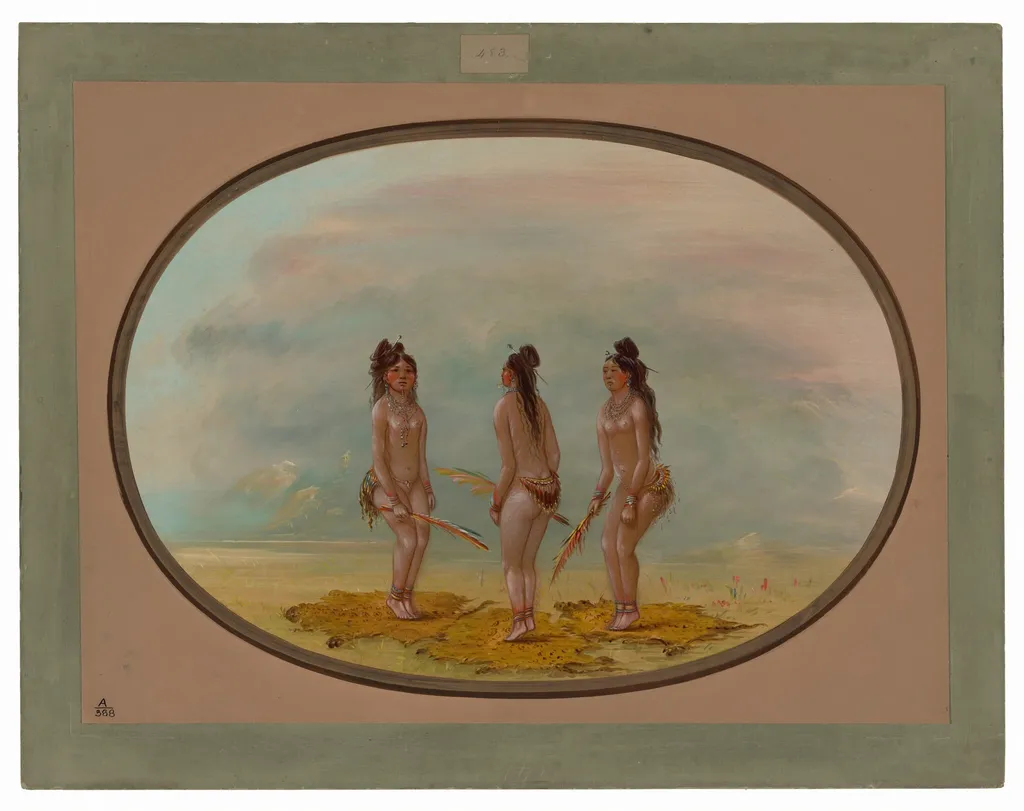
The Handsome Dance - Goo-a-give is an oil painting by the Impressionist artist George Catlin. It dates from 1862 and is held in the collection of the National Gallery of Art. Created in 1862, The Handsome Dance – Goo‑a‑give is an oil painting on card that has been mounted on paperboard.
About this work
Overview
It belongs to Catlin's second major body of work, the Cartoon Collection, which documented Indigenous peoples of the Americas.
The Handsome Dance - Goo-a-give is a genre scene painting by the American artist George Catlin, dated between 1854 and 1869. Executed in oil on card mounted on paperboard, the work measures 45.8 by 62.5 centimeters. It belongs to Catlin's second major body of work, the Cartoon Collection, which documented Indigenous peoples of the Americas. The painting is currently held in the National Gallery of Art in Washington, D.C., under accession number 1965.16.256.
Subject & Meaning
The painting depicts three young women of the Gooagive people of Venezuela performing a ceremonial dance known as the Mach-e-o-a. According to Catlin's 1871 catalog entry for the work, the chief selected these women to perform the dance for the artist. The figures stand nude with their bodies covered in pipe clay, giving them a statuesque appearance. They wear elaborate necklaces, multiple bracelets, anklets, and small fringed hip garments, while two hold feathered ceremonial objects with red, yellow, and green plumage. Catlin noted that their toes rested on tiger skins and remained unseparated from the ground as they moved gracefully to the beating of a drum.
History & Provenance
Created during the 1850s and 1860s as part of Catlin's Cartoon Collection, the painting remained with the artist until his death in 1872. It then descended to his daughters, Clara Gregory Catlin, Louise Catlin Kinney, and Elizabeth Wing Catlin. In 1912, the American Museum of Natural History in New York purchased the work from Elizabeth Wing Catlin. When the museum deaccessioned parts of the collection, Paul Mellon acquired it in 1959 through Kennedy Galleries in New York. Mellon gifted the painting to the National Gallery of Art in 1965. It has since been exhibited internationally, including shows in Nashville in 1971, Wilkes-Barre in 1973, Washington in 1980, Mexico City, Buenos Aires, and Santiago from 1989 to 1990, Oneonta in 1992, and Coral Gables in 1994.
Context
This work belongs to Catlin's Cartoon Collection, his second major project comprising over 600 works created during the 1850s and 1860s. This followed his earlier Indian Gallery, a collection of more than 500 paintings from the 1830s now largely housed at the Smithsonian American Art Museum. Catlin spent his career documenting Indigenous cultures he believed were vanishing due to American expansion, traveling extensively and publishing his observations. He faced considerable financial difficulties and struggled to sell his first collection to the United States government. He exhibited the Cartoon Collection in New York in 1871, publishing a descriptive catalog that provided the ethnographic details for this painting, but the endeavor failed to yield substantial financial returns.
Legacy
The painting has been featured in National Gallery of Art publications, including illustrated catalogues from 1970, 1980, and 1992, cementing its place in the institutional record of American art. As part of the 351 Cartoon Collection works gifted by Paul Mellon, it contributes to the broader historical and ethnographic understanding of South American Indigenous cultures as recorded by Catlin. The 1989 to 1990 traveling exhibition to Mexico City, Buenos Aires, and Santiago, organized by the United States Information Agency, specifically highlighted Catlin's South American subjects, bringing this visual record of the Gooagive people to audiences in the regions the artist originally visited.
Own this work as a print
Artist & collection

Artist
George Catlin ( KAT-lin; July 26, 1796 – December 23, 1872) was an American lawyer, painter, author, and traveler, who specialized in portraits of Native Americans in the American frontier.

 Bulls Fighting
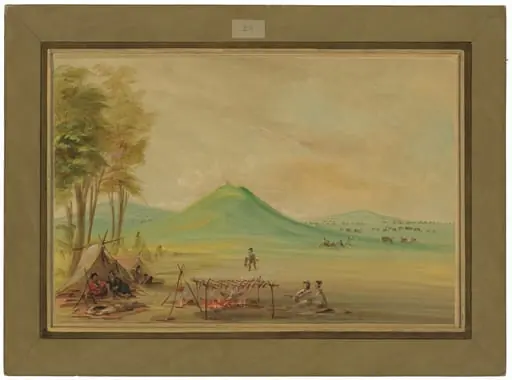 Expedition Encamped on a Texas Prairie. April 1686
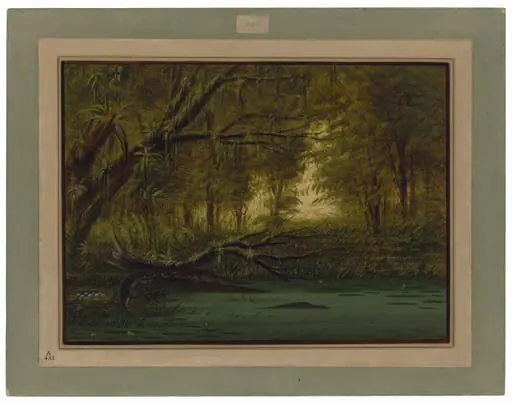 An Alligator's Nest
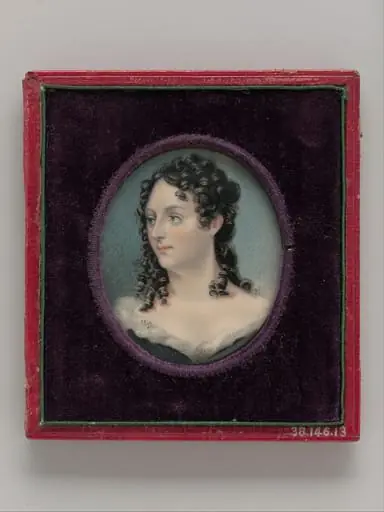 Mrs. George Catlin (Clara Bartlet Gregory)
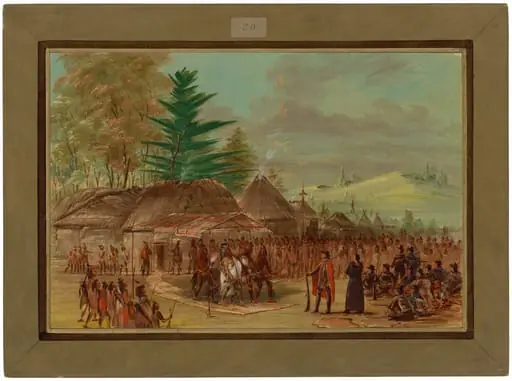 Chief of the Taensa Indians Receiving La Salle. March 20, 1682
 A Small Village - Payaguas Indians
 Omaha Chief, His Wife, and a Warrior
 Father Hennepin Leaving the Mississippi to Join La Salle. May 8, 1680