Artwork
Etretat, Rough Seas
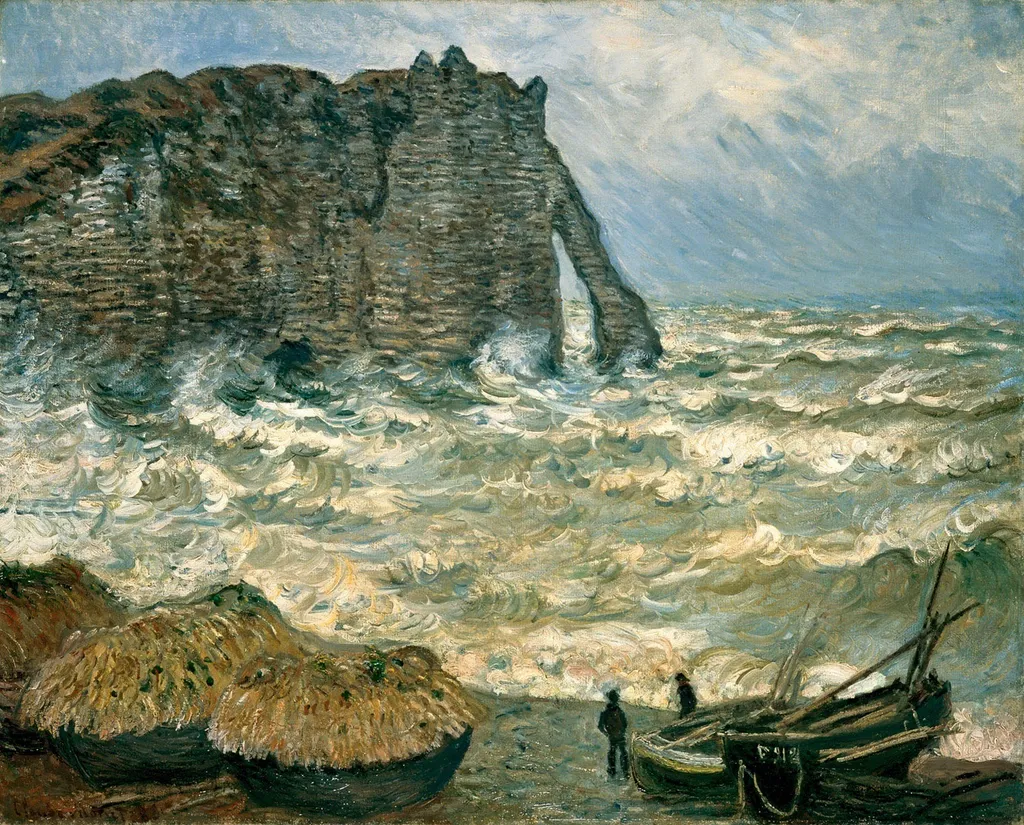
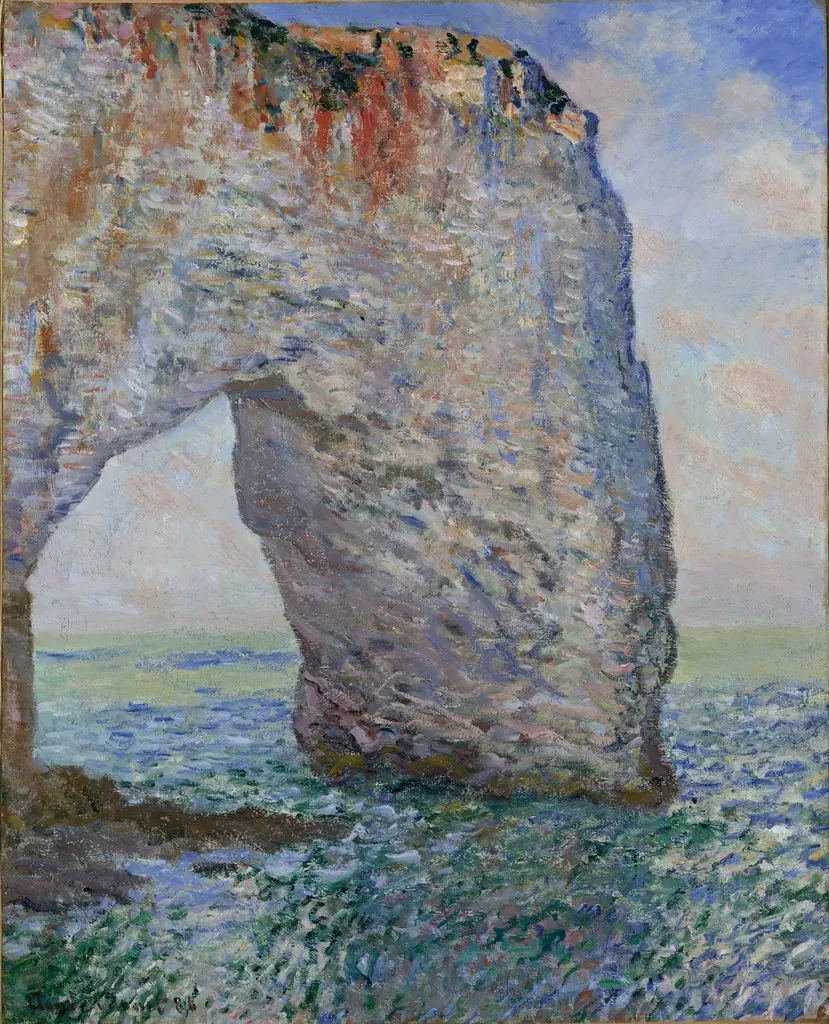
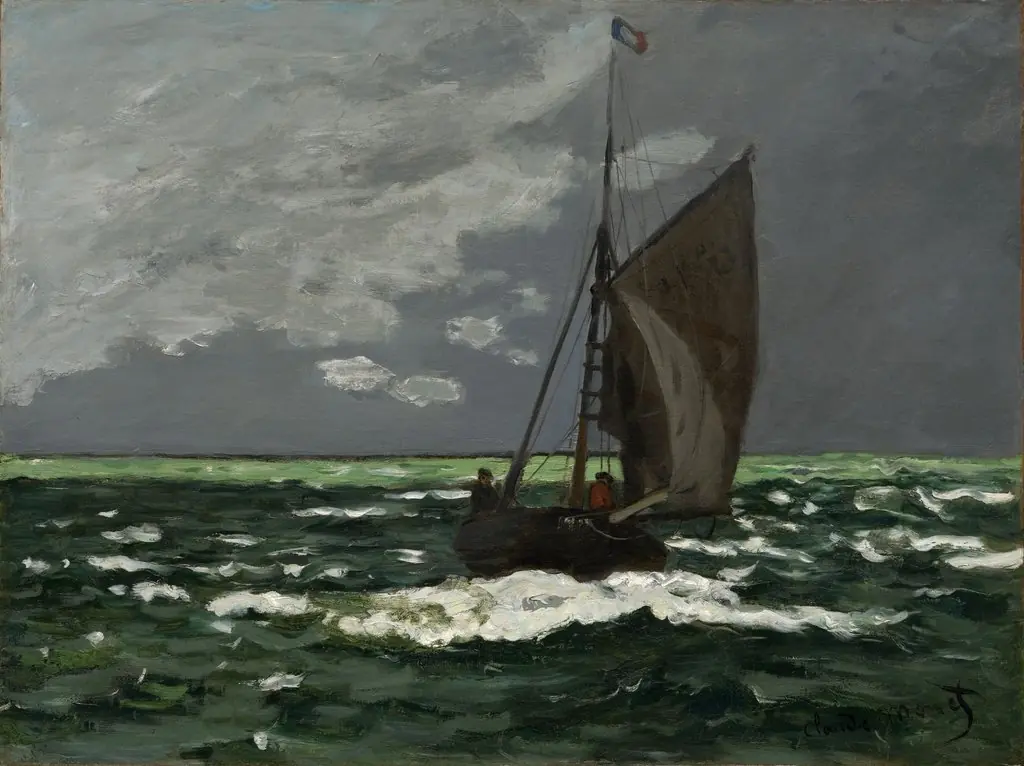
Etretat, Rough Seas is an oil painting by the Impressionist artist Claude Monet. It dates from 1892 and is held in the collection of the Museum of Fine Arts of Lyon.
About this work
Historians see this series as a turning point, moving from his early Impressionist style toward a deeper focus on light and atmosphere.
Etretat, Rough Seas is an oil painting by Claude Monet, made in 1883. It shows the chalk cliffs of Étretat on the French coast.
The work is part of a series of about fifty paintings Monet did of the same cliffs. He was interested in how light and weather change a place. Historians see this series as a turning point, moving from his early Impressionist style toward a deeper focus on light and atmosphere.
Museum of Fine Arts of Lyon.
Subject & Meaning
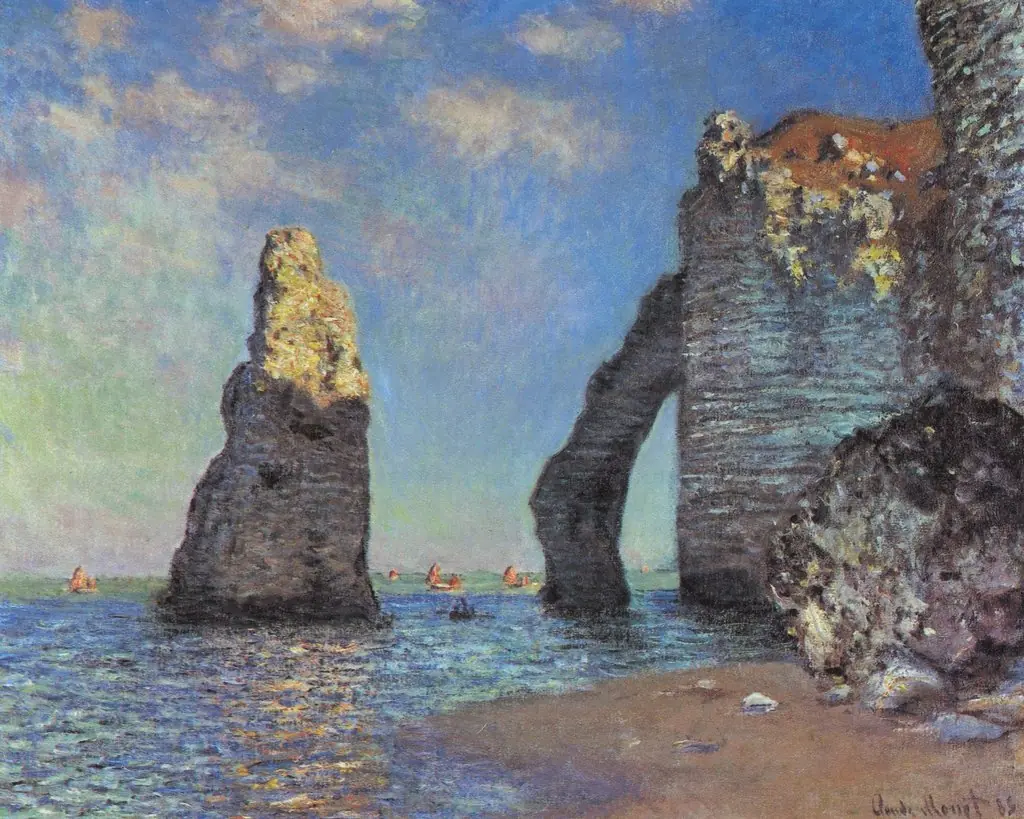
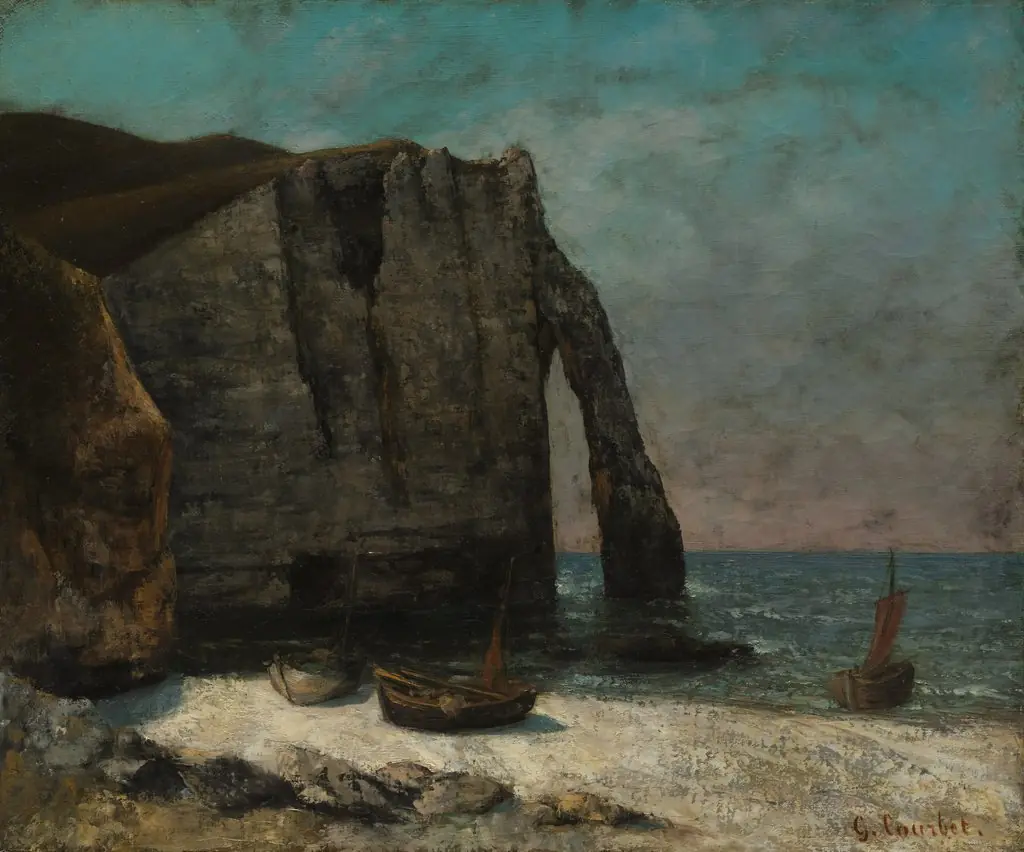
Monet’s Etretat, Rough Seas (1883) depicts the Normandy coast’s dramatic geology and volatile maritime conditions. The composition centers on the Porte d’Aval, the sea arch at Étretat, framed by the towering chalk cliffs and the churning English Channel. Two local men stand beside a grounded fishing boat, anchoring the scene in lived experience and providing a measure of the sea’s force.
The work belongs to Monet’s Étretat series, where he isolated natural elements, cliffs, arches, waves, and sky, to explore the mutable effects of light and weather. By minimizing human presence in later canvases, he emphasized the elemental dialogue between rock, sea, and atmosphere, capturing a place both timeless and transient.
Technique & Style
Executed in 1883, Etretat, Rough Seas is an oil painting on canvas measuring 80 cm in height. The work exemplifies Monet's plein-air method, where rapid adjustments were made to capture shifting weather and tides before further refinement occurred in the studio. The artist employed exposed, individual brushwork characteristic of early Impressionism; thick strokes define the mass of the cliffs, while broken, directional marks evoke the shimmering light on the sea.
This handling merges the external scene with subjective perception, utilizing a palette that generally favors subdued tones, though specific canvases incorporate intense, chemically derived pigments for heightened contrast. The composition demonstrates a balance between the spontaneity of direct observation and deliberate structural planning, such as the placement of related hues to maintain coherence without abrupt transitions.
History & Provenance
Claude Monet executed this oil painting in 1883 during his repeated visits to the Normandy coast between 1883 and 1886. The artist's signature and the date appear in the lower left corner of the canvas. The work entered the collection of the Museum of Fine Arts of Lyon in 1902, acquired directly from the Durand-Ruel gallery in Paris. It is catalogued as number 821 in Daniel Wildenstein's authoritative raisonné of Monet's oeuvre.
Claude Monet's Etretat, Rough Seas (1883) is held by the Museum of Fine Arts of Lyon in France. The museum acquired the painting in 1902 from the Parisian gallery Durand-Ruel. In the Wildenstein Institute catalogue raisonné, the work is listed under number 821.
The painting has appeared in numerous exhibitions since its acquisition. It was included in the 1941 exhibition in Grenoble dedicated to the fiftieth anniversary of Jongkind's death and the 1948 XXIV Venice Biennale. Later showings featured the 1957 Royal Scottish Academy exhibition in Edinburgh, the 1980 retrospective at the Grand Palais in Paris, and the 1989 presentation of Masterpieces of the Museum of Lyon in Lausanne and Tokyo.
The work also traveled to Birmingham in 1991 for an exhibition of French Impressionist treasures from the Midlands.
Context
Claude Monet’s 1883 oil painting Etretat, Rough Seas, housed in the Museum of Fine Arts of Lyon, emerged during a pivotal phase of his career when his focus shifted from Impressionist experimentation to sustained exploration of light, atmosphere, and serial observation. Part of a series of approximately fifty works depicting Étretat’s chalk cliffs, natural arches such as the Porte d’Aval, and turbulent seas, the painting reflects Monet’s matured approach to plein-air painting, often reworking outdoor sketches in his Giverny studio to capture shifting weather and tide conditions. Contemporary accounts note his reliance on dealer Paul Durand-Ruel for financial and material support, while his letters reveal frustrations with the site’s rapidly changing conditions and domestic pressures within his blended family in Giverny.
The work was exhibited in Paris in the mid-1880s through Durand-Ruel’s efforts and later acquired by the Museum of Fine Arts of Lyon in 1902, where it became part of the institution’s distinguished Impressionist collection. Art historians regard the Étretat series as a bridge between Monet’s earlier Impressionist output and his later, more abstracted studies of natural forms, influencing the trajectory of modern landscape painting.
Legacy
Art historians regard the Étretat series, which includes this 1883 work, as a pivotal stage in Claude Monet's career. These paintings mark the transition from his earlier Impressionist practices to the sustained observation of light and atmosphere that defined his later output. Since its acquisition by the Museum of Fine Arts of Lyon in 1902, the painting has been extensively reproduced and analyzed in scholarly literature.
It appeared in major exhibitions, including the 1948 Venice Biennale and the 1980 retrospective at the Grand Palais in Paris. The work is also cited in significant studies regarding Monet's engagement with the Normandy coast and the development of modern landscape painting.
Overview
Claude Monet’s 1883 oil painting titled Etretat, Rough Seas portrays the chalk cliffs of the Normandy town of Étretat. Executed in oil on canvas, the work belongs to a larger group of roughly fifty paintings in which Monet returned repeatedly to the same coastal scene, exploring its changing light and weather.
Own this work as a print
Artist & collection
Artist
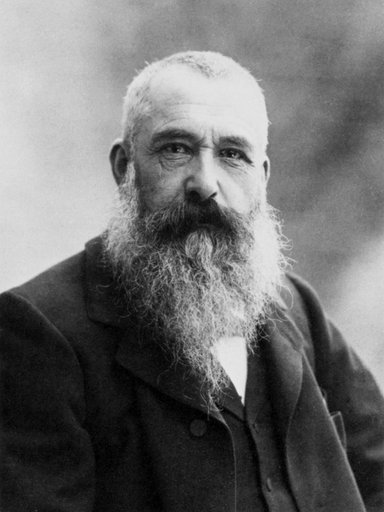
Oscar-Claude Monet was a French painter and founder of Impressionism who is seen as a key precursor to modernism, especially in his attempts to paint nature as he perceived it.