Artwork
The Luncheon
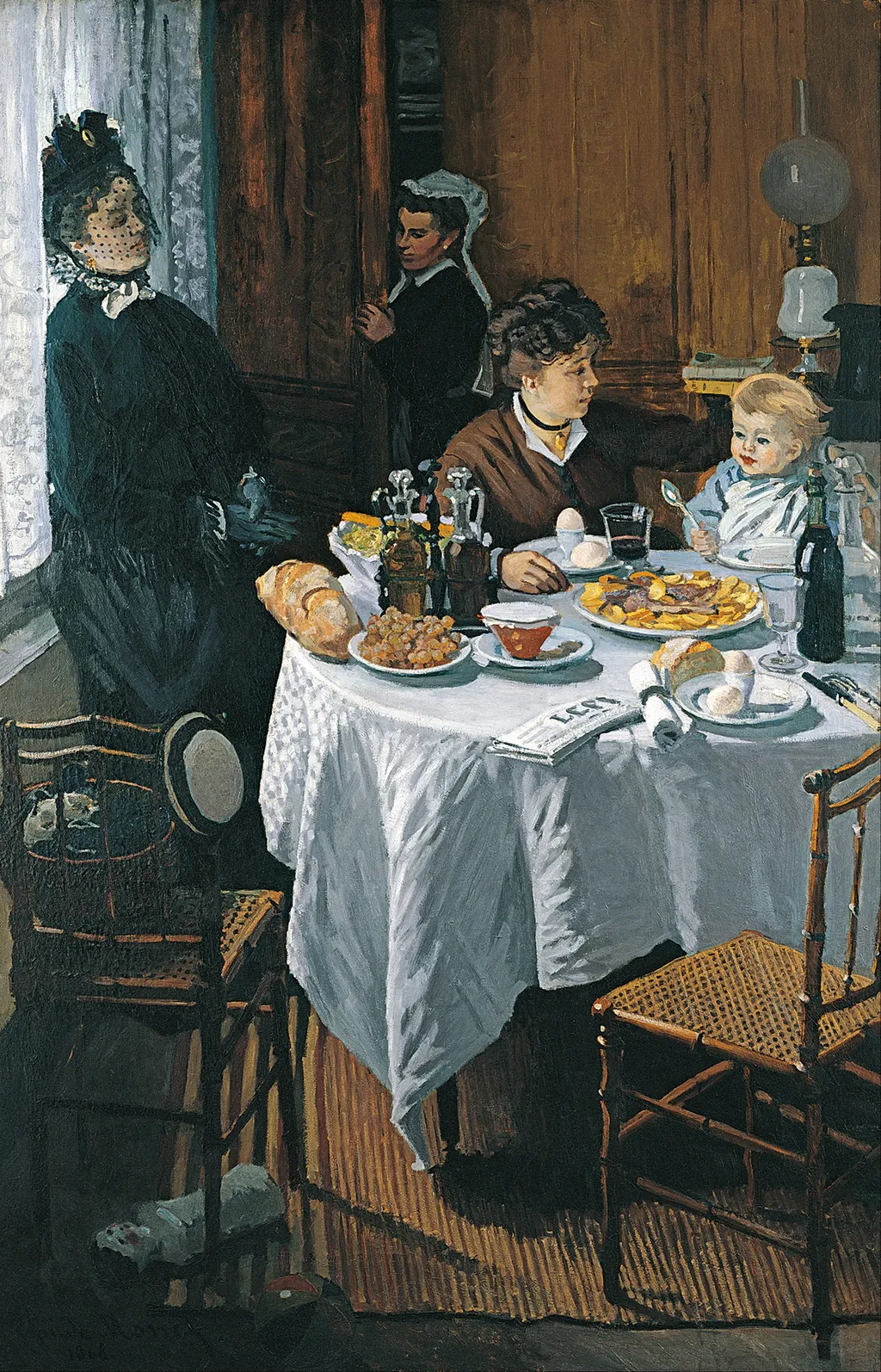
The Luncheon is an oil painting by the Realist artist Claude Monet. It dates from 1868 and is held in the collection of the Städel Museum.
About this work
Subject & Meaning
This arrangement transforms the genre scene into a self-referential family image, capturing an intimate moment of daily life during a stay in Normandy.
The work depicts a domestic lunch scene set in Étretat, featuring the artist's wife, Camille Doncieux, and their son, Jean Monet. The composition centers on a table laden with food, including lamb chops, potatoes, bread, grapes, and hard-boiled eggs. A third figure, likely Camille serving as a model for a visitor, stands by a window looking down at the table, while a servant appears in a doorway in the background.
The painting functions as a family portrait where an empty chair in the foreground, accompanied by a folded newspaper, suggests the presence of the father, Claude Monet himself, awaiting his meal. This arrangement transforms the genre scene into a self-referential family image, capturing an intimate moment of daily life during a stay in Normandy.
Technique & Style
Executed between 1868 and 1869, The Luncheon is a large-scale vertical composition painted in oil on canvas. The work measures 231.5 cm in height and 151.5 cm in width, establishing a monumental format for a domestic genre scene. Monet utilized this expansive support to depict a detailed family meal, arranging figures and objects such as a white tablecloth, food items, and furniture within an interior space.
Stylistically, the painting functions as both a genre scene and a family portrait, capturing specific individuals including the artist's wife and son. The composition features a seated mother and child at a table laden with victuals, while a standing female figure leans against a window on the left, and a servant appears in a doorway at the rear. An empty chair in the foreground implies the presence of the father, completing the domestic narrative through spatial arrangement rather than explicit depiction.
History & Provenance
The Luncheon was painted by Claude Monet in 1868, with the work completed the following year during a stay at Étretat in Normandy. The painting depicts a domestic meal featuring Monet's wife Camille Doncieux and their young son Jean, with an empty chair in the foreground reserved for the artist himself, signaled by a folded newspaper placed on the table.
The work was rejected by the organizers of the Salon of 1870 and was not shown publicly in Paris until 1874, when it was included in the first exhibition of the Impressionist painters.
The painting was acquired in 1910 and has been held by the Städel Museum in Frankfurt am Main, Germany, ever since.
The Luncheon is housed in the Städel Museum in Frankfurt, where it has been part of the museum’s collection since its acquisition in 1910. The painting entered public view after being rejected by the Paris Salon of 1870 and subsequently shown at the inaugural Impressionist exhibition held in 1874. Its early display history thus reflects the shifting acceptance of Impressionist works, moving from a Salon refusal to inclusion in the first dedicated Impressionist exhibition.
Context
Claude Monet's The Luncheon (1868–1869) occupies a significant place in the artist's development of genre scenes and family portraiture during the Second Empire. The work was initially rejected by the organizers of the Salon of 1870, preventing its immediate public debut in Paris. Consequently, it gained historical prominence only when it was exhibited at the first Impressionist exhibition in 1874, marking a key moment in the movement's public presentation.
The painting depicts a domestic interior in Étretat featuring Monet's wife, Camille Doncieux, and their son, Jean, alongside a visiting friend and a servant. By excluding the artist himself from the canvas while implying his presence through an empty chair and a folded newspaper, the composition reflects a specific familial dynamic. Since its acquisition in 1910, the work has been held by the Städel Museum in Frankfurt, serving as a documented example of Monet's early exploration of domestic life and his eventual break from the official Salon system.
Legacy
The Luncheon’s rejection by the Salon of 1870 and subsequent inclusion in the first Impressionist exhibition of 1874 solidified its role in the movement’s early public reception. By the early twentieth century, the painting had entered the Städel Museum in Frankfurt, anchoring its place in institutional art history and shaping its reception as a quintessential Impressionist domestic scene.
Its vertical format, intimate yet structured composition, and focus on family life became touchstones for later Impressionist genre works, influencing artists who sought to elevate everyday scenes into subjects worthy of serious artistic treatment. The painting’s later influence is most visible in the way it has been studied and exhibited as a manifesto of Impressionist ideals, particularly in surveys of the movement’s domestic and familial themes.
Overview
Painted in 1868, The Luncheon is a significant genre scene by Claude Monet that captures an intimate domestic moment within a bourgeois interior. The composition centers on a small wooden table draped in a white cloth, laden with plates and cutlery, around which a family gathers. A woman in a brown dress occupies the central position, gazing toward a young boy who holds a spoon, while a girl in a white cap stands near a window that provides the primary light source.
An older woman in black leans against the wall in the background, adding depth to the spatial arrangement. Executed in oil paint, the work demonstrates Monet's early mastery of natural light and his ability to render everyday life with immediacy, anticipating the techniques that would define Impressionism. Created just before his major breakthrough with Impression, Sunrise, this painting reflects the artist's focus on modern life and his experimentation with capturing fleeting moments of light and atmosphere within a confined space.
It stands as a crucial example of his pre-Impressionist development, bridging the gap between academic realism and the emerging avant-garde style.
Own this work as a print
Artist & collection
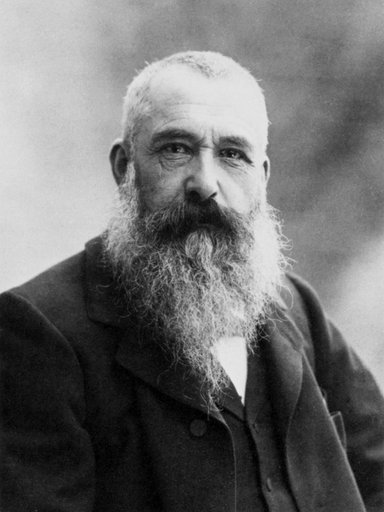
Artist
Oscar-Claude Monet was a French painter and founder of Impressionism who is seen as a key precursor to modernism, especially in his attempts to paint nature as he perceived it.