Artwork
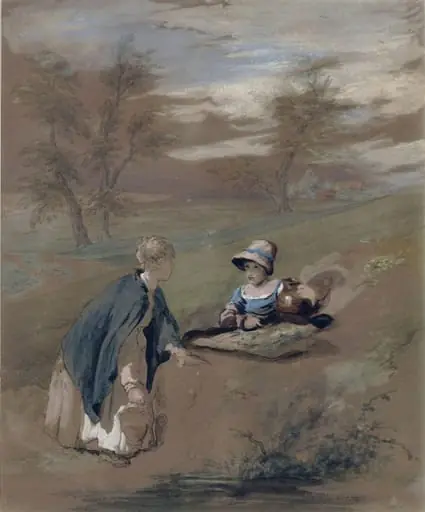
Madame Stumpf and Her Daughter
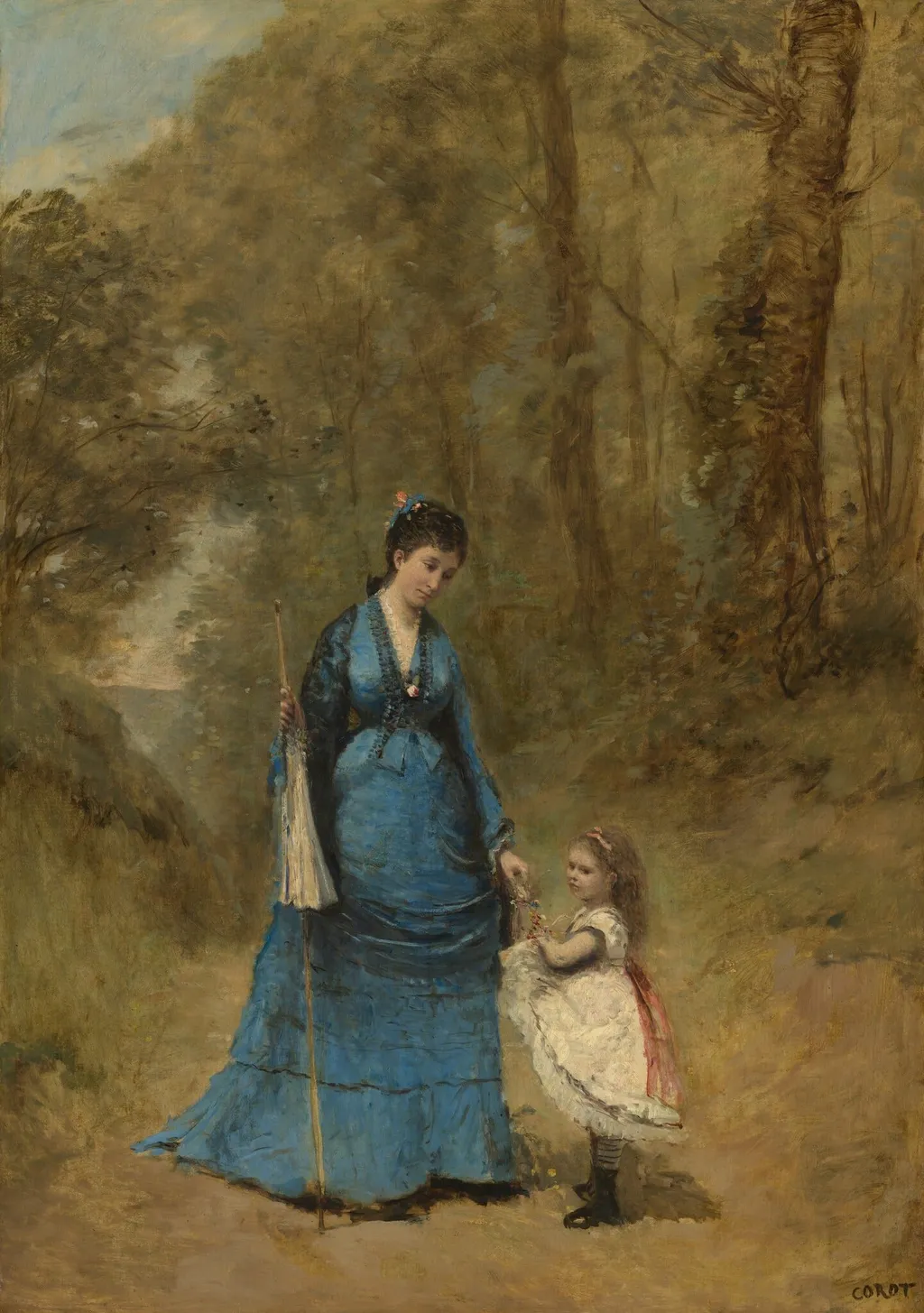
Madame Stumpf and Her Daughter is an oil painting by the Impressionist artist Jean Baptiste Camille Corot. It dates from 1872 and is held in the collection of the National Gallery of Art.
- Inscription
- Inscribed:lower right: COROT
About this work
Subject & Meaning
The painting depicts Madame Stumpf and her daughter, identified as Mme Barbier de Saint Hilaire, née Madeleine Stumpf, who was the child portrayed in the work.
The painting depicts Madame Stumpf and her daughter, identified as Mme Barbier de Saint Hilaire, née Madeleine Stumpf, who was the child portrayed in the work. Created in 1872 as an oil on canvas portrait, the piece captures the two figures in a domestic setting typical of Corot's intimate family studies. The subject matter centers on the maternal bond and the identity of the Stumpf family, with the child later becoming a known figure in the painting's provenance history.
The work represents a personal commission or gift, as it was originally given by the artist to Monsieur F. Stumpf, reflecting the close relationship between Corot and his subjects.
Technique & Style
Madame Stumpf and Her Daughter is an oil on canvas, classified as a portrait painting. The work is executed on a canvas support measuring 105 by 74 centimeters. Corot's handling reflects the refined, painterly approach associated with his late portrait practice, in which the sitter and her child are rendered with softened contours and a delicate tonal range rather than sharply defined detail.
The painting's stylistic qualities are consistent with Corot's characteristic treatment of figure subjects, where atmospheric subtlety and gentle modeling of light take precedence over linear precision.
The provenance record indicates the canvas remained in good condition through successive ownerships, including its confiscation in 1940 and recovery in 1947, with no reported damage or restoration interventions noted in the documentation.
History & Provenance
Painted in 1872, Madame Stumpf and Her Daughter is a portrait by Jean-Baptiste-Camille Corot depicting the artist’s pupil Zacharie Birtschansky’s wife and their child.
The work was given by Corot to Monsieur F. Stumpf and remained with the Stumpf family at least until the 1906 dispersal of their collection in Paris. It later passed to Madeleine Stumpf, the daughter depicted, before being sold by 1922 to Tedesco Frères and Paul Rosenberg & Co. During World War II the painting was confiscated from the Rosenberg holdings in France in 1940 and recovered in 1947.
By about 1965 it belonged to E.V. Thaw & Co., New York, before passing through Thomas Agnew & Sons in March 1966 to Ailsa Mellon Bruce, who bequeathed it to the National Gallery of Art, Washington, D.C., in 1970.
Madame Stumpf and Her Daughter is held by the National Gallery of Art in Washington, D.C., where it entered the collection as a bequest from Ailsa Mellon Bruce in 1970. The work was acquired by Bruce on March 26, 1966, following its sale by Thomas Agnew and Sons in London. Prior to this, it passed through the hands of E.V. Thaw & Co. and the dealers Tedesco Frères and Paul Rosenberg.
During World War II, the painting was confiscated from the Rosenberg collection in France in September 1940 and later returned to the owners in 1947 after being traced to a Swiss collection. The artwork was originally given by the artist to Monsieur F. Stumpf and remained with the Stumpf family until at least 1906.
Context
Madame Stumpf and Her Daughter (1872) is regarded as a quiet, psychologically nuanced portrait that exemplifies Corot’s later genre work. Scholars highlight its subtle handling of light and intimate domestic subject as characteristic of his transition toward plein-air naturalism while retaining studio refinement. The painting’s provenance reflects a complex post-war trajectory, including confiscation during World War II, restitution to the Rosenberg collection, and eventual acquisition by the National Gallery of Art in 1970.
Its inclusion in major sales records from 1906 through 1966 underscores its documented journey from the Stumpf family to private dealers and, ultimately, public collection.
The work is frequently cited in studies of Corot’s portraiture as a bridge between academic tradition and emerging Impressionist sensibilities, contributing to broader reassessments of 19th-century French genre painting. Its presence in the National Gallery of Art’s collection has enabled sustained scholarly attention to Corot’s role in shaping modern portraiture, particularly in the depiction of bourgeois domestic life.
Overview
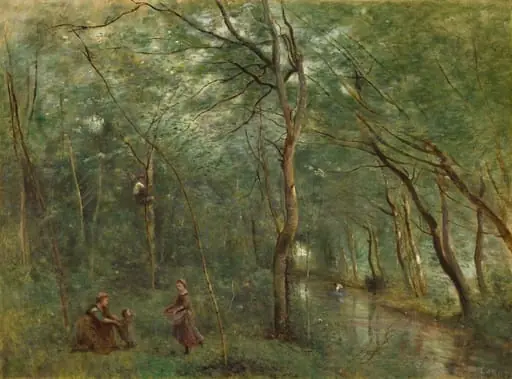
Jean-Baptiste-Camille Corot painted Madame Stumpf and Her Daughter in 1872. Executed in oil on canvas, the work presents a mother and child positioned on a rural path framed by trees. The figures are rendered with a gentle, atmospheric quality that reflects Corot’s late style, situated between classical portraiture and the nascent Impressionist approach.
Own this work as a print
Artist & collection
Artist
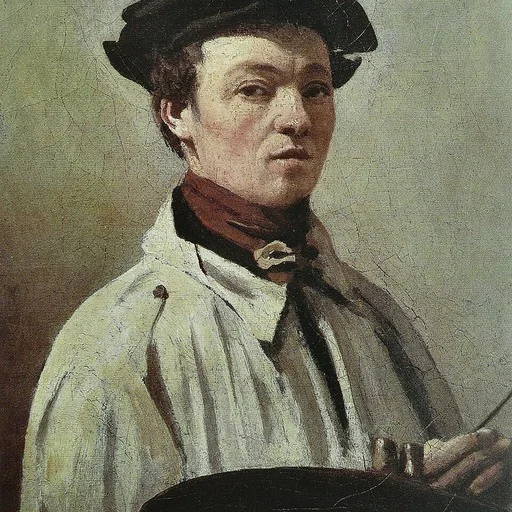
Jean-Baptiste-Camille Corot (UK: KORR-oh, US: kə-ROH, kor-OH; French:; 16 July 1796 – 22 February 1875), or simply Camille Corot, was a French landscape and portrait painter as well as a printmaker in etching.