Artwork
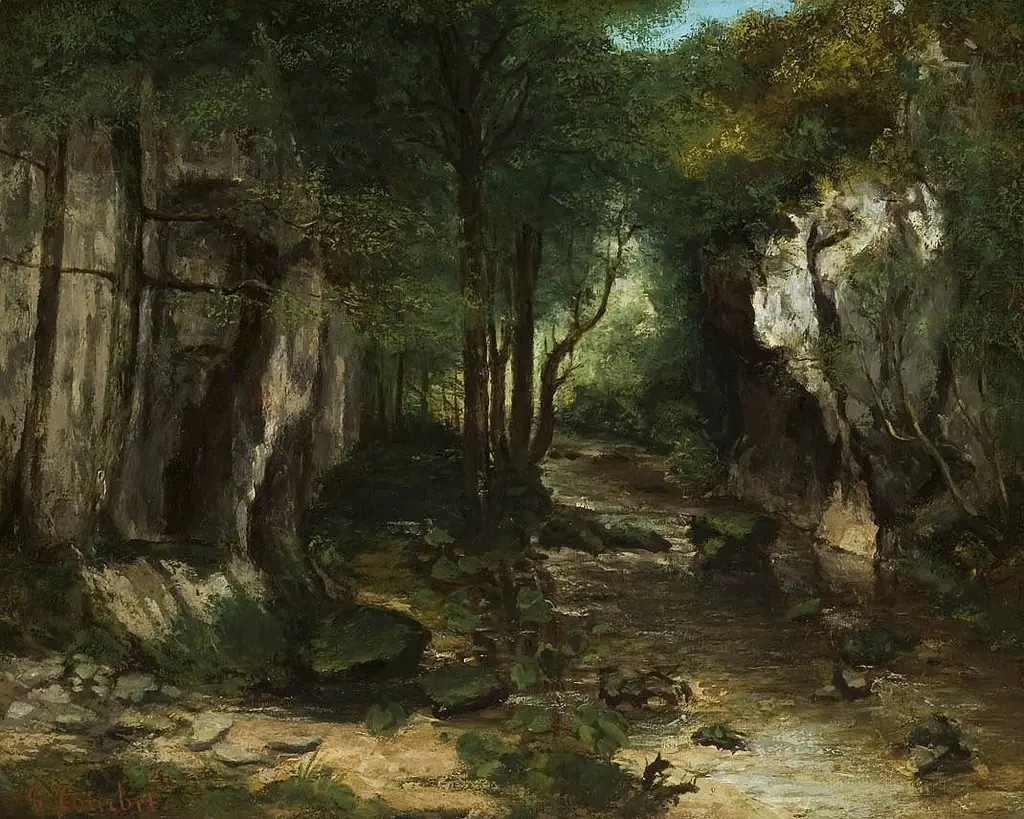
The Stream (Le Ruisseau du Puits-Noir; vallée de la Loue)
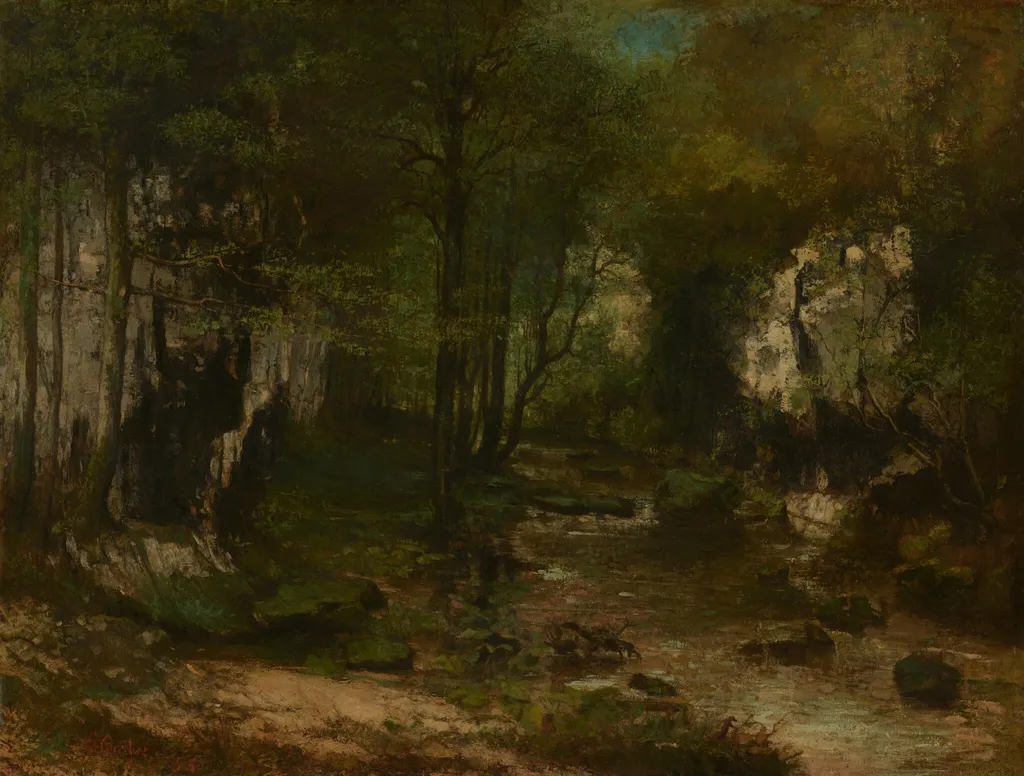
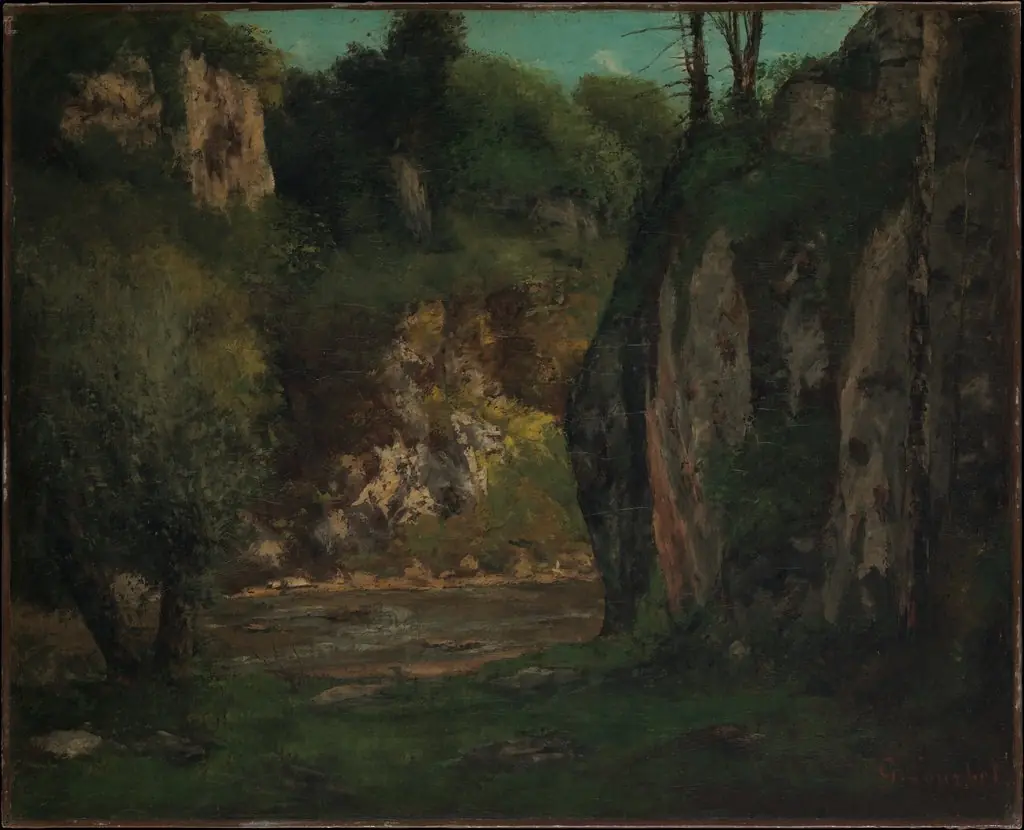
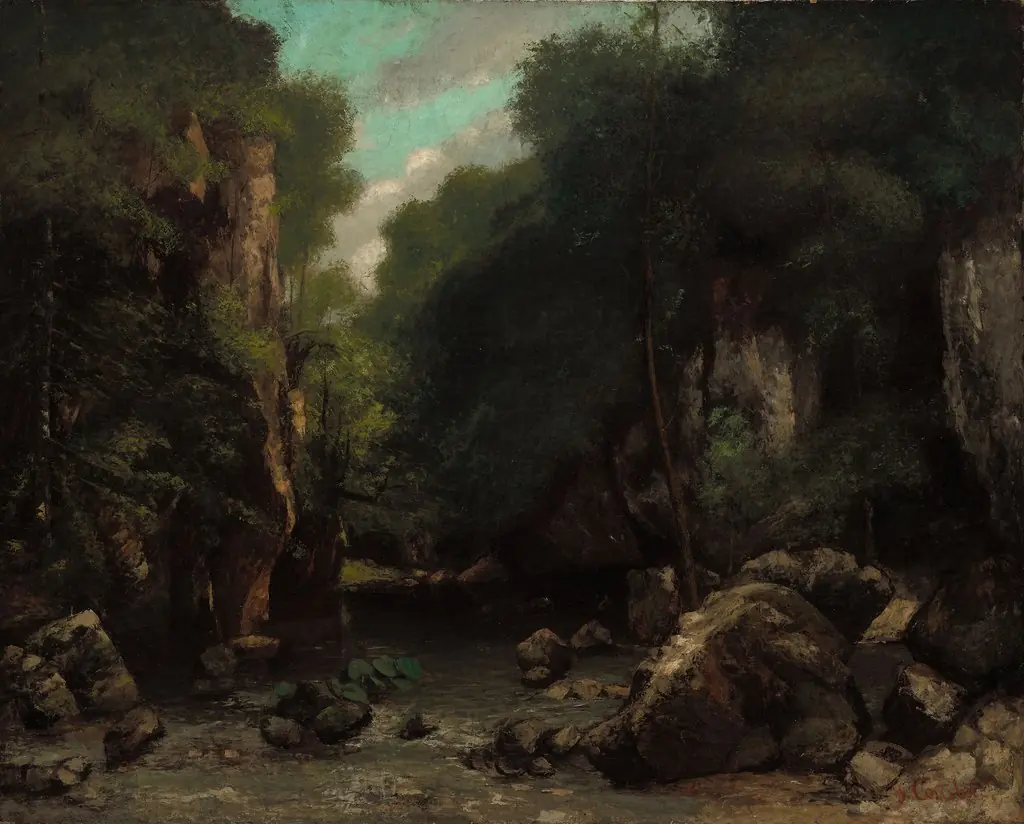
The Stream (Le Ruisseau du Puits-Noir; vallée de la Loue) is an oil painting by the Impressionist artist Gustave Courbet. It dates from 1855 and is held in the collection of the National Gallery of Art.
- Inscription
- Inscribed:lower left: G. Courbet '55
About this work
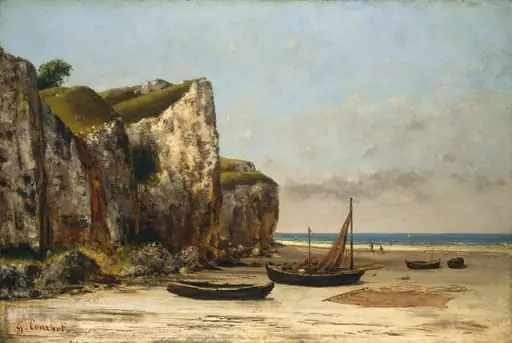
A quiet stream cuts through dark woods, rocks and shallow water under a gray sky. A single tall tree leans over the water, its dark trunk and green leaves filling the left side. Courbet painted it in 1855 near his home in eastern France, showing nature plainly, the dark colors making the stream look deep and cool.
Subject & Meaning
Executed in 1855, this oil painting depicts a landscape scene from the valley of the Loue river, specifically identified as the stream at Puits-Noir.
Executed in 1855, this oil painting depicts a landscape scene from the valley of the Loue river, specifically identified as the stream at Puits-Noir. The composition features trees as its primary visual elements, grounding the work in the naturalistic observation characteristic of the genre. While the title explicitly locates the subject within the Doubs region of France, the available records do not elaborate on specific symbolic programs or allegorical meanings beyond the direct representation of this particular geographic site.
The work functions as a topographical record of the French countryside, focusing on the physical attributes of the stream and its surrounding vegetation rather than conveying a documented narrative or religious iconography.
Technique & Style
The Stream (Le Ruisseau du Puits-Noir; vallée de la Loue) is an 1855 oil painting on canvas by Gustave Courbet, classified as a landscape. The work measures 104 × 137 cm and portrays a solitary tree beside a stream, rendered with Courbet’s characteristic realist brushwork and muted tonal palette that emphasizes texture of foliage and water. Executed on a stretched canvas support, the surface shows the artist’s direct handling, with visible impasto in the tree trunk and delicate glazing in the sky.
The painting’s condition remains stable, having been conserved minimally after its acquisition by the National Gallery of Art in 1943.
History & Provenance
The painting was created by Gustave Courbet in 1855. By that year it was already in the possession of Vauthrin, who retained it through at least 1867, lending it to the 1855 Exposition universelle in Paris and to the 1867 Courbet exhibition at the Rond-Point de l'Alma. The work subsequently passed to Laurent-Richard, at whose Hôtel Drouot sale on 23 May 1878 it was offered as Le Ruisseau du Puits-Noir (vallée de la Loue, Doubs), realizing 13,100 francs.
It then entered the Paris collection of E. Secrétan, who held it until his death in 1899. The painting next surfaced with Etienne-François-Haro and his son Henri Haro in Paris, reappearing at the Galerie Sedelmeyer sale of 30–31 May 1892. On 15 October 1897 the Haros sold it to Durand-Ruel et Cie, which transferred it four days later to Henry O. and Louisine Havemeyer of New York.
Their daughter Adaline Havemeyer Frelinghuysen inherited the canvas and in 1943 gave it to the National Gallery of Art.
Gustave Courbet's The Stream (1855) is held by the National Gallery of Art in Washington, D.C., where it entered the collection in 1943 as a gift from Adaline Havemeyer Frelinghuysen. The work was originally lent to the Exposition universelle in Paris in 1855 and subsequently exhibited at the Oeuvres de M.G. Courbet au Rond-Point de l'Alma in 1867. Following its creation, the painting passed through the hands of several prominent collectors, including Vauthrin, Laurent-Richard, and E. Secrétan, before being acquired by the art dealers Etienne-François-Haro and his son Henri.
In October 1897, it was purchased by Henry Osborn Havemeyer and his wife Louisine Waldron Elder in New York. The painting was later included in the 1993 exhibition Splendid Legacy: The Havemeyer Collection at The Metropolitan Museum of Art in New York.
Context
The Stream (Le Ruisseau du Puits-Noir; vallée de la Loue), painted by Gustave Courbet in 1855, exemplifies his realist commitment to direct observation of natural scenery. It debuted at the 1855 Exposition universelle in Paris and later appeared in the 1867 Courbet retrospective at the Rond‑Point de l'Alma. The canvas, documented in scholarly literature such as the 1993 catalogue Splendid Legacy: The Havemeyer Collection, traces a provenance from Vauthrin to Durand‑Ruel and the Havemeyer family before its 1943 donation to the National Gallery of Art. Its depiction of a solitary tree within a flowing stream underscores Courbet’s influence on later landscape painting.
Overview
Gustave Courbet's The Stream (Le Ruisseau du Puits-Noir; vallée de la Loue), painted in 1855, is an oil on canvas landscape. This work exemplifies the artist's commitment to Realism, a movement he spearheaded in 19th-century French painting. It depicts a natural scene with an emphasis on direct observation rather than idealized forms.
The painting captures a specific moment in nature, reflecting Courbet's rejection of prevailing academic and Romantic artistic conventions.
Legacy
Courbet's innovative approach to depicting everyday reality, particularly in landscape, had a significant impact on subsequent art movements. His commitment to direct observation and unidealized subject matter laid groundwork for artists like the Impressionists, who further explored light and atmosphere. Even later movements, such as Cubism, found inspiration in his bold departure from traditional representation, solidifying his stature as a pivotal figure in 19th-century art.
Own this work as a print
Artist & collection
Artist
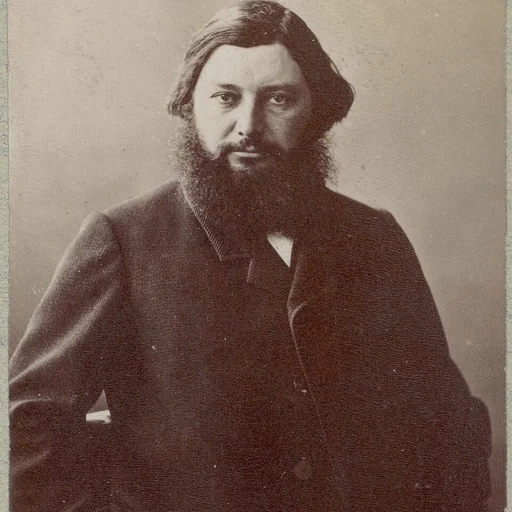
Jean Désiré Gustave Courbet (UK: KOOR-bay; US: koor-BAY; French:; 10 June 1819 – 31 December 1877) was a French painter who led the Realism movement in 19th-century French painting.