Artwork
An Eastern Ruler Seated on His Throne
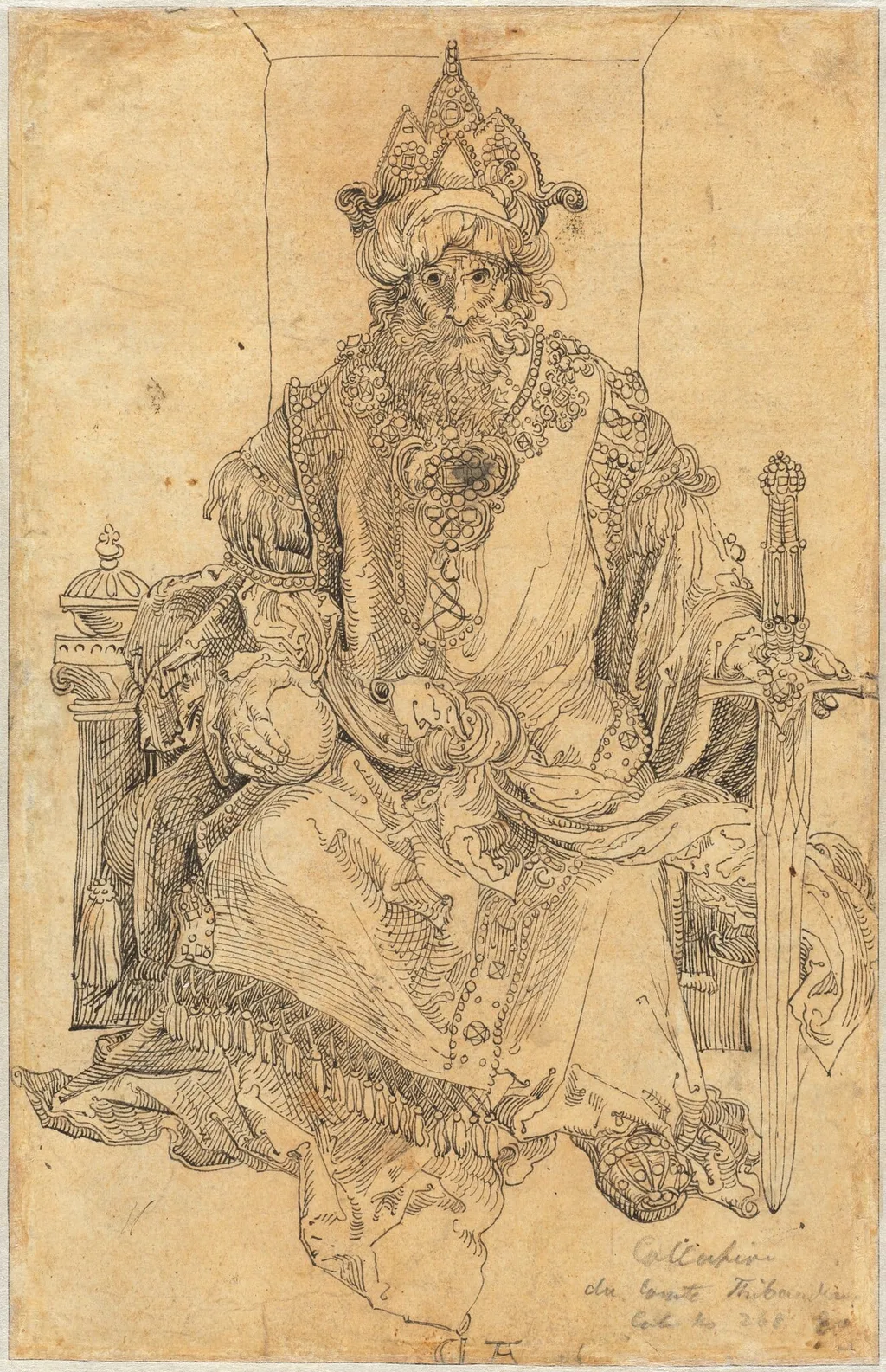
An Eastern Ruler Seated on His Throne is an ink drawing by the Northern Renaissance artist Albrecht Dürer. It dates from 1495 and is held in the collection of the National Gallery of Art.
- Inscription
- Inscribed:lower center in monogram, partly cut: AD
About this work
Overview
It depicts a sultan in a frontal, commanding pose and is noted for its dense, precise linework and cross-hatching.
An Eastern Ruler Seated on His Throne is a drawing by Albrecht Dürer, created circa 1495 in Nuremberg. Executed in pen and black ink on laid paper, the work measures 30.6 by 19.7 centimeters. It depicts a sultan in a frontal, commanding pose and is noted for its dense, precise linework and cross-hatching. The drawing is held in the National Gallery of Art in Washington, D.C., under the accession number 1972.22.1.a, where it has resided since its purchase in 1972.
Subject & Meaning
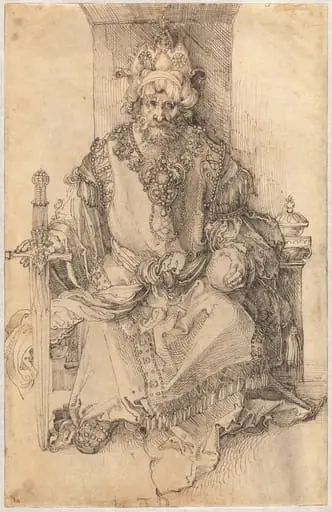
The drawing portrays a bearded sultan seated frontally on an ornate throne, filling the vertical composition. The ruler wears a tall, jeweled crown with pointed peaks and a fur-trimmed, elaborately decorated robe with patterned borders and a large clasp at his chest. He holds the hilt of a long sword that stands upright beside him. Scholarly analysis, such as that by Heather Madar, situates the work within the context of early modern Orientalism and Dürer's depictions of the Ottoman Turks. The detailed rendering of the ruler's clothing and accessories emphasizes his authority and exoticized status from a Western European perspective.
Technique & Style
Dürer utilized pen and black ink on laid paper to construct the image, employing a limited palette that emphasizes the brown ink on aged, yellowed paper. The technique features dense, precise pen work with extensive cross-hatching to model shadows and textures. Dürer paid particular attention to the clothing, jewelry, and the decorative finials and draped fabric of the throne, outlining certain elements multiple times to achieve extra contrast. The background is plain, framed by a simple rectangular line behind the figure. The paper shows discoloration and wear. An inscription of Dürer's monogram, partially cut, appears at the lower center, likely inscribed by another early hand, with faint handwritten text in the lower right corner.
History & Provenance
The drawing's dimensions suggest it was originally part of a sketchbook before being separated. Its documented provenance begins with William Young Ottley in London, followed by Sir Thomas Lawrence, whose collection mark (Lugt 2445) identifies his ownership. It subsequently passed to S.G. Liesching in Stuttgart and Count Adolphe-Narcisse Thibeaudeau in Paris. After the Count's sale in Paris from April 20 to 25, 1857, the drawing entered a private collection in the United States. It was purchased privately via Robert Light by the National Gallery of Art in 1972, with support from the Ailsa Mellon Bruce Fund. The drawing has been featured in numerous exhibitions, including Circa 1492: Art in the Age of Exploration at the NGA in 1991, and major Dürer exhibitions at the Albertina in Vienna in 2003 and 2019.
Context
Created around 1495, the drawing emerges from a period when Dürer was refining his pen work to achieve sharp detail and high precision. The work has been the subject of significant scholarship since its acquisition by the NGA. Christopher White published a study of the drawing in 1973, and it was cataloged by Walter L. Strauss in 1974. It has since been reproduced in major surveys of Dürer's work, including those by Peter Strieder in 1982 and Rainer Schoch in 2001. Andrew Robison analyzed the drawing in depth for the 2013 Albertina exhibition catalog, and its role in Dürer's engagement with Ottoman imagery was explored by Heather Madar in 2011.
Legacy
The drawing's reputation as a masterwork of pen technique has ensured its frequent exhibition and publication. It has been displayed internationally, including at the British Museum in 1984 and the Museo Correr in Venice in 2014 for The Poetry of Light. Beyond specialized art history, the image has been reproduced in educational design textbooks, such as Visual Forces by Benjamin Martinez and Jacqueline Block, and Creating and Understanding Drawings by Gene A. Mittler and James D. Howze, cementing its status as a canonical example of intricate line work and compositional design in Western art.
Own this work as a print
Artist & collection
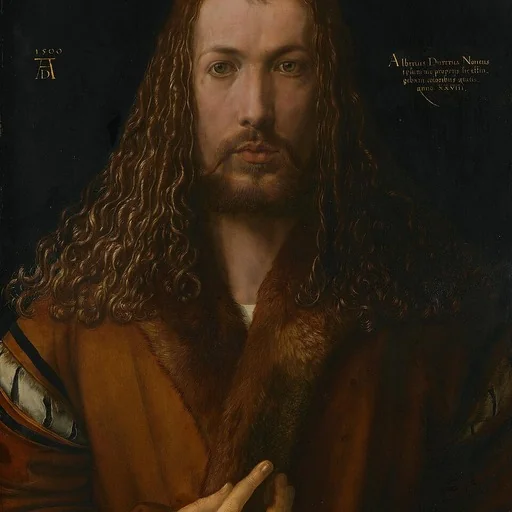
Artist
Albrecht Dürer spent his life in Nuremberg, a busy German city where artists traded prints like currency.

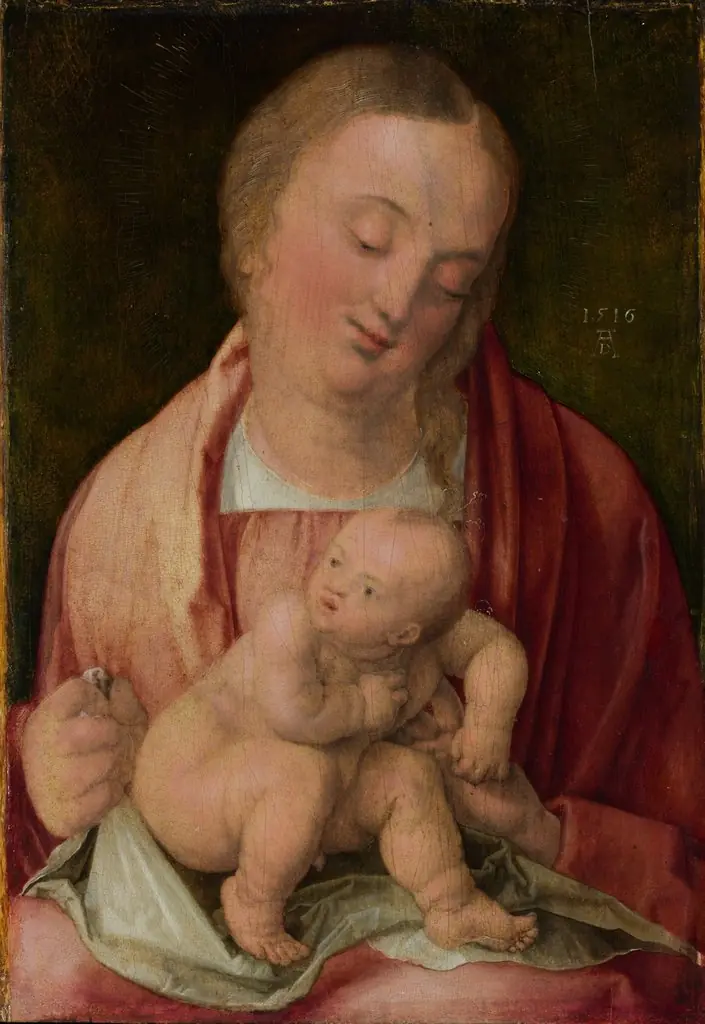
![Madonna and Child [obverse], by Albrecht Dürer](https://artifactworldgallery.com/img/albrecht-durer--madonna-and-child-obverse--d7b8ebf05d22ebe5-w320.webp)
![Lot and His Daughters [reverse], by Albrecht Dürer](https://artifactworldgallery.com/img/albrecht-durer--lot-and-his-daughters-reverse--b4ebf9b282faa17a-w320.webp)