Artwork
Portrait of a Woman with a Man at a Casement
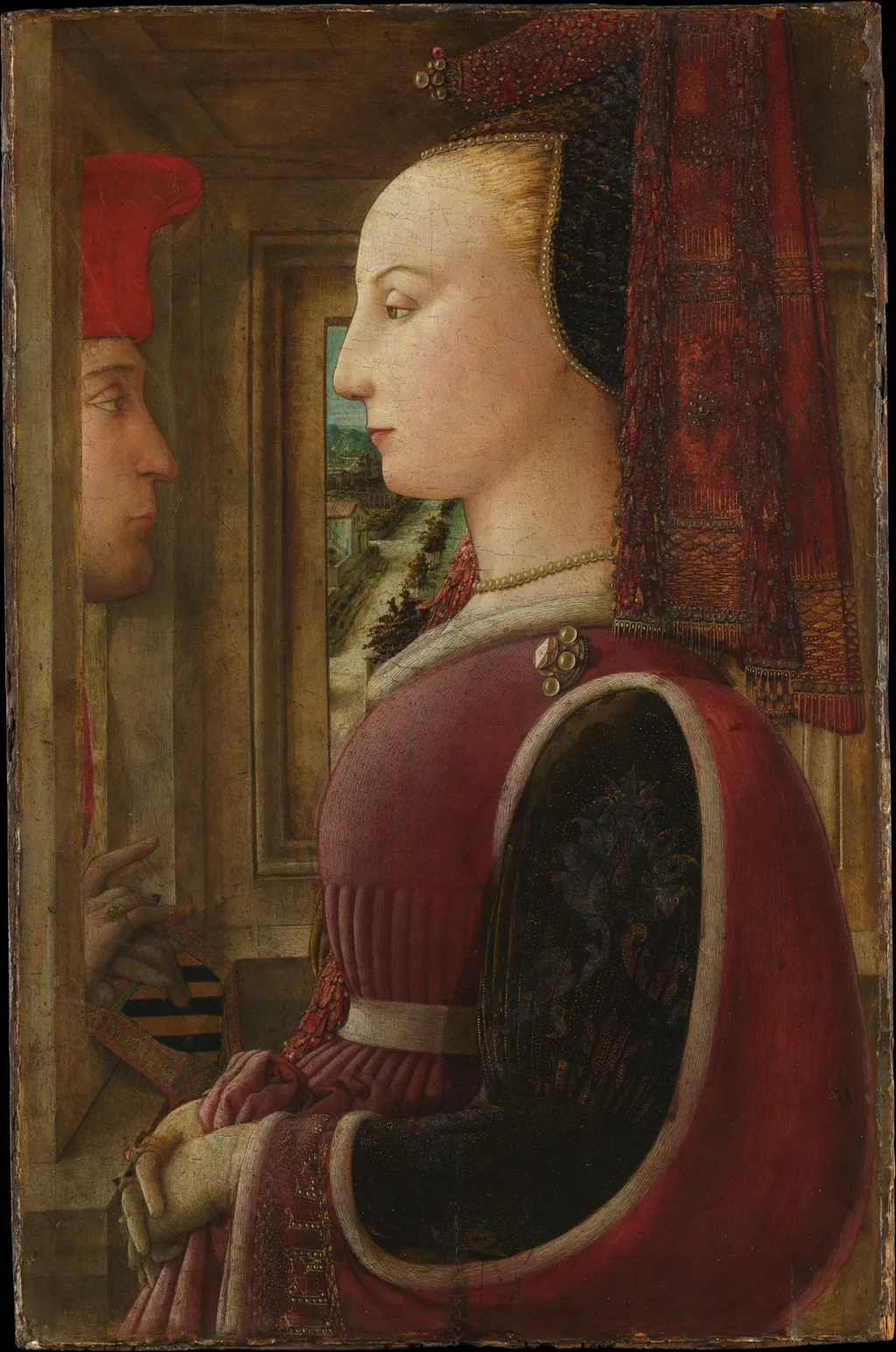
Portrait of a Woman with a Man at a Casement is a tempera painting by the Early Renaissance artist Filippo Lippi. It dates from 1440 and is held in the collection of the Metropolitan Museum of Art.
About this work
Subject & Meaning
The woman wears elaborate French-style clothing and jewelry, including a high headdress with a double scarlet fabric flap (infulae) draped over her shoulders.
The painting is widely considered the earliest known double portrait, depicting a richly dressed woman in profile and a young man observing her from a casement window. The woman wears elaborate French-style clothing and jewelry, including a high headdress with a double scarlet fabric flap (infulae) draped over her shoulders. The subjects' gazes are composed and aloof, appearing not to meet.
A coat of arms on the window sill identifies the Florentine Scolari family, leading scholars to associate the work with the 1436 marriage of Lorenzo di Ranieri Scolari and Angiola di Bernardo Sapiti. Consequently, the artwork likely commemorates a betrothal or marriage, or serves as a memorial to a deceased wife. Symbolically, the open window revealing a bird's-eye landscape, a motif inspired by Northern Early Netherlandish art, contrasts the interior architectural setting with the exterior world, while flower boxes on the overlooking ledge may carry marital or domestic symbolism.
Technique & Style
Executed in tempera on a wood panel measuring 64.1 by 41.9 cm, this work represents an early Italian example of integrating portraiture within an architectural setting and landscape. Stylistically, the composition reflects Northern European influences, specifically from Flemish Primitives, through its use of a casement window opening onto a bird's-eye view of a canal, flower boxes, and distant houses. The female subject is depicted in strict profile, adorned in rich French-style attire and jewelry, topped by a distinctive high headdress featuring double scarlet fabric flaps known as infulae.
A young man appears at the window before her; however, their gazes remain haughty and composed, deliberately avoiding direct contact. Behind the woman, an open window reveals a rural backdrop, further emphasizing the innovative spatial arrangement for its time.
History & Provenance
Filippo Lippi created this tempera on wood panel between approximately 1435 and 1436, a dating supported by stylistic analysis linking it to the artist's stay in Padua. The work is unanimously attributed to Lippi. A coat of arms on the windowsill identifies the Florentine Scolari family, suggesting the painting was commissioned to commemorate a betrothal, a marriage, or a deceased bride.
Scholars commonly associate it with the 1436 marriage of Lorenzo di Ranieri Scolari and Angiola di Bernardo Sapiti. The painting's early provenance is uncertain; however, it was purchased in Florence in 1829 by an English collector. It later entered the collection of Henry Gurdon Marquand, who bequeathed it to the Metropolitan Museum of Art in 1889, where it remains today.
The work is housed in the Metropolitan Museum of Art, New York, having entered the collection through the bequest of Henry Gurdon Marquand in 1889. Its accession is recorded as part of the Marquand collection, and it remains on view in the museum’s European paintings galleries. The painting was included in the exhibition "The Renaissance Portrait: From Donatello to Bellini," which presented the work alongside other early portraiture to highlight its significance as an early double portrait.
Context
The painting occupies a foundational position in the history of Italian and European portraiture. Stylistic analysis dates it to Fra Filippo Lippi's Paduan sojourn of 1435–1436, and it is recognized as the earliest known double portrait in existence. It is also regarded as the first European painting to insert the portrait format into an architectural setting with a landscape background, a device Lippi adapted from Early Netherlandish prototypes.
The bird's-eye view through a window onto a canal quay with flower boxes is identified as a distinctly Northern motif. Together with Pisanello's Portrait of an Este Princess, dated circa 1435–1449, the work is considered one of the earliest Italian examples of the female portrait. The coat of arms on the windowsill belongs to the Florentine Scolari family, and the panel is generally linked to the 1436 marriage of Lorenzo di Ranieri Scolari and Angiola di Bernardo Sapiti, suggesting a commemorative function for a betrothal, marriage, or deceased bride.
Overview
This painting, titled Portrait of a Woman with a Man at a Casement, is rendered on a wood panel. It presents a prominent female figure positioned in the foreground, accompanied by a male figure subtly appearing in the background. The composition emphasizes the woman's presence through her attire and direct engagement, while the man's partial visibility adds a narrative element to the scene.
Own this work as a print
Artist & collection

Artist
Filippo Lippi (c. 1406 – 8 October 1469), also known as Lippo Lippi, was an Italian Renaissance painter of the Quattrocento (fifteenth century) and a Carmelite priest. He was an early Renaissance master of a painting…


- Portrait of a Lady known as Esmeralda Brandini
 Portrait of a Woman
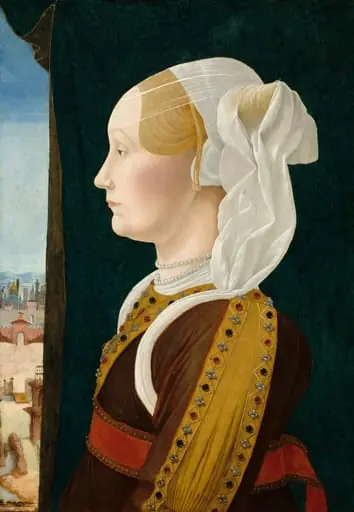 Ginevra Bentivoglio
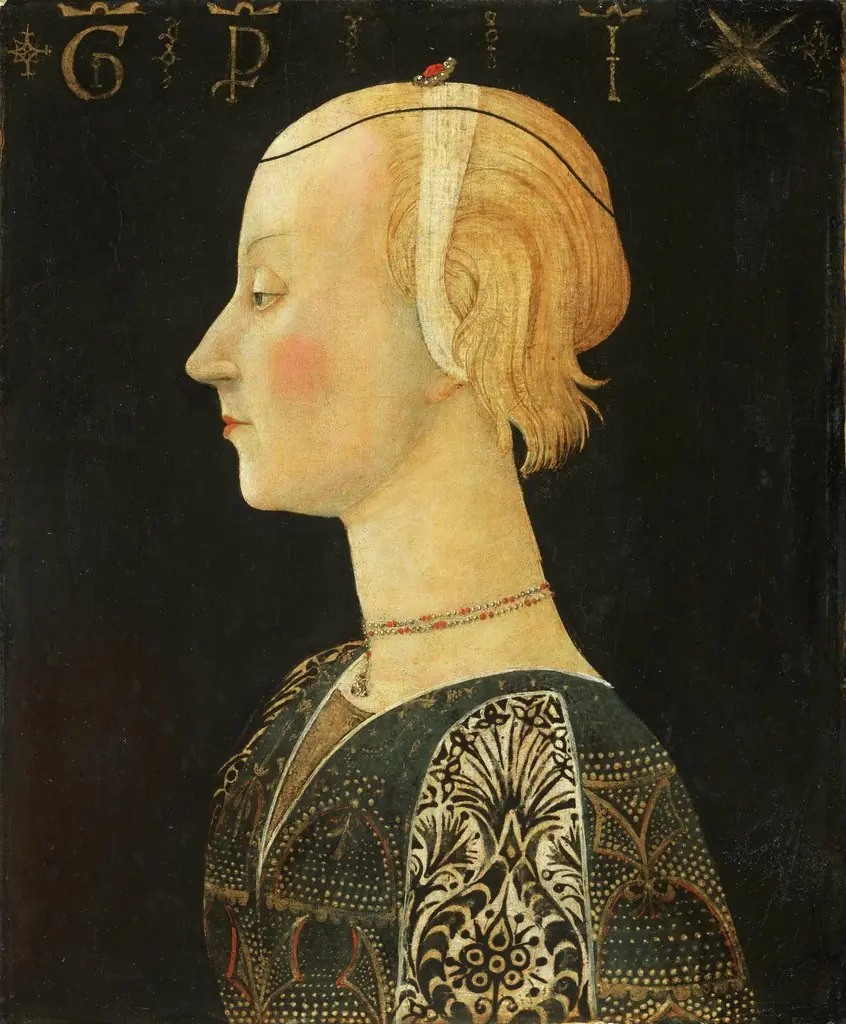 Portrait of a Lady
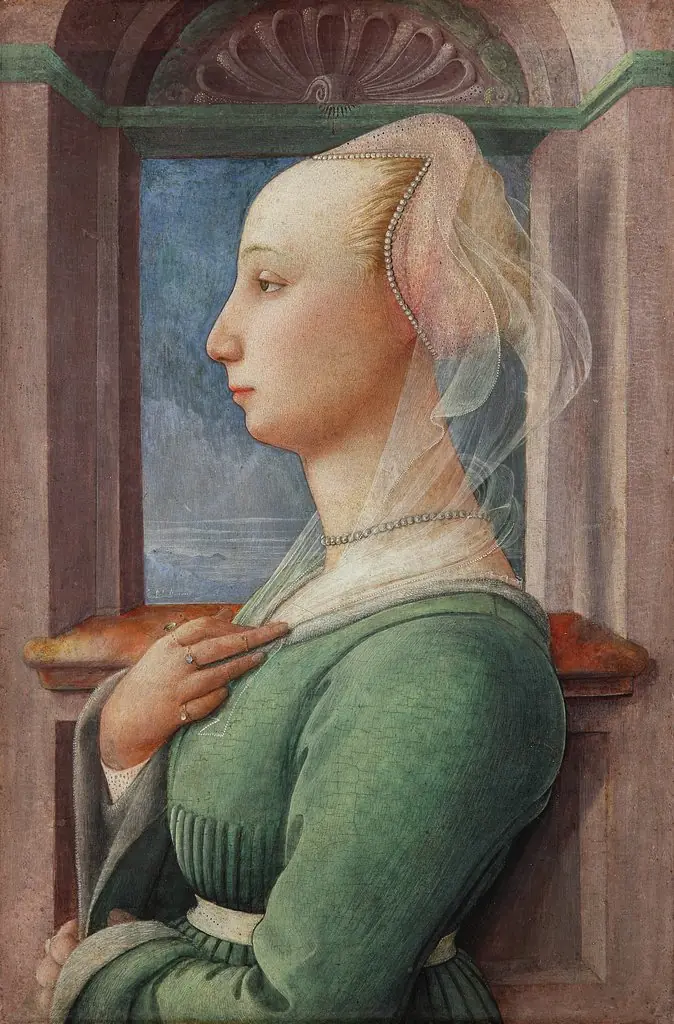 Portrait of a Lady
 Maria Magdalena
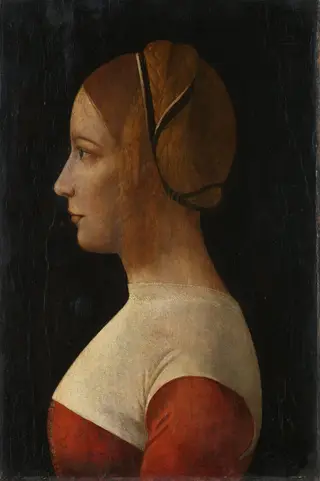 Portrait of a young Woman
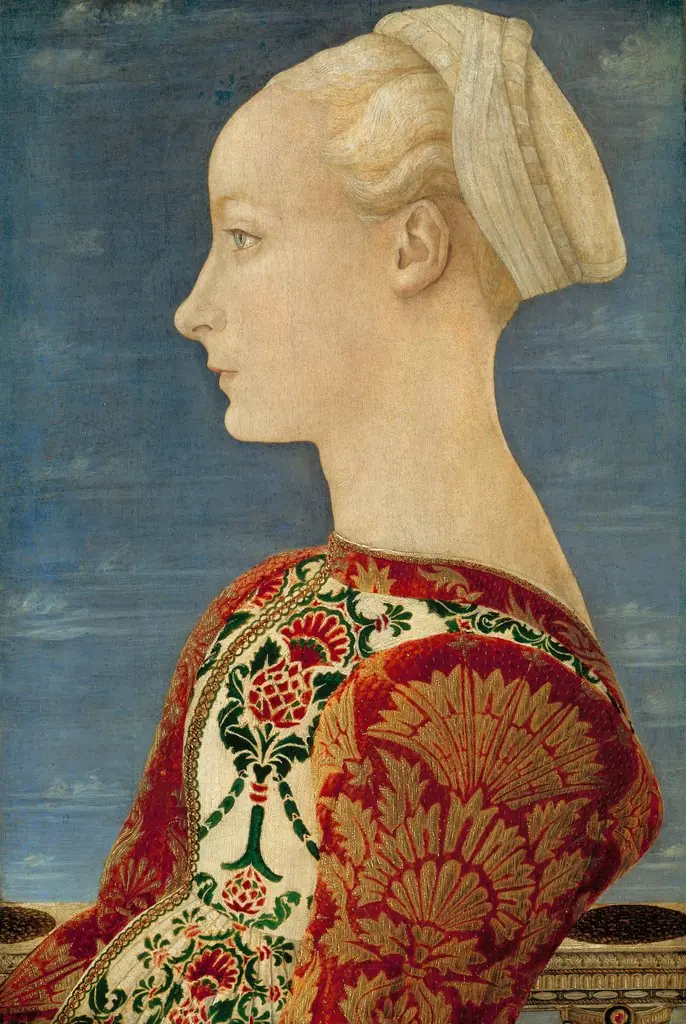 Profile Portrait of a Young Lady
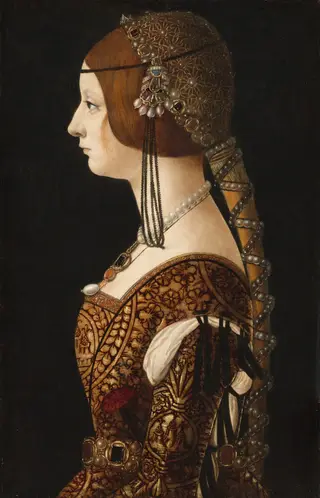 Bianca Maria Sforza
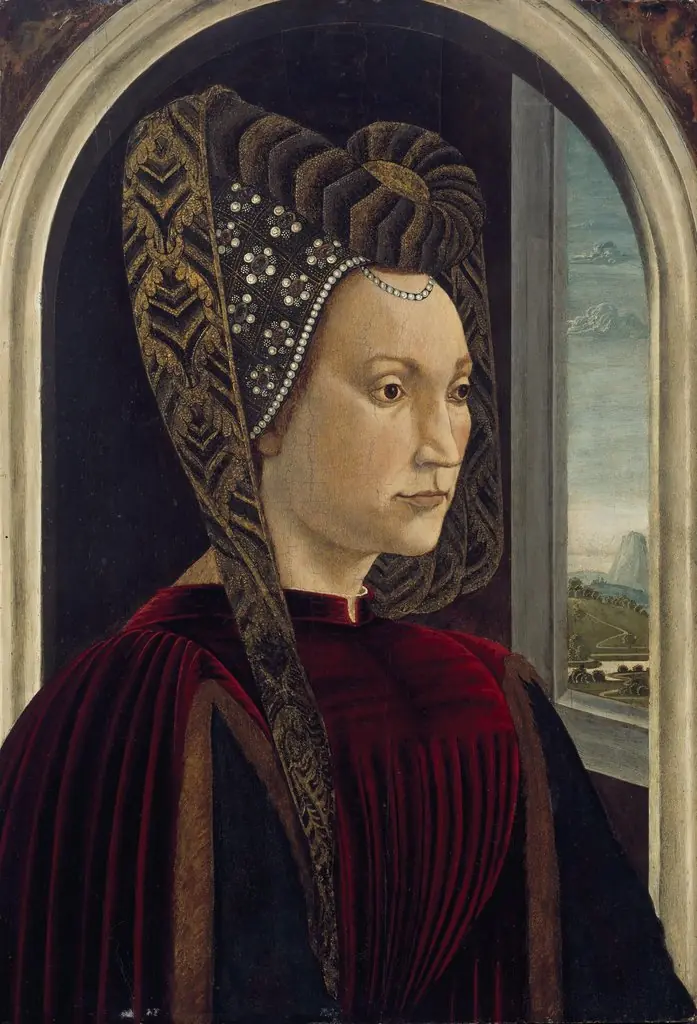 Presumed Portrait of Clarice Orsini, Wife of Lorenzo the Magnificent
 Francesco Sassetti and His Son Teodoro
 Portia and Brutus