Artwork
The Immaculate Conception
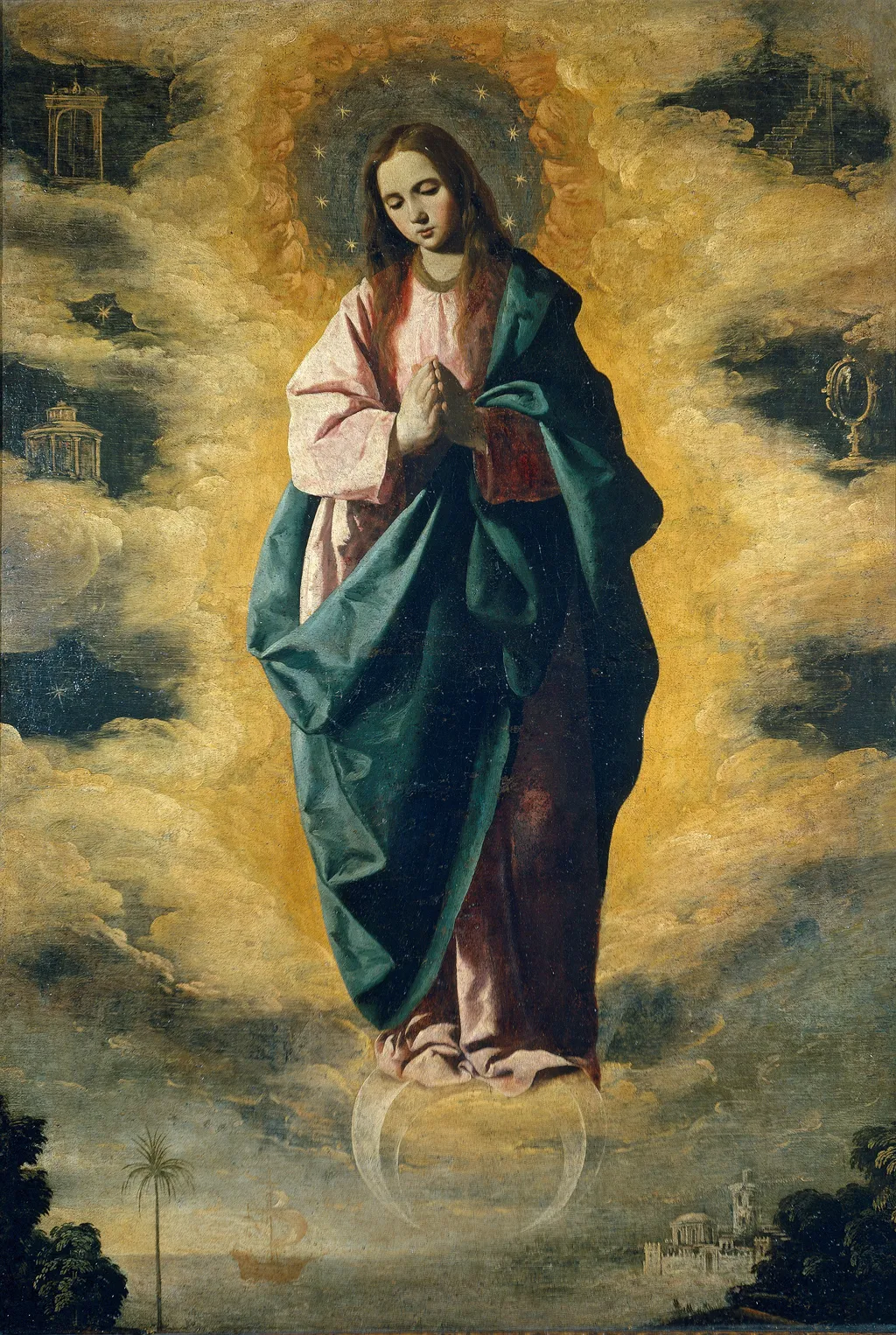
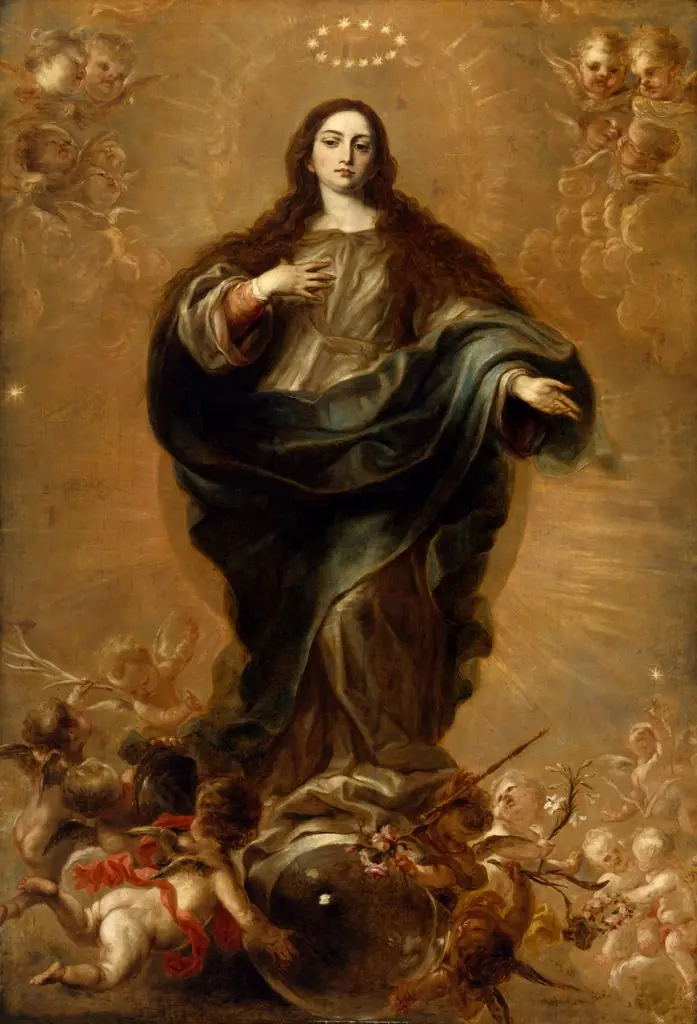
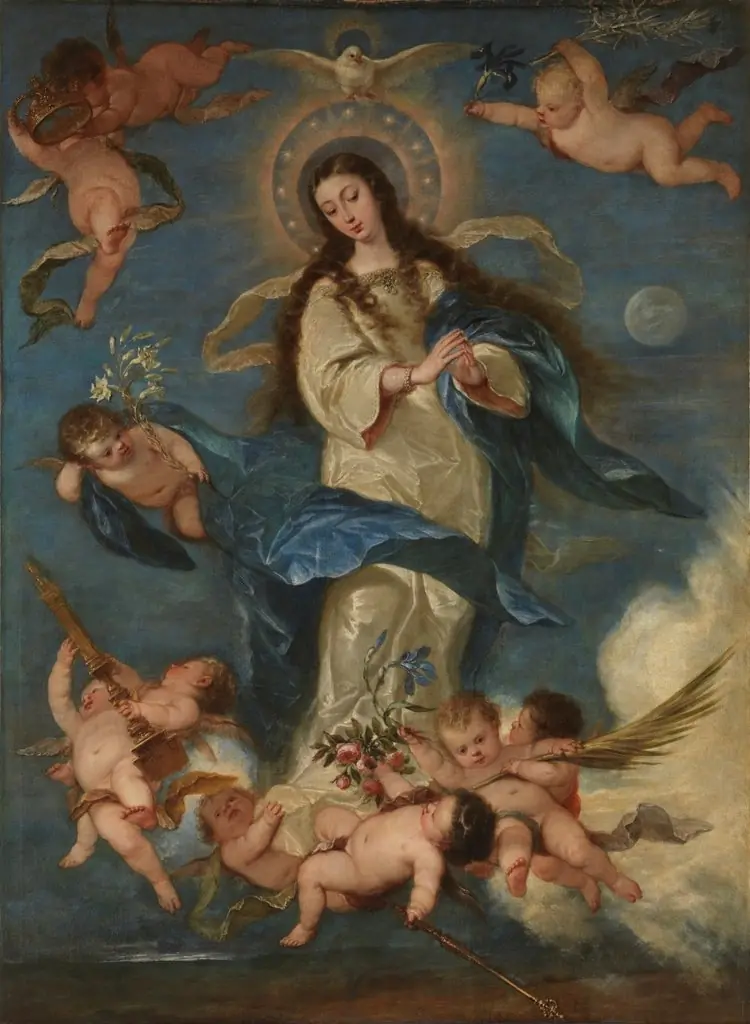
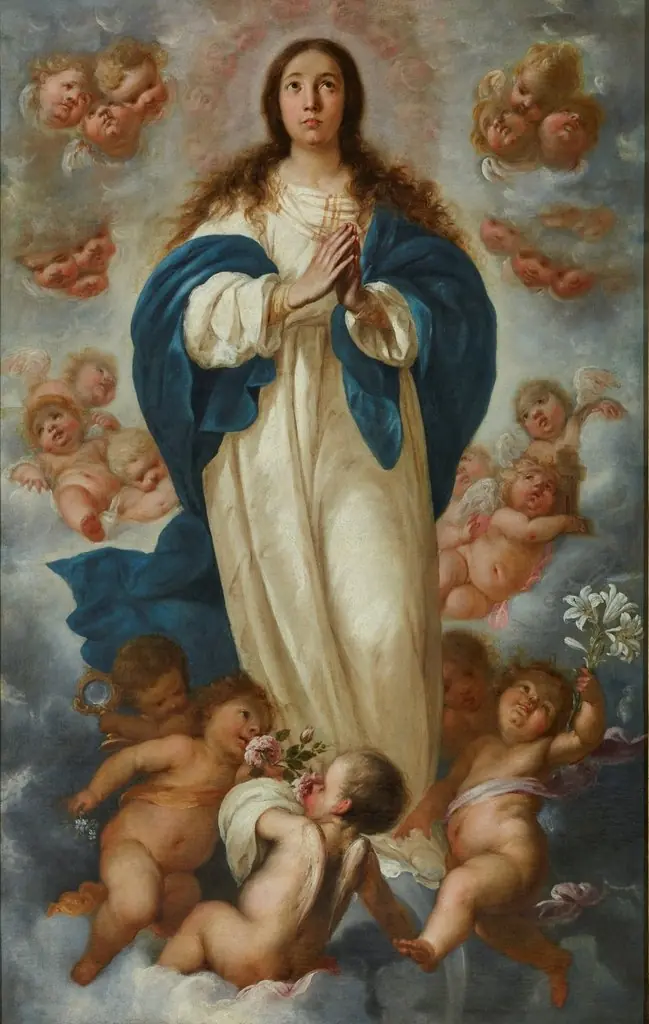
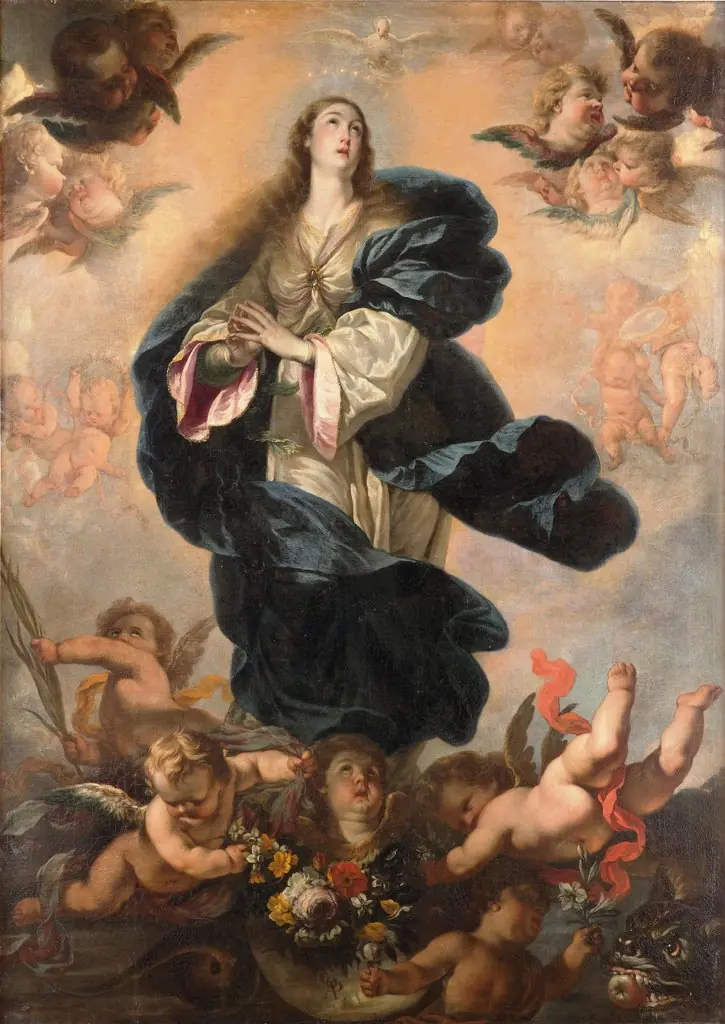
The Immaculate Conception is an oil painting by the Baroque artist Francisco de Zurbarán. It dates from 1628 and is held in the collection of the Museo del Prado.
About this work
Subject & Meaning
The painting depicts the Immaculate Conception of Mary, a subject not explicitly narrated in the canonical Gospels but central to Spanish religious tradition.
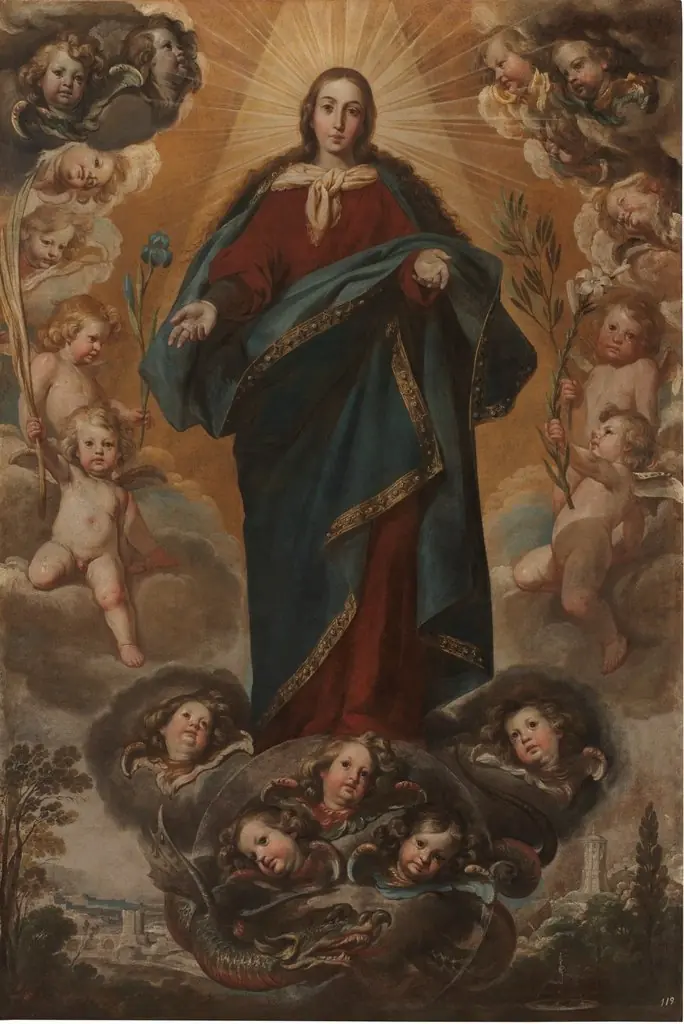
The painting depicts the Immaculate Conception of Mary, a subject not explicitly narrated in the canonical Gospels but central to Spanish religious tradition. The iconography draws directly from Revelation 12, portraying the Virgin as a woman clothed with the sun, standing on a crescent moon, and crowned with twelve stars. Zurbarán further enriches the composition with symbols from the Litany of Loreto, dividing the scene into celestial and terrestrial realms.
The sky features representations such as the Gate of Heaven, the Ivory Tower, and Jacob's Ladder, while the landscape below includes the Palm of Engedi and the Tower of David. The Virgin is shown as an adolescent with a modest expression, illuminated by a strong backlight that highlights her blue mantle and pale pink dress, surrounded by cherubim within a golden halo.
Technique & Style
The Immaculate Conception is an oil painting on canvas created by Francisco de Zurbarán around 1628–1630. The work measures approximately 127 x 89 cm and is housed in the Museo del Prado, where it is catalogued under inventory number 2992. It is regarded as one of Zurbarán’s earliest treatments of the subject and is noted for its intimate, devotional quality.
The composition contrasts a celestial realm with an earthly landscape, incorporating symbolic elements from the Litany of Loreto and biblical imagery. Celestial motifs include the Gate of Heaven, the Ivory Tower, and the Morning Star, while earthly symbols feature the Palm of Engadi, the Solace of Navigators, the Tower of David, and the City of God. The Virgin Mary is depicted as a modest adolescent, positioned centrally in the heavenly sphere upon a transparent, crescent moon, surrounded by a halo of twelve stars and cherubim within a golden circle, with a radiant halo emphasizing her pale pink robe and blue mantle.
History & Provenance
The painting was executed by Francisco de Zurbarán around 1628–1630, with the corpus record dating it to 1628 and the Wikidata entry giving possible inception dates of 1628, 1629, or 1630. It is catalogued as number 20 in Odile Delenda's critical catalogue of the artist and as number 135 in Tiziana Frati's monograph. The work is recorded as oil on canvas measuring 127 x 89 cm (or 128 x 89 cm according to the Museo del Prado).
The documented provenance begins in Seville with Doña Celia Méndez, Marquesa viuda de la Puebla de Obando, who founded the Esclavas del Divino Corazón. From her it passed to the Convento de las Esclavas del Divino Corazón in Seville. The painting was subsequently purchased by the Spanish Ministerio de Educación and entered the Museo del Prado in 1956, where it is recorded under inventory number P002992.
The Immaculate Conception by Francisco de Zurbarán is held in the Museo del Prado in Madrid, where it is registered under inventory number P002992. The painting entered the museum's collection in 1956 after being acquired by the Ministry of Education. Prior to this transfer, the work was associated with Doña Celia Méndez, the widow of the Marquis of Puebla de Obando, and subsequently kept at the Convent of the Esclavas del Divino Corazón in Sevilla.
The work is cataloged as number 20 in the critical reasoned catalog by art historian Odile Delenda and number 135 in the catalog by Tiziana Frati. It is one of three canvases on this specific theme by Zurbarán currently in the Prado's holdings.
Context
This painting is recognized as likely the first version of the Immaculate Conception theme executed by Francisco de Zurbarán, distinguished by scholars for its intimate and moving quality. Art historian Odile Delenda catalogs the work as number 20 in her critical raisonné, while Tiziana Frati assigns it number 135. The composition reflects the spiritual and artistic atmosphere of Seville during Zurbarán's formative years between 1614 and 1617, contributing to a new pictorial image of this subject.
Although the dogma was not officially decreed until 1854, the iconography had evolved in Spain since the Middle Ages, drawing upon the Book of Revelation and the Litany of Loreto. The work exemplifies the Baroque movement's approach to religious art, utilizing strong light contrasts to accentuate the Virgin's modest expression and symbolic attributes.
Overview
Francisco de Zurbarán’s oil painting titled The Immaculate Conception was completed in 1628 and is part of the collection at Madrid’s Museo del Prado. The work presents a singular vision of the Virgin Mary, rendered in a luminous, ethereal setting that emphasizes her sanctity.
Own this work as a print
Artist & collection
Artist
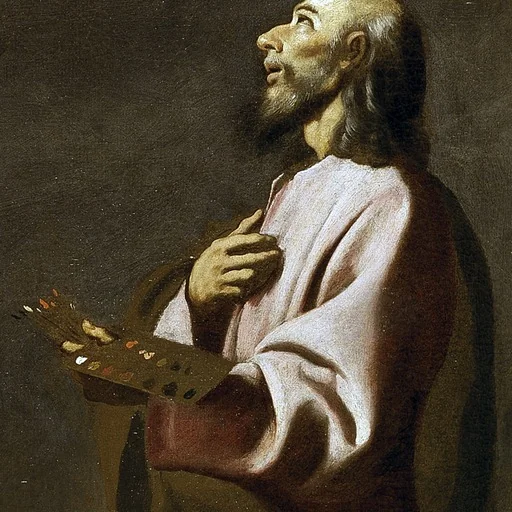
Francisco de Zurbarán was a Spanish Baroque painter. He is known primarily for his religious paintings depicting monks, nuns, and martyrs, and for his still-lifes. Zurbarán gained the nickname "Spanish Caravaggio",…