Artwork
The Martyrdom of Saint James
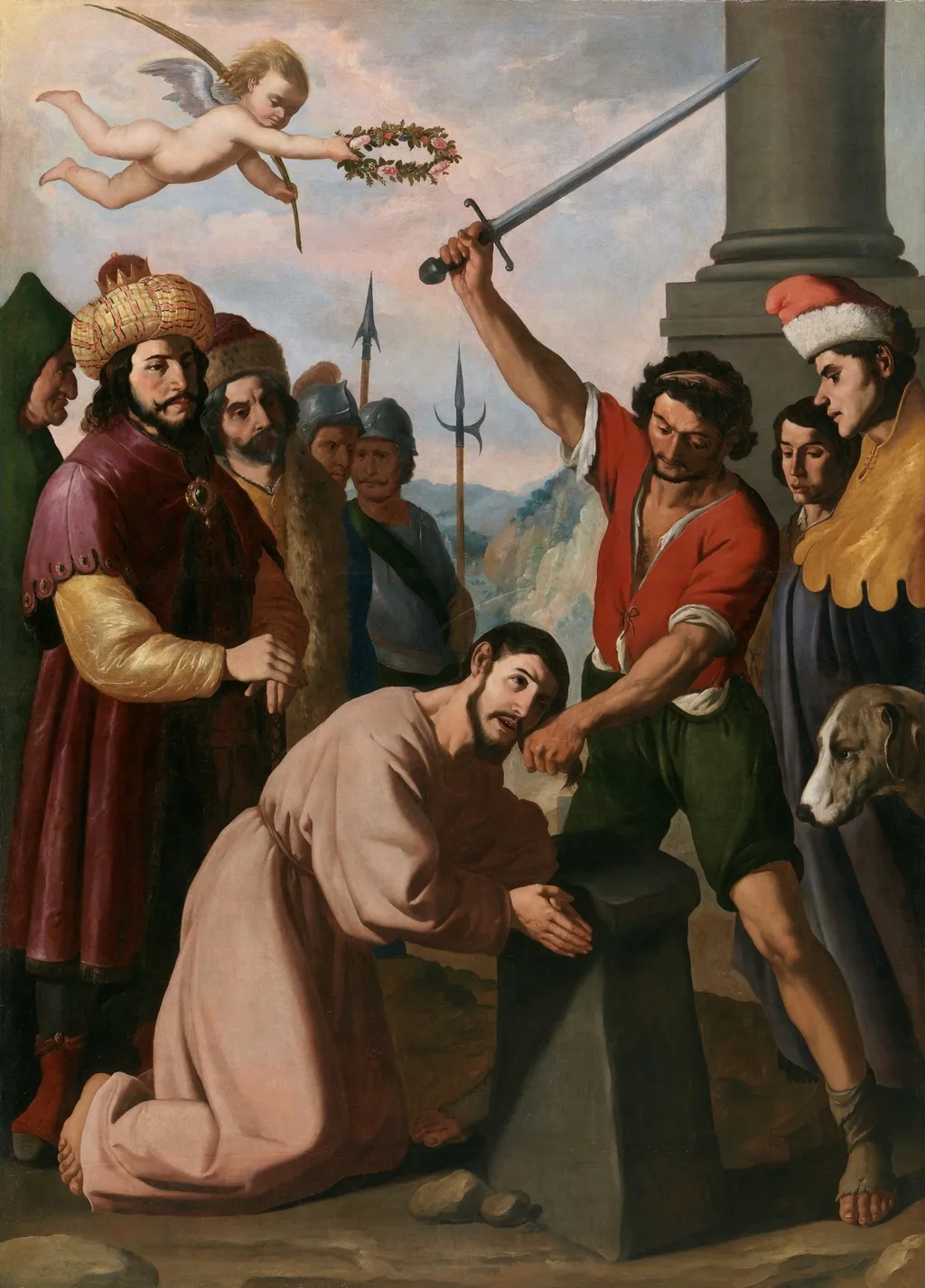
The Martyrdom of Saint James is an oil painting by the Baroque artist Francisco de Zurbarán. It dates from 1640 and is held in the collection of the Museo del Prado.
About this work
Subject & Meaning
The executioner raises a sword while gripping the saint's hair, and Herod Agrippa observes from the left, wearing a distinctive turban topped with a crown.
The painting depicts the martyrdom of Saint James the Elder, an event briefly narrated in the Acts of the Apostles where King Herod Agrippa orders the apostle's execution by sword. Zurbarán avoids gruesome details, instead capturing a serene moment where the saint kneels in prayer, dressed in a simple tunic bound by a rope, awaiting his death. The executioner raises a sword while gripping the saint's hair, and Herod Agrippa observes from the left, wearing a distinctive turban topped with a crown.
Symbolically, a cherub above Herod presents James with a palm and crown, traditional emblems of martyrdom and victory over death. The soldier's contemporary clothing suggests the persistence of heresy into the artist's own time. Additional elements include a figure in a Phrygian cap and a dog's head on the right, alongside a recurring column motif. The composition utilizes diagonals to maintain a meditative atmosphere, emphasizing spiritual quietude over physical violence.
Technique & Style
Zurbarán painted The Martyrdom of Saint James in oil on canvas (252 × 186 cm) around 1636–1640, employing the Baroque emphasis on dramatic chiaroscuro and restrained composition. The work is signed in the lower left corner. Stylistically, Zurbarán avoids graphic violence, rendering the saint kneeling in quiet prayer, surrounded by contemporarily-dressed figures and a diagonal arrangement that creates a serene, meditative atmosphere.
The painting's color palette, delicate modeling of fabric, and use of shadow convey volumetric depth, while the inclusion of symbolic elements such as a dog and a crown reflects Baroque iconography.
History & Provenance
Francisco de Zurbarán painted The Martyrdom of Saint James on canvas between approximately 1636 and 1640. The work was originally created for the high altarpiece of the Church of Nuestra Señora de la Granada or the Parish Church of Santiago in Llerena, though it vanished during the eighteenth century. It resurfaced in Seville, where it was purchased from Antonio Domine, before entering the Spanish Gallery of King Louis Philippe in Paris between 1838 and 1848.
Following the gallery's dispersal, the painting was sold at Christie's in London in May 1853 to collector Sharpe for 70 pounds. The work later passed through the collections of Julia Martínez Ibáñez and Luis Plandiura. After an unsuccessful proposal to the Museo del Prado in 1935, the Spanish State and the museum acquired the painting on 1 July 1988 for 195,000,000 pesetas.
Context
Scholarship on Zurbarán's Martyrdom of Saint James has centered on Odile Delenda's critical catalogue, where the work is catalogued as no. 116, and on its display in the 1988 Prado retrospective curated by Claudie Ressort and Jeannine Baticle.
The painting's restrained evocation of martyrdom, eschewing graphic violence in favor of serene composition and luminous stillness, has been read as emblematic of Zurbarán's mature style during his so-called "prodigious decade." Its diagonal arrangement and quietude align with the hieratic elegance of his altarpieces for the Charterhouse of Jerez, situating the work within the austere yet refined idiom of Seville's Counter-Reformation culture.
Its later exhibition history, from the Galerie Espagnole in Paris (1838–1848) to London sales in 1853 and eventual return to Madrid in 1988, underscores its contested but ultimately canonical status within the Spanish Baroque.
Overview
Painted in 1640, Francisco de Zurbarán's The Martyrdom of Saint James depicts the execution of the apostle James the Greater. The composition centers on the kneeling saint, dressed in a luminous white robe, who gazes upward in prayer as an executioner raises a sword to strike. The scene is populated by a group of figures in rich, colorful garments, including a prominent figure in a red hat standing beside a dog, which adds a specific narrative detail to the earthly setting.
Zurbarán employs his characteristic tenebrist style, using stark contrasts between the deep shadows and the illuminated figures to heighten the dramatic tension and spiritual focus. In the upper background, an angel descends holding a wreath of flowers, symbolizing the saint's imminent martyrdom and heavenly reward. This work exemplifies Zurbarán's mastery of religious realism and his ability to convey intense piety through physical presence and light.
Created during the height of the Spanish Golden Age, the painting reflects the Counter-Reformation emphasis on vivid, emotionally resonant religious imagery intended to inspire devotion. It stands as a significant example of the artist's mature style, where sculptural solidity and dramatic lighting converge to create a powerful narrative moment.
Own this work as a print
Artist & collection
Artist
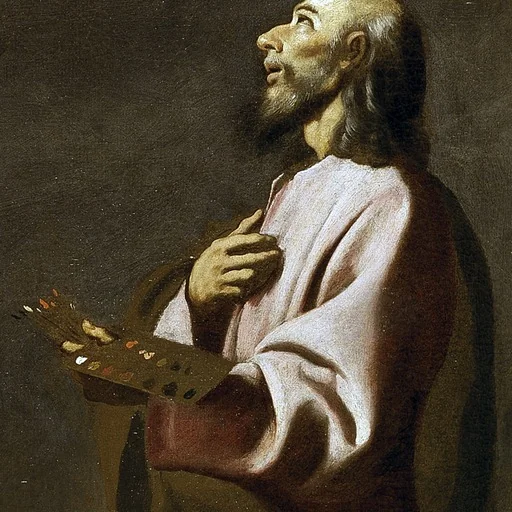
Francisco de Zurbarán was a Spanish Baroque painter. He is known primarily for his religious paintings depicting monks, nuns, and martyrs, and for his still-lifes. Zurbarán gained the nickname "Spanish Caravaggio",…

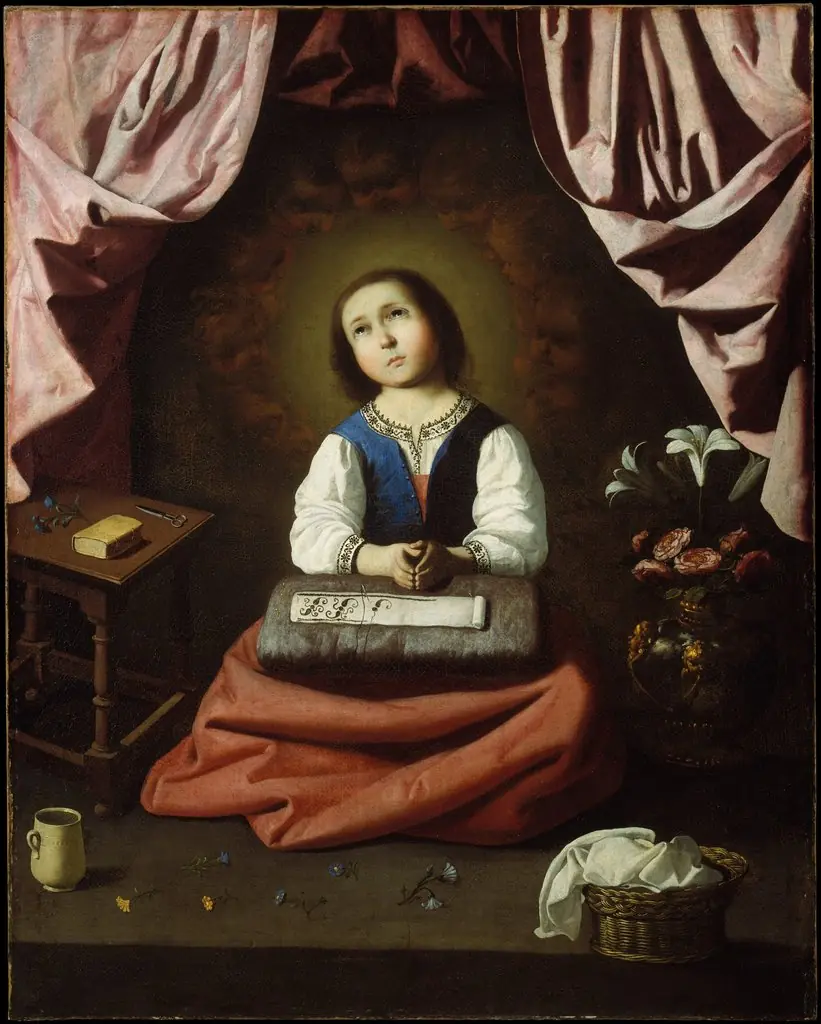
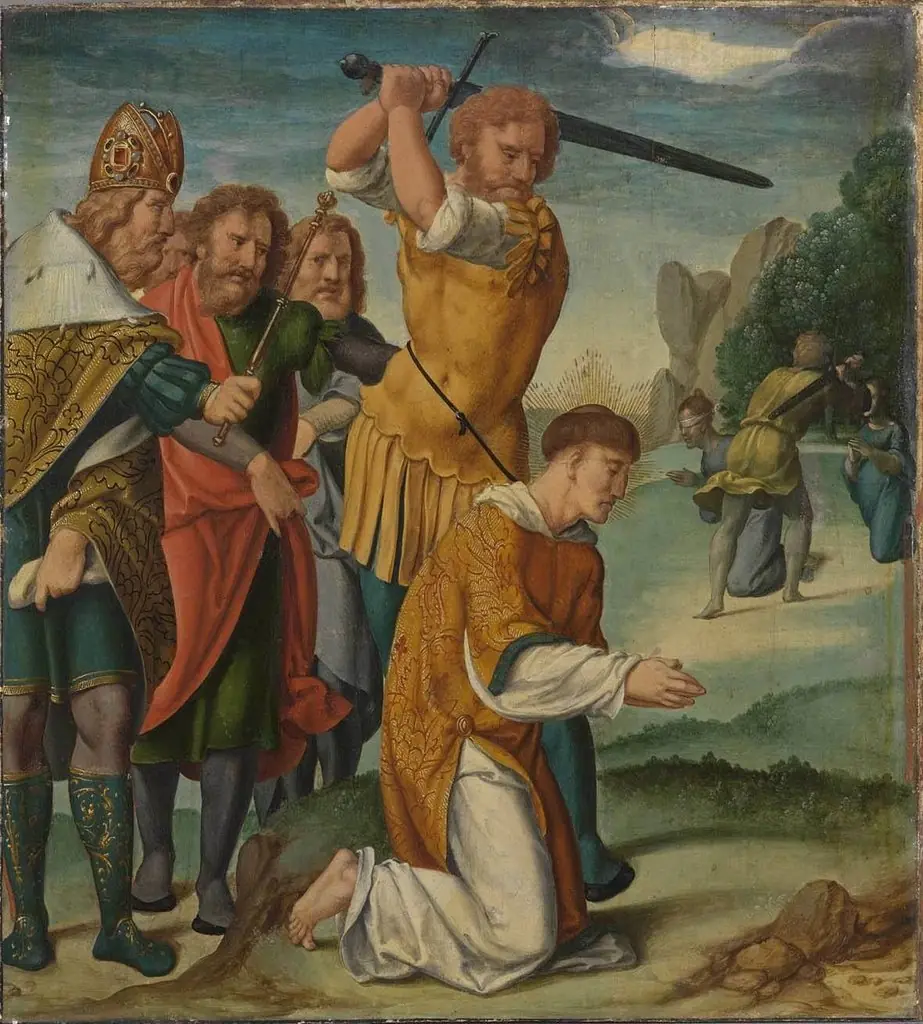 Cyriakus-Folge: Tod des hl. Cyriakus
 Willem III, Count of Holland, Ordering the Beheadal of the Bailiff of Zuid Holland, 1336
 Mocking of Christ
 The Crown of Thorns
 The martyrdom of Saint Cyriacus
 The Martyrdom of Saint Stephen
 The Flagellation
 Martyrdom of Saint Hippolyte
 The Flagellation of Christ
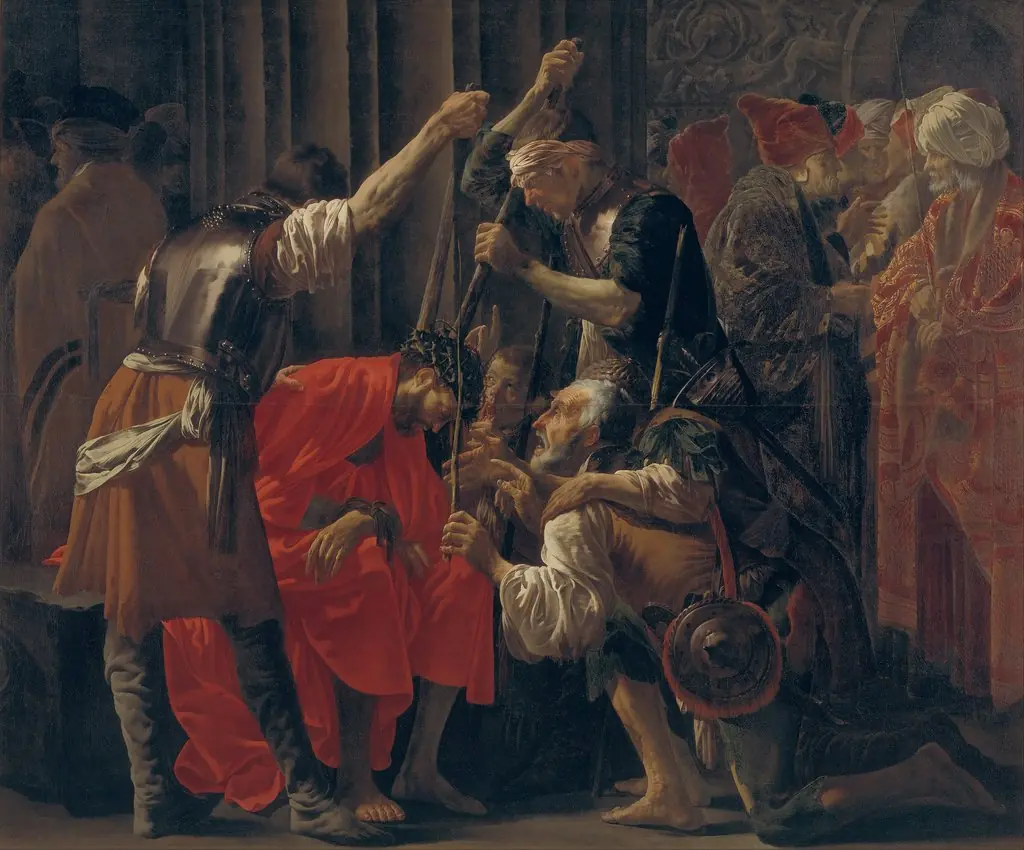 Christ Crowned with Thorns