Artwork
Mrs. Richard Brinsley Sheridan
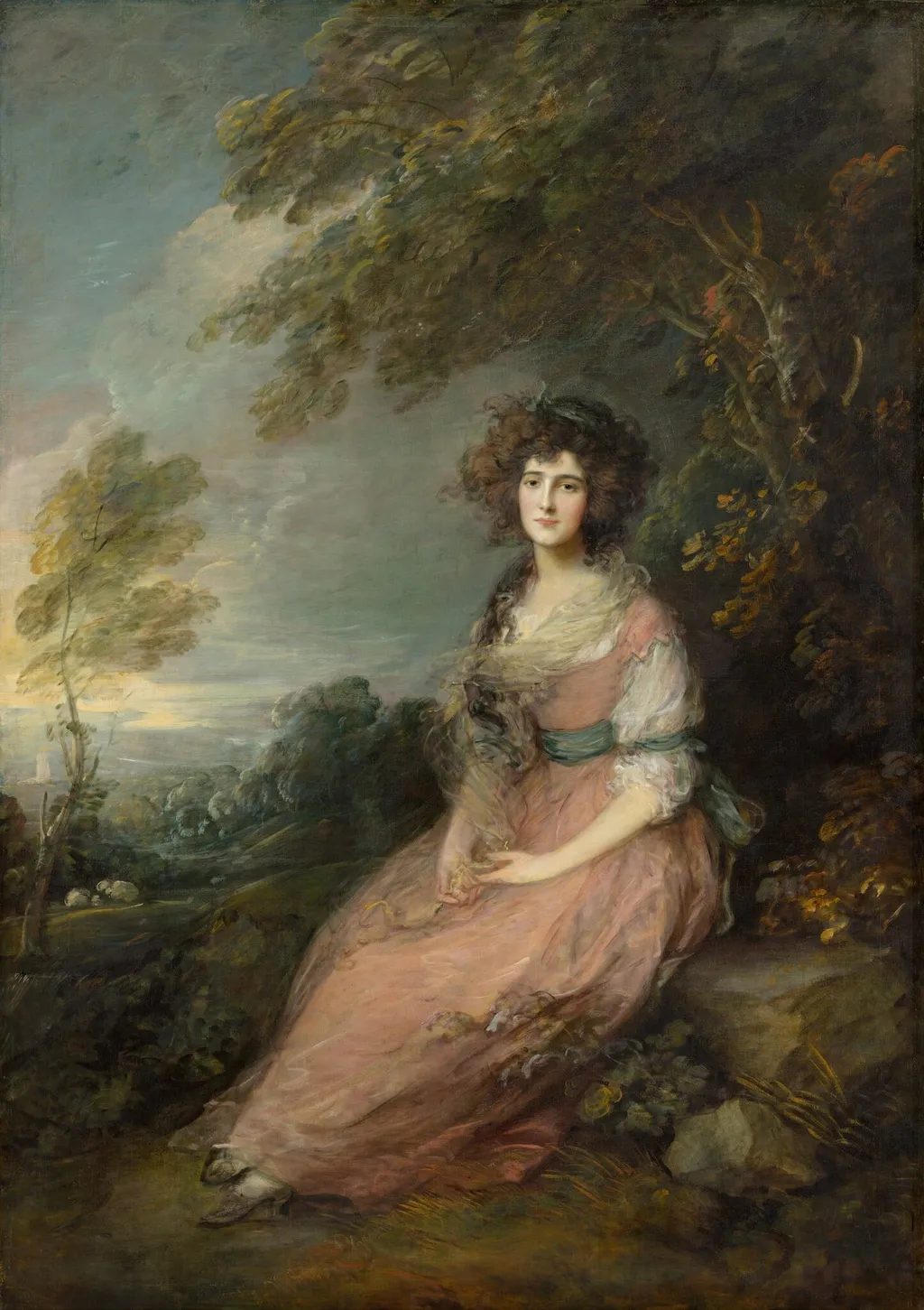
Mrs. Richard Brinsley Sheridan is an oil painting by the Rococo painting artist Thomas Gainsborough. It dates from 1786 and is held in the collection of the National Gallery of Art. This oil on canvas depicts Elizabeth Ann Linley, known as Mrs.
About this work
Subject & Meaning
This setting reflects both Gainsborough's artistic temperament and the sitter's documented preference for the quiet English countryside over London society.
The work depicts Elizabeth Ann Linley, the celebrated singer and wife of Richard Brinsley Sheridan, portrayed as a solitary figure within a windblown, romantic landscape. This setting reflects both Gainsborough's artistic temperament and the sitter's documented preference for the quiet English countryside over London society. Iconographically, the composition utilizes a diagonal arrangement where the lonely tree mirrors the subject's isolation, suggesting a longing for a life she could not fully achieve.
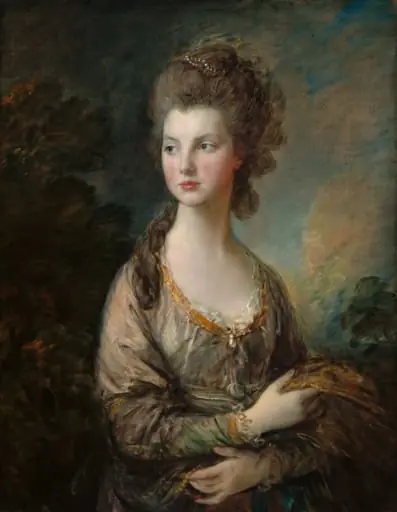
The painting conveys a sense of romantic melancholy through her indirect gaze and firm, sculptural features, contrasting her calm face with the nervous, impressionistic brushwork of her gown and surroundings. The interplay of her hair with the foliage and the reflection of sunset hues in her dress further integrates the human subject with nature. Ultimately, the portrait represents the tension between her worldly elegance and an inner, isolated vulnerability, capturing her fresh beauty alongside a hint of the sadness that preceded her early death.
Technique & Style
Executed in oil on canvas between 1785 and 1787, this full-length portrait measures 219.7 by 153.7 centimeters. Gainsborough employed a diagonal composition characteristic of the grand manner, utilizing a freely painted, impressionistic style. The artist applied liquid paint using a wet-into-wet technique, building rich, sumptuous effects through multiple layers while employing thin washes and free-flowing brushstrokes for details.
The sitter's gown features long, zigzagging strokes of thin oil to create vibrancy, contrasting with the calm, solid rendering of her face. A shimmering transparency in the hand-held scarf is achieved through long brushstrokes and diluted color. Stylistically, the work blends romantic melancholy with sculptural definition in the facial features, while the background landscape and the sitter's hair are treated with similar textural handling to unify the figure with her natural surroundings.
History & Provenance
Thomas Gainsborough painted this portrait of Elizabeth Ann Linley between 1785 and 1787, exhibiting the unfinished work at his Schomberg House studio in 1786. Due to Richard Brinsley Sheridan's financial difficulties, the painting entered the collection of his friend Harriet, Lady Robert Spencer (née Fawkener), reportedly saved from sheriff seizure by a servant who passed it over a wall to her Delapré Abbey garden. Although Sheridan intended to repurchase it, the work remained with the Bouverie family, passing by descent to General Everard Bouverie.
It was sold at Christie's on March 2, 1872, where Alfred de Rothschild purchased it for his father, Baron Lionel. The painting remained in the Rothschild family through successive inheritances until 1936, when it was sold to Duveen Brothers. The A.W. Mellon Educational and Charitable Trust acquired it in April 1937, gifting it to the National Gallery of Art later that year.
The portrait is held by the National Gallery of Art in Washington, D.C., as part of the Andrew W. Mellon collection. It entered the museum in 1937 as a gift from the A.W. Mellon Educational and Charitable Trust, which had purchased the work on April 26, 1937, from Duveen Brothers, Inc. Prior to this acquisition, the painting passed through the Rothschild family inheritance before being sold in 1936.
Historically, the work was exhibited at Thomas Gainsborough's studio at Schomberg House, Pall Mall, in 1786. Earlier in its provenance, it was displayed at Delapré Abbey in Northampton while in the possession of the Bouverie family.
Context
The portrait of Mrs. Richard Brinsley Sheridan is situated within the Romantic movement in British art, a classification reflected in its cataloguing (2). Exhibited at Gainsborough’s studio on Schomberg House, Pall Mall in 1786, the work was later described by the National Gallery of Art as freely painted and impressionistic in style, with a hint of romantic melancholy in the sitter’s gaze (3). It exemplifies Gainsborough’s tendency to place full‑length figures in landscape settings, suiting Elizabeth Linley’s love of the English countryside (3).
After remaining in private hands, passing through the Rothschild family, Duveen Brothers and the Mellon Trust, the painting entered the NGA’s Andrew W. Mellon collection in 1937 (1,4). Its romantic character and exhibition history mark it as an important example of late‑18th‑century English portraiture.
Overview
This oil on canvas depicts Elizabeth Ann Linley, known as Mrs. Richard Brinsley Sheridan, painted by English artist Thomas Gainsborough. Created between 1785 and 1787, the portrait captures a prominent figure of 18th-century society. It became part of the National Gallery of Art's collection in Washington, D.C., in 1937, representing a significant work from Gainsborough's later career.
Own this work as a print
Artist & collection

Artist
Thomas Gainsborough (; 14 May 1727 (baptised) – 2 August 1788) was an English painter, draughtsman and printmaker who specialised in portrait and landscape painting.