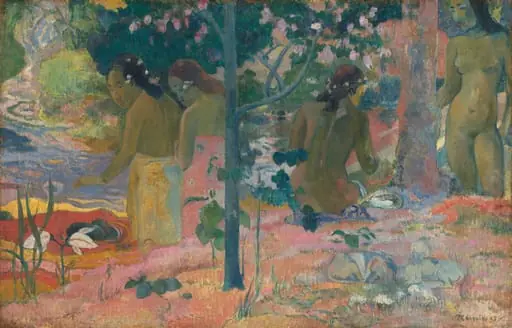
Artwork
Parau na te Varua ino (Words of the Devil)
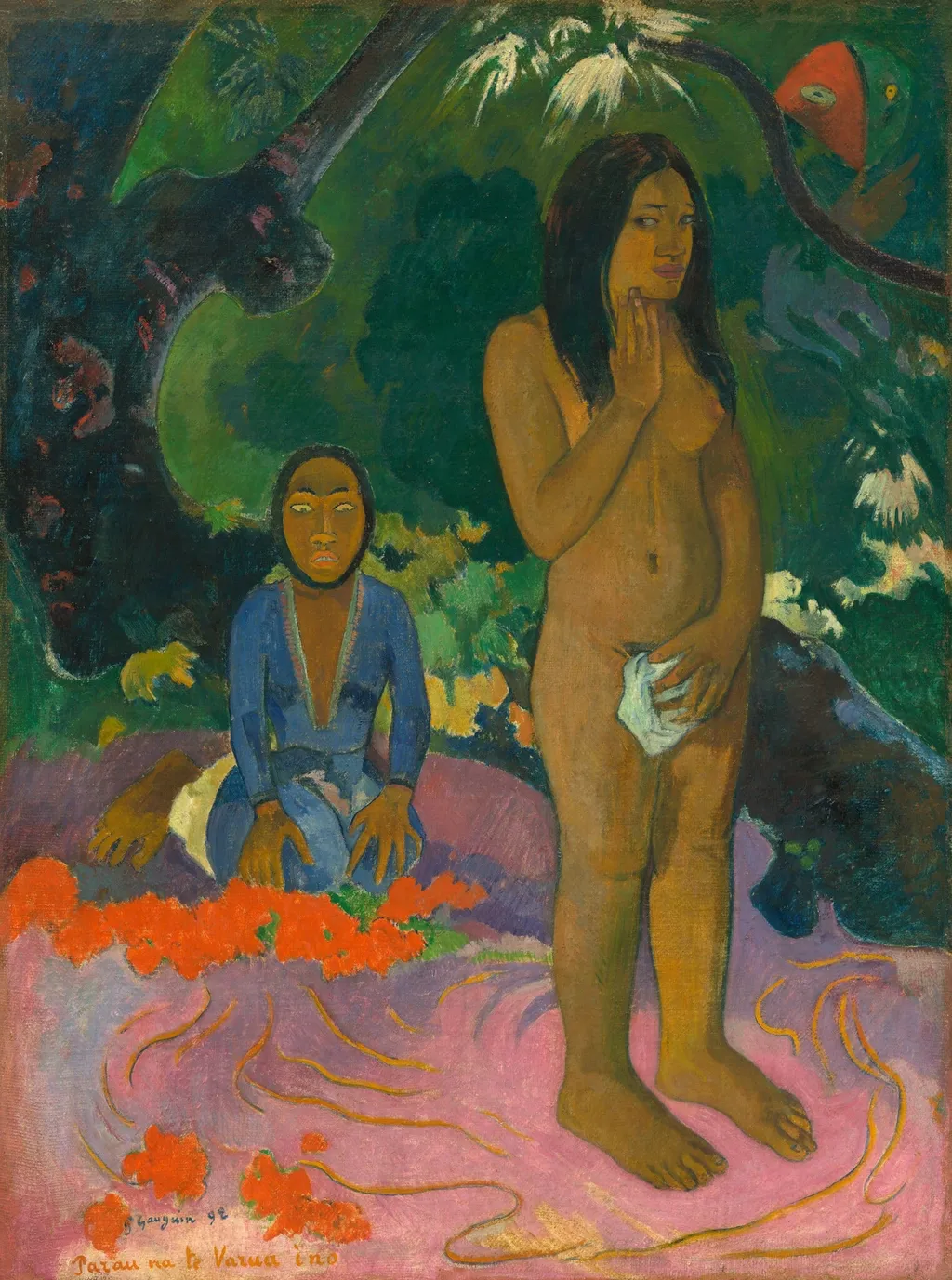
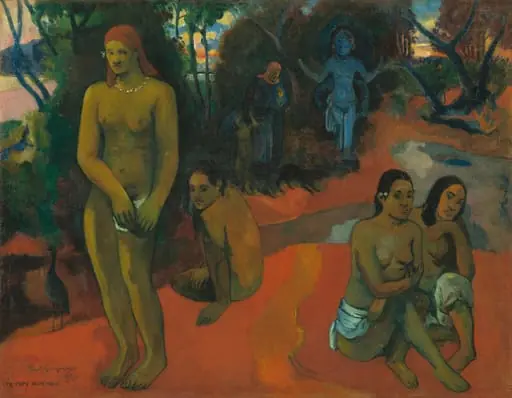
Parau na te Varua ino (Words of the Devil) is an oil painting by the Impressionist artist Paul Gauguin. It dates from 1892 and is held in the collection of the National Gallery of Art.
- Inscription
- Inscribed:lower left: P Gauguin 92 / Parau na te Varua ino
About this work
Subject & Meaning
The composition is horizontally divided by a tree root, separating a dark, green upper section representing the forest from a pinkish lower ground.
Painted in 1892 during his first stay in Tahiti, Parau na te Varua ino depicts a young nude Tahitian woman in the foreground who shields her genitalia and breast while looking back at a kneeling, masked man behind her. The title, translating to "Words of the Devil," remains ambiguous but likely refers to the male figure as an evil spirit or devil summoning the spirits of the dead. The composition is horizontally divided by a tree root, separating a dark, green upper section representing the forest from a pinkish lower ground.
This imagery connects Tahitian spiritual beliefs with Western iconography, as the woman's pose evokes medieval depictions of Eve in the Garden of Eden or the classical Venus de Medici. Consequently, the work explores themes of original sin, the loss of virginity, and human vulnerability, while challenging traditional Western standards of beauty through its depiction of a non-European subject.
Technique & Style
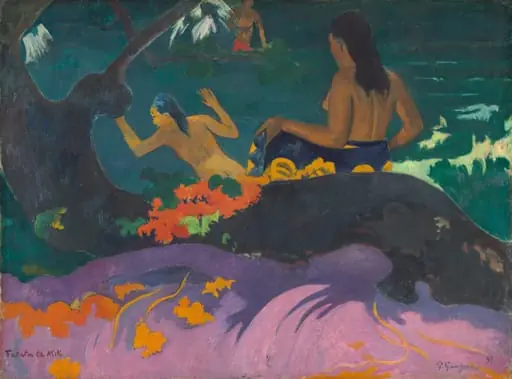
Executed in 1892, Parau na te Varua ino is an oil painting on canvas measuring 91.7 by 68.5 cm. Gauguin structurally divides the composition horizontally using a tree root, a motif recurring in his work Fatata te Miti. This division separates the canvas into distinct chromatic zones: the upper register features dark greens and blacks representing the forest depth, while the lower section utilizes vivid pink and red tones to depict the ground.
The artist employs these intense tropical colors to evoke sensual pleasure and contrast the foreground figure with the background. Stylistically, the nude Tahitian woman's pose references medieval depictions of Eve and the classical Venus de Medici, yet Gauguin elongates the form to challenge Western beauty standards. The kneeling masked man behind her recalls the spiritual figures found in Manao Tupapau, embodying a menacing presence derived from the artist's imagination rather than direct observation.
History & Provenance
Paul Gauguin painted Parau na te Varua ino in 1892 during his first stay in Tahiti. The canvas remained with the artist until it was offered at the Gauguin sale in Paris on 18 February 1895 as lot 10, where it was bought in. It later passed through George-Daniel de Manfreid in Paris, who on 17 October 1900 facilitated its purchase by the dealer Ambroise Vollard. A receipt from that transaction identifies the work by the inventory mark "AG," as recorded in the Wildenstein-Plattner Institute's catalogue raisonné of Gauguin's paintings from 1891 to 1903.
On 30 May 1906 Vollard sold the painting for 4,000 francs to Alexandre Berthier, 4th Prince de Wagram; the bill apparently went unsettled, and the canvas had returned to Vollard's stock (no. 5453) by 1910. By 1928 it was with Paul Rosenberg in Paris, after which it passed through Millet in Paris and Phileas Pluckett in Manchester before entering the stock of Paul Guillaume. In 1930 Guillaume sold it to Marie N. and W. Averell Harriman in New York.
It subsequently entered the W. Averell Harriman Foundation, which gifted it in 1972 to the National Gallery of Art in Washington, D.C.
Context
Scholarly readings of Parau na te Varua ino link its unsettling iconography to Gauguin’s Tahitian sojourn and his engagement with indigenous beliefs. The title’s literal translation, “Words of the Devil”, has been tied to the kneeling masked figure, interpreted as a malevolent spirit summoning the dead, a motif paralleled in the artist’s Manao Tupapau (Spirit of the Dead Watching).
Analyses emphasize the painting’s compositional and chromatic division, greens and blacks above, pinks below, anchored by a tree root that recurs across works from this period. The crouching nude’s pose, with hands shielding body and breast, has been read as evoking Eve in the Garden of Eden or the Venus de’ Medici, reframing Western paradigms of sin and beauty through a primitivist lens. Critics note Gauguin’s selective synthesis of Tahitian spirituality with European allegory, producing an image whose meaning remains deliberately ambiguous yet culturally transgressive.
Legacy
The painting has been recognized as a significant work in Gauguin's oeuvre for its symbolic depth and complex narrative. It was featured in the 1913 Armory Show, introducing modernist art to American audiences and contributing to Gauguin's rising reputation in the United States. After passing through several private collections, it entered the National Gallery of Art in Washington, D.C., in 1972, where it remains part of the permanent collection.
The work continues to influence discussions on postcolonial representation and the interpretation of non-Western subjects in modern art.
Overview
Parau na te Varua ino, painted in 1892 by Paul Gauguin, is an oil on canvas executed during his initial Tahitian period. The work is part of the National Gallery of Art’s collection. Its composition is bisected by a prominent tree root that also appears in Gauguin’s earlier piece Fatata te Miti, creating a visual division between two distinct color zones.
Own this work as a print
Artist & collection
Artist
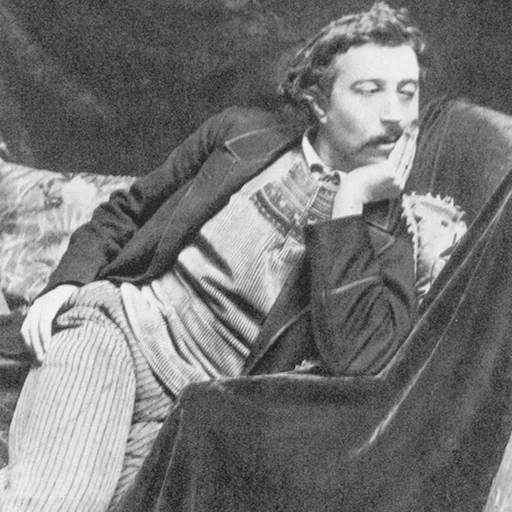
Eugène Henri Paul Gauguin (; French:; 7 June 1848 – 8 May 1903) was a French painter, sculptor, printmaker, ceramist, and writer, whose work has been primarily associated with the Post-Impressionist and Symbolist movements.