Artwork
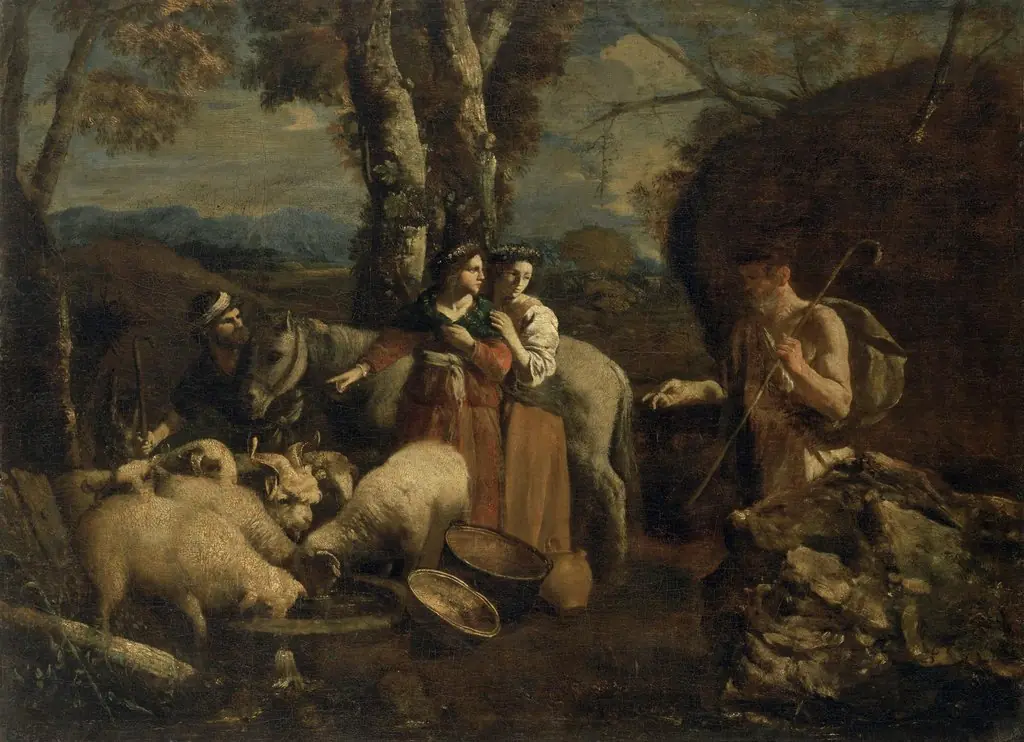
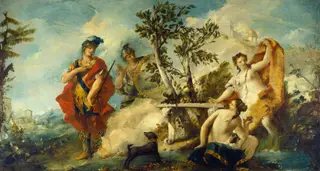
Erminia and the Shepherds
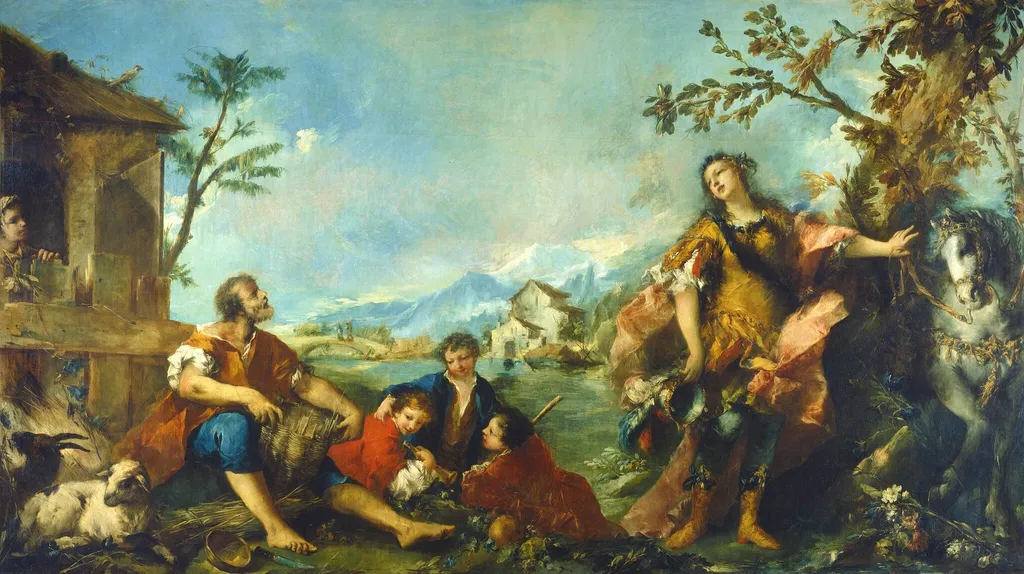
Erminia and the Shepherds is an oil painting by the Rococo painting artist Francesco Guardi. It dates from 1752 and is held in the collection of the National Gallery of Art.
About this work
Technique & Style
The painting is executed in oil on canvas, measuring 251.5 width by 442.2 cm. The work was created in 1750. The medium and support follow the standard Venetian practice of the period for large-scale narrative paintings. The canvas dimensions indicate an expansive format suited to the multi-figure composition drawn from Torquato Tasso's Jerusalem Delivered.
History & Provenance
Shelswell-White before being offered by an unspecified Dublin dealer in 1955 as works attributed to Giovanni Antonio Pellegrini.
The five Tasso paintings, including this work, were recorded in Ireland by the mid-19th century. Richard White, the second Earl of Bantry, is the earliest documented owner; he likely acquired them in Italy around 1820. By descent, the set passed to Mrs. Shelswell-White before being offered by an unspecified Dublin dealer in 1955 as works attributed to Giovanni Antonio Pellegrini.
The following year, David Carritt acquired them for Geoffrey Merton, after which Thomas Agnew & Sons handled the London sales before the National Gallery of Art, Washington, purchased the group in 1964.
The dating of the series to 1750 aligns with Francesco Guardi’s early production, though no direct commission record survives.
The painting is held in the collection of the National Gallery of Art in Washington, D.C., having been purchased by the institution in 1964 from Thomas Agnew & Sons of London. Prior to this acquisition, the work passed through the hands of dealer David Carritt, who acted for Geoffrey Merton in 1956, and was previously offered by an unspecified Dublin dealer in 1955 attributed to Pellegrini. The artwork's earlier provenance traces back to Richard White, the 2nd Earl of Bantry of County Cork, Ireland, who likely acquired it in Italy around 1820, after which it remained in the family by descent to Mrs. Shelswell-White.
While rumors have suggested the piece was once housed at Versailles or acquired as a work by François Boucher, these claims remain unsubstantiated in curatorial records.
Context
Scholarship regarding this work focuses heavily on its modern rediscovery and attribution within Francesco Guardi's oeuvre. The painting is recognized as part of a series illustrating Torquato Tasso's Gerusalemme liberata, a discovery detailed in early literature by Antonio Morassi and Fern Rusk Shapley. While some contemporary accounts attributed the find to a Dublin dealer, other narratives suggest the works were discovered by David Carritt in an Irish shed.
Art historical discourse has also addressed early confusion surrounding the series' authorship; Francis J.B. Watson speculated that the original owner, the Earl of Bantry, may have mistaken these Venetian works for paintings by François Boucher. Additionally, unsubstantiated rumors linking the canvases to Versailles have been noted in curatorial files but lack evidentiary support. The work's inclusion in the National Gallery of Art's collection solidifies its status as a key example of Guardi's narrative history painting from the mid-18th century.
Legacy
The 1750 canvas Erminia and the Shepherds entered the collection of the National Gallery of Art, Washington, D.C., in 1964, having passed from the Irish earl of Bantry through a Dublin dealer and a London firm before acquisition. Its provenance was clarified only gradually, with early scholarship noting the series' discovery in an Irish shed and attributing it to Guardi rather than the initially suspected Boucher. The work remains part of the National Gallery of Art's collection today.
Scholarship on the painting's reception is sparse, but its inclusion in the National Gallery of Art's holdings has ensured continued study of Guardi's late oeuvre, particularly his narrative cycles drawn from Torquato Tasso's Jerusalem Delivered. The discovery of this series contributed to renewed interest in Guardi's work during the mid‑twentieth century, though no major exhibitions or price records are documented for this specific canvas.
The painting is catalogued in the National Gallery of Art's collection and is accessible through the institution's online database, which provides technical details such as its dimensions (251.5 cm × 442.2 cm) and medium (oil on canvas).
Overview
Francesco Lazzaro Guardi’s Erminia and the Shepherds (1752) is an oil on canvas executed in the Rococo idiom. Though Guardi later became celebrated for his vedute of Venice, this work departs from his typical cityscapes, presenting a lyrical narrative scene rendered with the lightness and decorative flair characteristic of mid‑eighteenth‑century Venetian painting.
Subject & Meaning
The composition depicts a young woman in a bright yellow dress beside a white horse, engaged with a seated man and two boys amid a pastoral setting. The figures appear to be in the midst of a friendly encounter, suggesting a moment of hospitality or courtship within an idyllic countryside, a theme often explored in Rococo storytelling.
Artist & collection
Artist
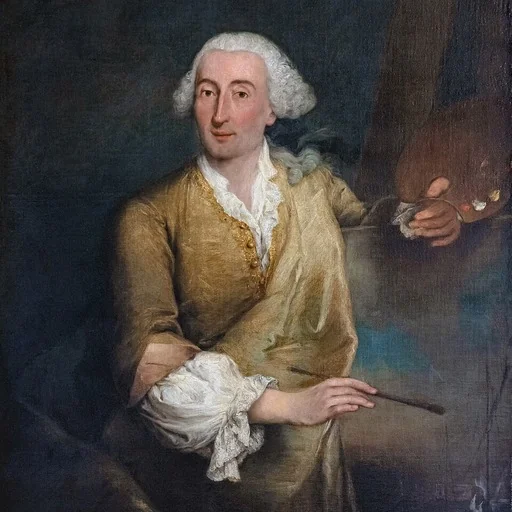
Francesco Lazzaro Guardi (Italian pronunciation:; 5 October 1712 – 1 January 1793) was an Italian painter, nobleman, and a member of the Venetian School.