Artwork
The Seven Deadly Sins and the Four Last Things
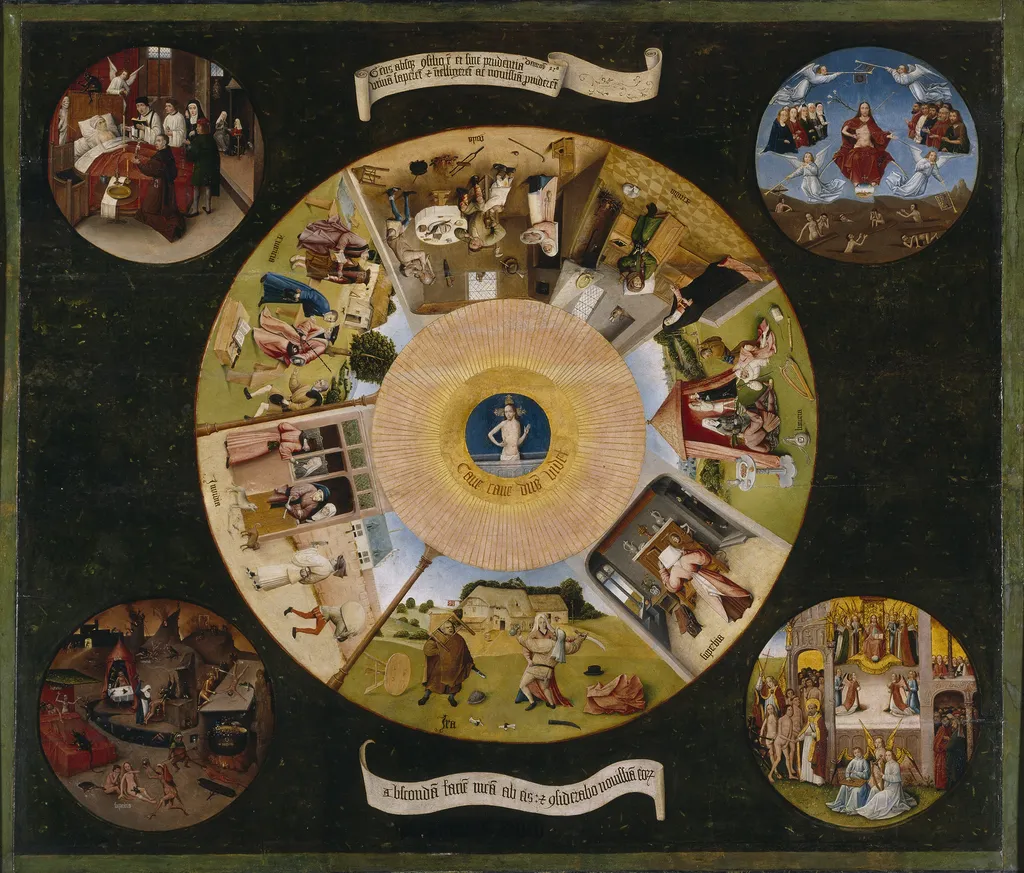
The Seven Deadly Sins and the Four Last Things is an oil painting by the Northern Renaissance artist Hieronymus Bosch. It dates from 1500 and is held in the collection of the Museo del Prado.
About this work
Subject & Meaning
The painting presents a circular composition in which seven scenes around the outer ring illustrate the Seven Deadly Sins, wrath, envy, greed, gluttony, sloth, lust, and pride, rendered as everyday Netherlandish interiors and landscapes rather than abstract personifications. Each vignette is labeled in Latin, grounding its moral meaning in contemporary life: a tavern brawl for wrath, a corrupt judge pocketing bribes for greed, a drunken feast for gluttony, a dozing man ignoring a nun’s admonishing dream for sloth, a picnic under a pink tent for lust, a woman admiring herself in a demon-held mirror for pride, and neighbors coveting a nobleman’s hawk and retinue for envy.
The four corner medallions depict the Four Last Things, Death, Judgment, Hell, and Heaven, arranged in a sequence that moves from mortal demise to final accounting. At the center, framed by an eye-like aureole, Christ emerges from the tomb, his wound visible; beneath is the warning Cave cave d[omi]n[u]s videt (“Beware, the Lord sees”), and above and below are Latin verses from Deuteronomy that underscore human folly and the need to foresee one’s end. Together the program warns that unchecked sin leads from death through judgment to eternal punishment, while the central image of the risen Christ offers the possibility of redemption through vigilant self-scrutiny.
Technique & Style
Within the main circle, seven distinct scenes depicting vices are separated by architectural elements such as columns or walls, occasionally linked by windows.
Executed in oil paint on wooden panels, this work measures approximately 120 by 150 cm, though specific records list dimensions of 119.5 by 139.5 cm. Technical analysis identifies the support material as poplar rather than the oak typically used by the artist, a factor that has complicated dendrochronological dating. The composition is structured around a large central circle surrounded by four smaller medallions in the corners, a layout unique among the painter's oeuvre. Within the main circle, seven distinct scenes depicting vices are separated by architectural elements such as columns or walls, occasionally linked by windows.
The central motif features Christ emerging from a tomb within a radiant band symbolizing the eye of God. Stylistically, the work presents sins through genre-like scenes of daily life rather than traditional allegorical figures, characterized by varied brushstrokes and evidence of pentimenti in the underpainting.
History & Provenance
The Seven Deadly Sins and the Four Last Things is a circular oil painting on poplar panel, created between 1500 and 1510, currently housed in the Museo del Prado in Madrid. It depicts seven deadly sins arranged clockwise around a central circle, surrounded by four circular vignettes illustrating the 'Four Last Things', Death, Judgment, Heaven, and Hell, with a central 'pupil' showing Christ emerging from the tomb and the inscription 'Cave cave dominus videt'. The work was collected by Philip II of Spain prior to 1560, who regarded it as an original Bosch and displayed it in his bedroom at El Escorial before donating it to the monastery in 1574, where it was cataloged as a Bosch original.
Its provenance includes a 1560 reference by Felipe de Guevara to an unnamed 'discipulo' who copied Bosch's style, leading to 19th-century attributions to this pupil, though later scholarship, including technical analysis by the Bosch Research Conservation Project, has largely dismissed this view. Modern consensus, based on stylistic analysis of clothing, panel material (poplar rather than oak), and pentimenti, places its creation between 1505 and 1510, consistent with Bosch's later period, and attributes it to Bosch himself rather than a follower.
The painting is held in the Museo del Prado, Madrid, with inventory number P02794.
It entered the Spanish royal collection before 1560 and was recorded in Philip II’s bedroom at El Escorial. In 1574 Philip II donated it to El Escorial, where it remained until transferred to the Museo del Prado, where it has been on continuous display since at least 1898. Since 2015 the work has been exhibited in a sealed case at the Prado.
Legacy
The painting's legacy is defined by its long-standing status as a favorite of Philip II of Spain, who acquired it before 1560 and displayed it in his bedroom at El Escorial until donating it to the monastery in 1574. For centuries, the work was cataloged as an autograph piece by Hieronymus Bosch, though its authorship has been a subject of scholarly debate since the late 19th century. While Felipe de Guevara's 1560 writings initially fueled theories that a pupil created the work, modern attribution remains contested; the Bosch Research and Conservation Project classified it as a follower's work in 2015, a conclusion the Museo del Prado officially rejected.
The painting's unique composition, featuring daily life scenes rather than pure allegory, has influenced literary analysis, serving as a central element in William Gaddis's novel The Recognitions.
Overview
The work, titled The Seven Deadly Sins and the Four Last Things, is an oil painting on wooden panels arranged in a circular format. It consists of a central large circle surrounded by four smaller circles, each containing numerous miniature scenes that illustrate moral and eschatological themes.
Context
The piece reflects the late medieval preoccupation with didactic imagery, combining moral instruction with eschatological warning. By integrating scriptural quotations from Deuteronomy alongside visual representations of sin and the afterlife, the work aligns with contemporary devotional practices that used vivid pictorial narratives to educate viewers about spiritual peril.
Own this work as a print
Artist & collection
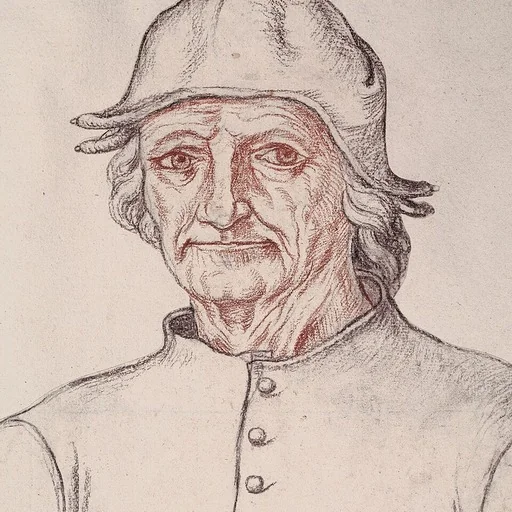
Artist
Hieronymus Bosch (; Dutch:; born Jheronimus van Aken; c. 1450 – 9 August 1516) was a Dutch painter from Brabant. He is one of the most notable representatives of the Early Netherlandish painting school. His work,…