Artwork
Leda and the Swan
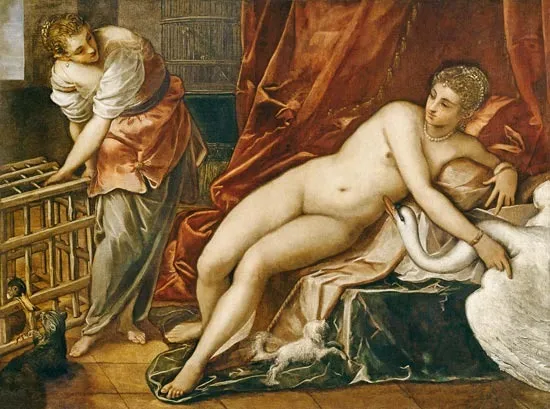
Leda and the Swan is an oil painting by the Mannerist artist Jacopo Tintoretto. It dates from 1550 and is held in the collection of the Uffizi Gallery.
About this work
This painting is called Leda and the Swan. It's an oil painting on canvas.
The artist, Jacopo Tintoretto, created it around 1550. There was some doubt about whether it was really his work, but restorations in 1988 and 1994 confirmed its authenticity.
To learn more about the style and methods used in this painting, look up the technique of chiaroscuro.
Subject & Meaning
The composition includes various animals, such as a dog rushing toward its mistress, a parrot in the background, and a cat, which frame the central encounter.
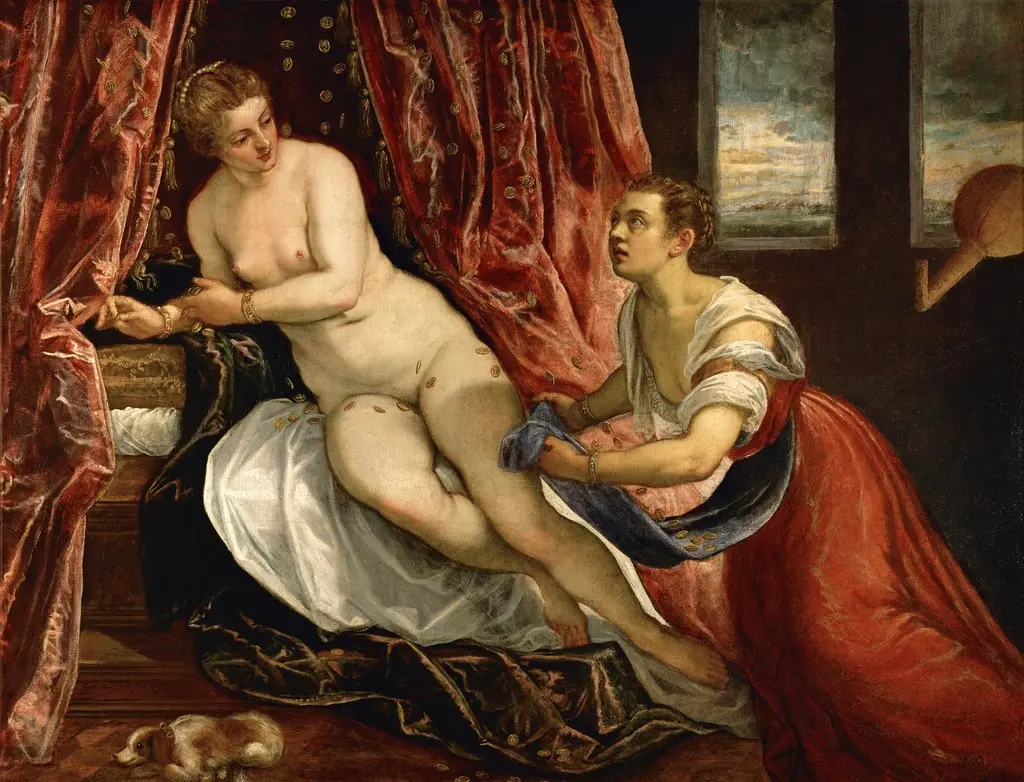
Jacopo Tintoretto’s Leda and the Swan depicts the mythological union of Zeus, disguised as a swan, and the mortal Leda. The scene is set in a domestic interior where a semi-reclining, nude Leda reaches toward the swan while glancing at a servant standing near a cage containing a duck. The composition includes various animals, such as a dog rushing toward its mistress, a parrot in the background, and a cat, which frame the central encounter.
Leda is adorned only with pearls in her hair and necklace, emphasizing her beauty within the Mannerist style. Art historians suggest that such Venetian Renaissance depictions of mythological figures often served as portraits of contemporary courtesans, grounding the divine narrative in the recognizable social realities of 16th-century Venice.
Technique & Style
Tintoretto’s Leda and the Swan (c. 1550) is executed in oil on canvas, measuring 167 × 221 cm []. The support, a large, horizontally oriented canvas, accommodates the dynamic composition, characterized by rapid, fluid brushwork typical of the Venetian Mannerist style. The handling is notably loose, with figures rendered through soft transitions rather than sharp contours, creating a luminous interplay between forms and their surroundings [].
Highlights, such as the pearls adorning Leda’s neck and hair, are applied with abrupt, almost improvisational strokes, contrasting with darker, more opaque passages to enhance depth [].
Stylistically, the work employs a diagonal tension, with Leda’s reclining body forming a dynamic axis countered by the opposing diagonal of the servant, generating a bold “V”-shaped composition []. The crimson drapery behind Leda intensifies the contrast with her pale flesh, a hallmark of Tintoretto’s dramatic use of color. Restorations in 1988 and 1994 reaffirmed the painting’s autograph status, revealing its original vibrancy despite centuries of wear [].
History & Provenance
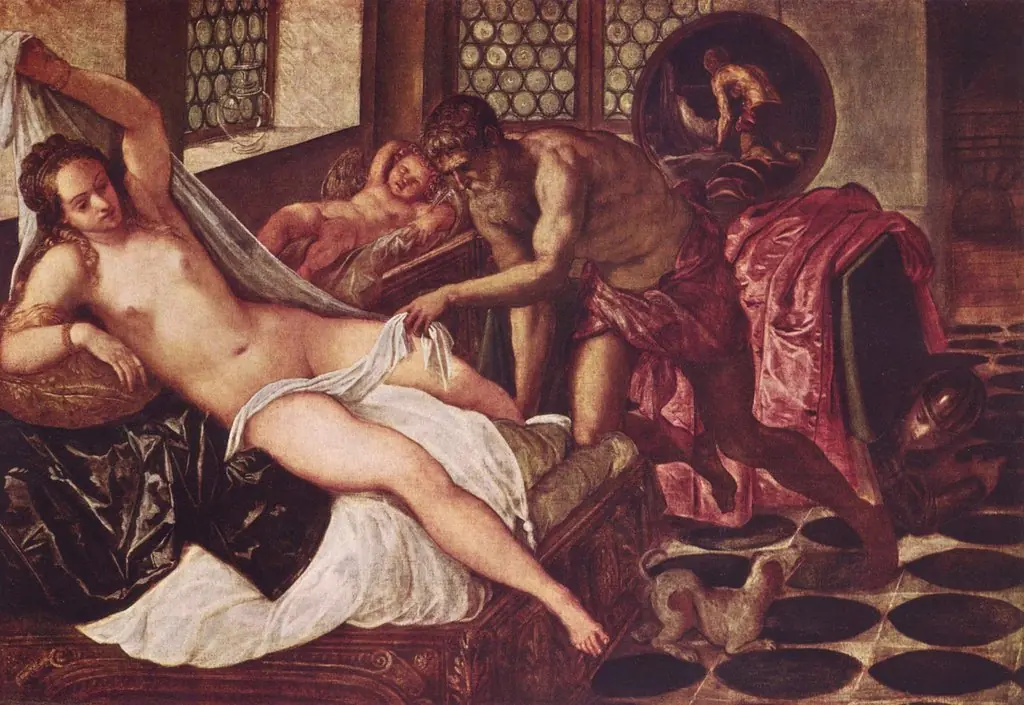
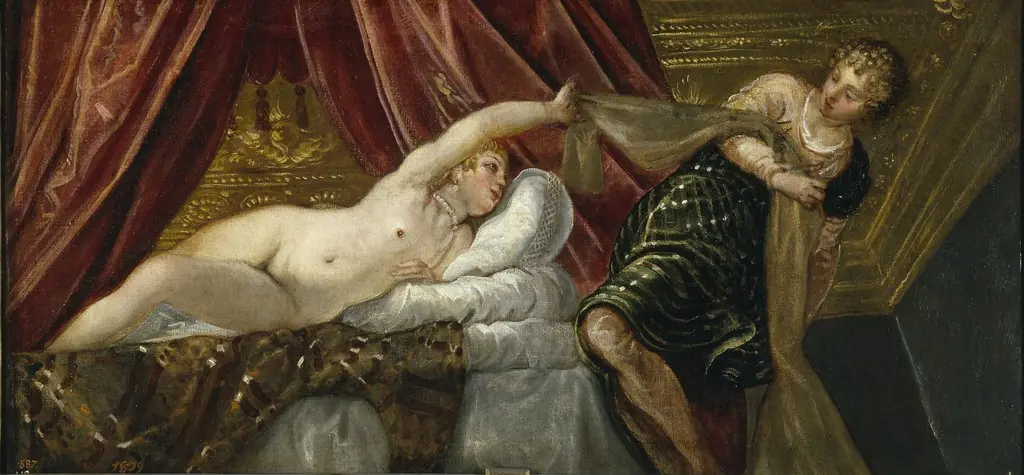
Leda and the Swan is an oil on canvas by Jacopo Tintoretto, dated by most scholars to c. 1550–1560, though its precise dating has long divided critics. The work is now commonly grouped with mythological and biblical compositions of the same decade, such as Mars and Venus Surprised by Vulcan (Alte Pinakothek) and Joseph and Potiphar's Wife (Museo del Prado).
By the late eighteenth century the painting was in the Orleans Collection in Paris. It subsequently moved to London, where it was acquired by the Duke of Bridgewater, and in 1857 it passed to Paul Norton. In 1895 Arturo De Noè Walker donated it to the Uffizi in Florence, where it remains today.
The Uffizi also holds a second autograph version, formerly in the collection of Alessandro Contini-Bonacossi, from which the servant figure was cut away at an unknown date; this variant is regarded as the likely prototype for the exhibited painting. Restorations in 1988, retouched in 1994, resolved earlier doubts about the work's autograph status.
The painting is held by the Uffizi Gallery in Florence. It was donated to the museum in 1895 by Arturo De Noè Walker. Earlier in its provenance, the work was in the Orleans Collection in Paris during the late eighteenth century, then passed to the Duke of Bridgewater in London, and was purchased in 1857 by Paul Norton.
The Uffizi also retains a second version in storage, formerly from the collection of Alessandro Contini-Bonacossi, from which the servant figure was removed at an unspecified date; this variant is regarded as a likely prototype for the exhibited canvas. Restorations carried out in 1988 and retouched in 1994 confirmed the autograph status of the painting.
Context
Scholarly opinion on the painting's dating has long been divided, though critics now generally place it in the 1550s alongside Tintoretto's mythological and biblical works such as Mars and Venus Surprised by Vulcan and Joseph and Potiphar's Wife.
Doubts about the work's autograph status were resolved by restorations in 1988 and 1994, which revealed its remarkable pictorial qualities. The Uffizi also holds a second autograph version in its deposits from the Alessandro Contini-Bonacossi collection; this cut-down variant, missing its servant figure, is considered the probable prototype for the gallery painting.
The provenance traces a notable European trajectory: from the Orleans Collection in late 18th-century Paris, through the Duke of Bridgewater in London and Paul Norton (1857), before Arturo De Noè Walker's 1895 donation to the Uffizi. Stylistically, scholars emphasize its dynamic "V"-shaped composition and particularly loose brushwork, where figures merge softly with the background through luminous reflections rather than firm contour lines.
Overview
Jacopo Tintoretto's painting, Leda and the Swan, executed in oil on canvas, depicts a scene from classical mythology. While its precise creation date has been debated, art historians generally attribute it to the mid-16th century, specifically the 1550s. This work is characteristic of the Venetian master's engagement with dramatic narrative and dynamic composition during a prolific period of his career.
Artist & collection

Artist
Jacopo Robusti (late September or early October 1518 – 31 May 1594), best known as Tintoretto ( TIN-tə-RET-oh; Italian:; Venetian: ), was an Italian Renaissance painter of the Venetian school.