Artwork
Self-Portrait with his first Wife at the Clavichord
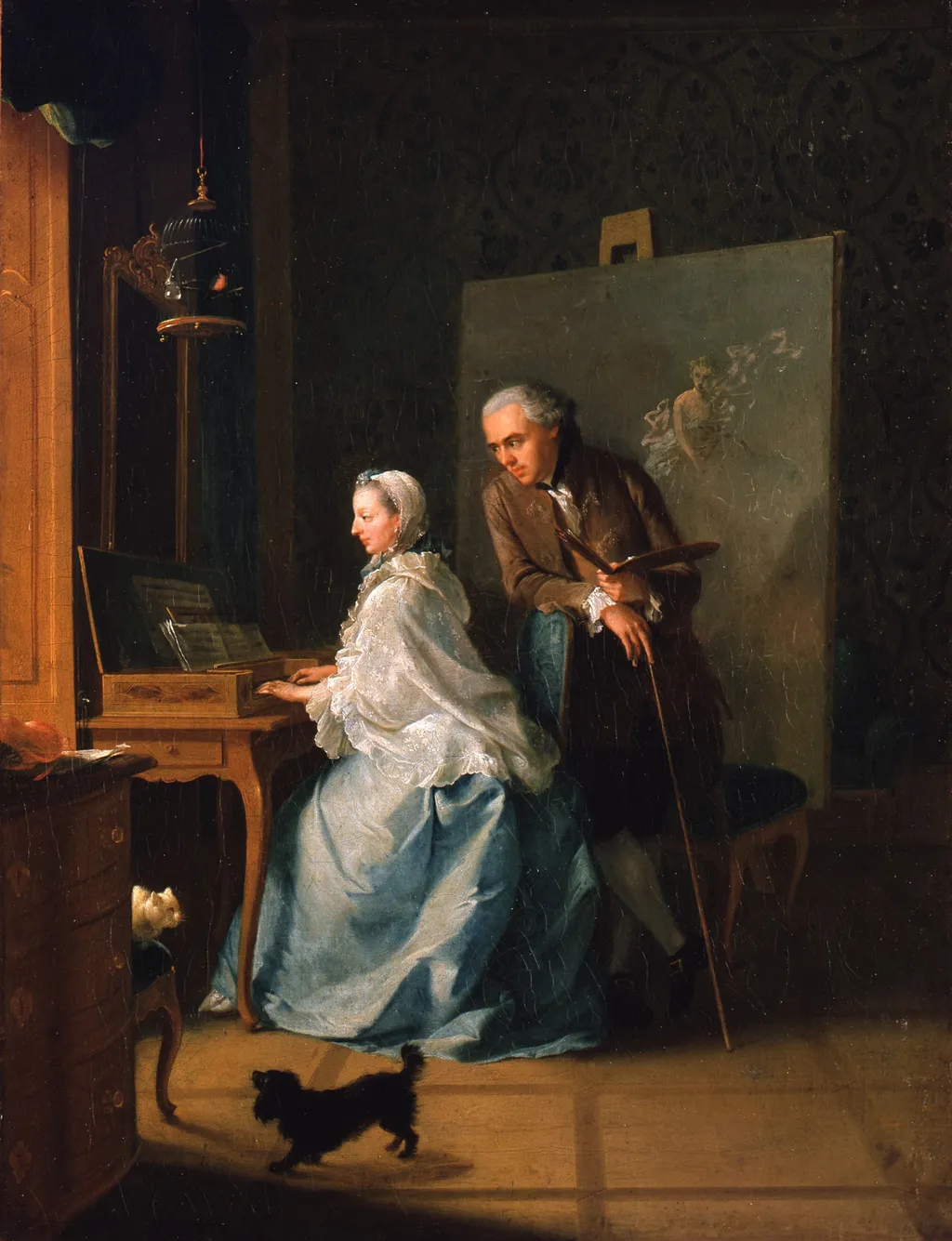
Self-Portrait with his first Wife at the Clavichord is an oil painting by the Rococo painting artist Johann Heinrich Tischbein. It dates from 1756 and is held in the collection of the Gemäldegalerie Berlin.
About this work
Overview
Self-Portrait with his first Wife at the Clavichord is an oil-on-canvas painting by the German artist Johann Heinrich Tischbein the Elder (1722-1789), executed in 1756. Measuring 48 by 34 centimetres, this intimate double portrait depicts the newly married artist and his first wife, Marie Sophie Robert (1726-1759), in a domestic interior. The work is held by the Gemäldegalerie Berlin (inventory number 1697) and represents a significant example of mid-eighteenth-century German portraiture, blending personal narrative with professional self-fashioning. Its small scale and detailed observation distinguish it within Tischbein's oeuvre, offering insight into the life of a court painter who had recently achieved both professional recognition and marital happiness.
Subject & Meaning
The painting presents Marie Sophie seated at a clavichord, her hands on the keys, wearing a pale blue gown with white lace shawl and cap.
The painting presents Marie Sophie seated at a clavichord, her hands on the keys, wearing a pale blue gown with white lace shawl and cap. Behind her stands Tischbein himself, holding a painter's palette and brush, leaning on a maulstick. To his right rests a large canvas on an easel displaying a partially painted figure. The scene unfolds in a dim interior with dark walls and a tiled floor, where a small black dog stands in the foreground and a white cat sits on a chair to the left. Near the window hangs a birdcage with a bullfinch, and sheet music rests on the instrument. Warm light enters from the left, illuminating the figures and creating deep shadows. The composition balances the sister arts of painting and music, though scholars debate whether this embodies emblematic notions from previous centuries or simply reflects the unsophisticated narrative delight of a prosperous Hessian citizen. The "picture within the picture" shows preparatory indications for Menelaus in Combat with Paris, a mythological scene Tischbein completed in 1757; the barely visible outline of Venus rescuing Menelaus has been interpreted as an allusion to the young couple's marital bliss.
Technique & Style
Executed in oil on canvas, the painting displays a restrained chromatic intensity built from browns, blues, whites, and muted greens. The paint surface shows fine craquelure throughout. The background consists of brown wallpaper with stencilled blue ornaments. Compositionally, the work achieves notable balance, with the figures arranged to create harmony between the domestic and professional spheres. The handling of light demonstrates Tischbein's training in academic French painting and his exposure to Venetian influences, particularly the work of Pietro Longhi, whom he likely encountered during his Italian升 studies in Italy between 1748 and 1751. The warm leftward illumination that models the figures and creates deep shadows reflects the portrait traditions of Rigaud and Largillierre, whose works Tischbein studied in Paris under Carle Vanloo. The oversized "preliminary work" on the easel, disproportionately large relative to the finished composition it represents, ensures its recognisability within the Berlin picture's confined space.
Context
Johann Heinrich Tischbein the Elder emerged from a large family of artists. Apprenticed at age fourteen to the wallpaper painter Zimmermann in Kassel, he received promotion from the Count of Stadion for a study trip to Paris, where he entered the workshop of Carle Vanloo. From 1748 to 1751 he travelled in Italy, befriending Piazzetta in Venice. Upon his return to Germany in late 1751, he was named court painter to Landgrave William VIII of Hesse-C, an appointment formally conferred on 14 April 1753. In 1762 he became professor of painting at the Collegium Carolinum. The self-portrait belongs to a period of professional consolidation and personal happiness, created shortly after his marriage and during his tenure as court painter. The pictorial type of the artist interrupted at work by domestic or musical companionship may have been inspired by Pietro Longhi, whose genre scenes Tischbein likely encountered in Venice. Scholarly attention, notably by Rainer Michaelis for the Gemäldegalerie Berlin's 2019 publication 200 Masterpieces of European Painting, has examined the work's layered meanings and its place within Tischbein's developing career.
Legacy
The painting occupies a significant position in Tischbein's oeuvre as his first self-portrait with his first wife, establishing a model he would revisit. Its influence extends through the etching he produced after it in 1756, which disseminated the composition more widely. The work has served as a touchstone for understanding the intersection of professional identity and domestic intimacy in eighteenth-century German art. The existence of a later variation, formerly in the artist's family and sold in 2017, attests to the composition's continued resonance for Tischbein himself and subsequent collectors. As a document of a Hessian court painter's self-representation at the moment of his rise to prosperity and status, the painting offers art historians a nuanced case study in how artists of the period negotiated between personal narrative and professional ambition. Its preservation in the Gemäldegalerie Berlin ensures its accessibility for ongoing scholarship on German portraiture and the cultural life of the period.
Own this work as a print
Artist & collection
Artist
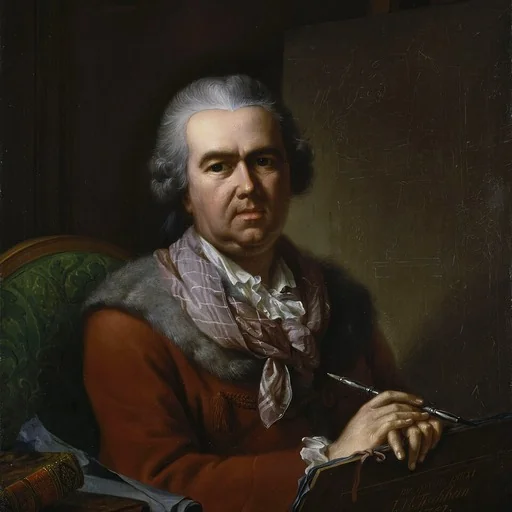
Johann Heinrich Tischbein (3 October 1722 – 22 August 1789) was a German painter.

- Familiegroep bij een klavecimbel
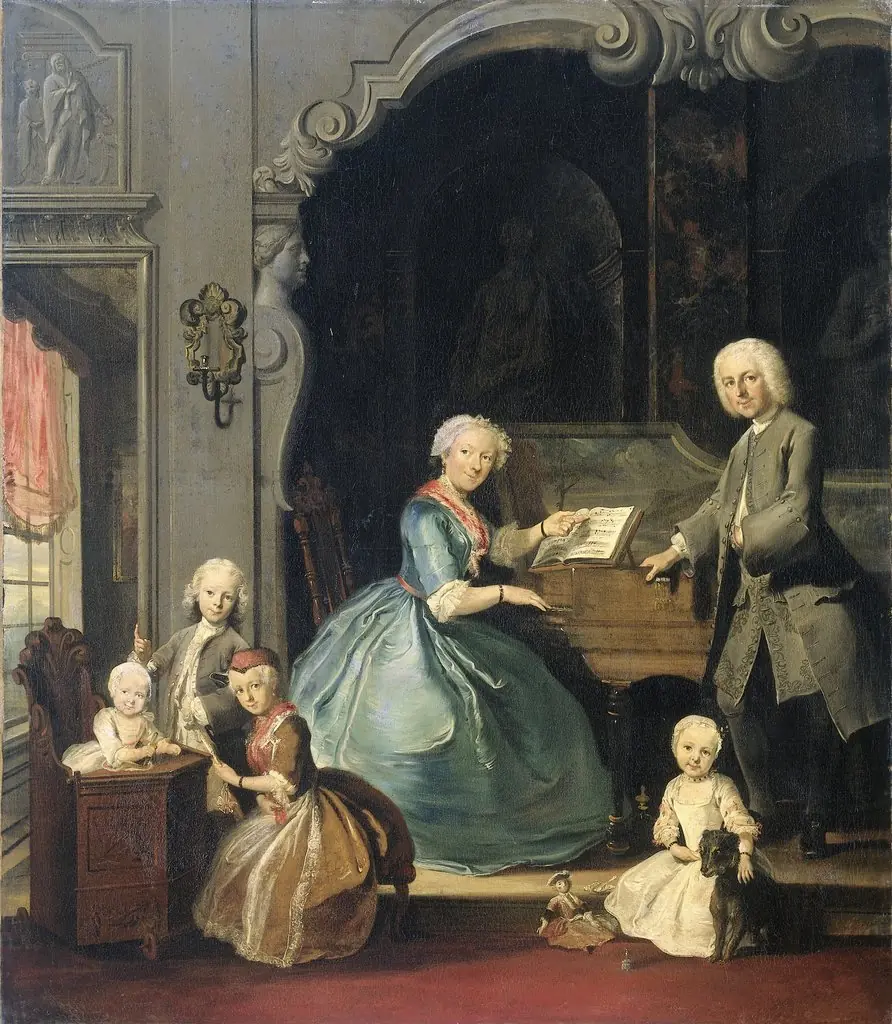 Family Group near a Harpsichord
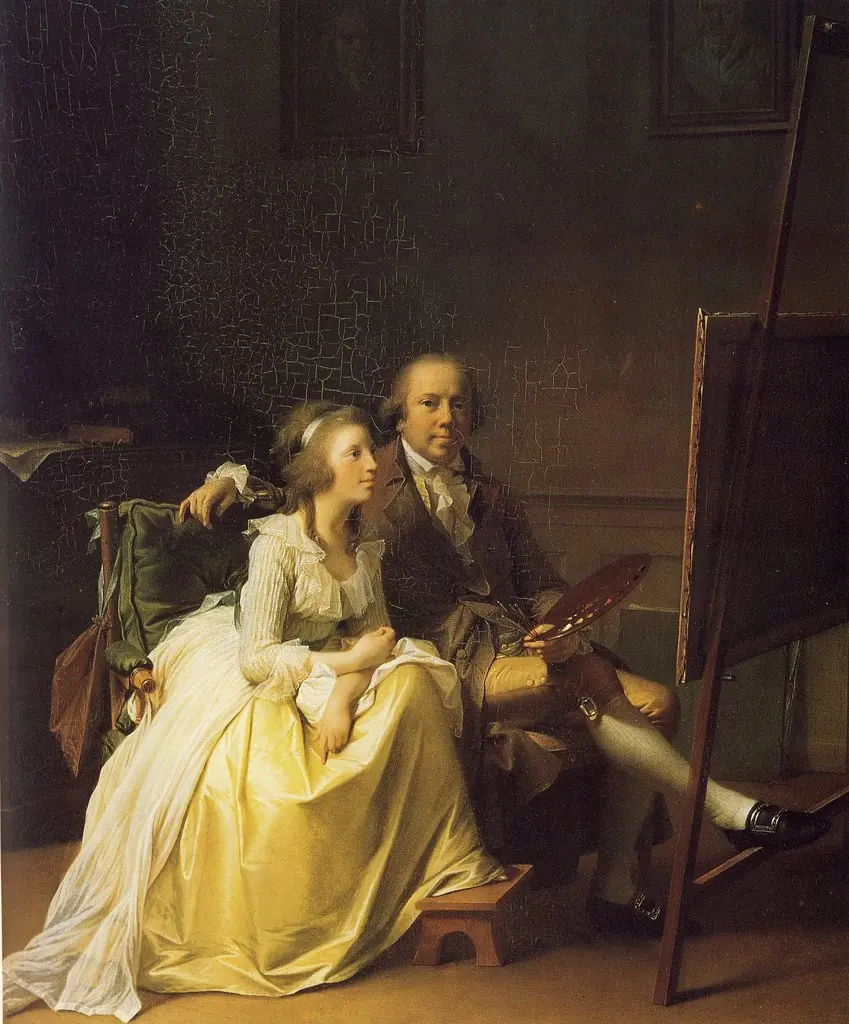 The Artist and his Wife Rosine, née Dørschel
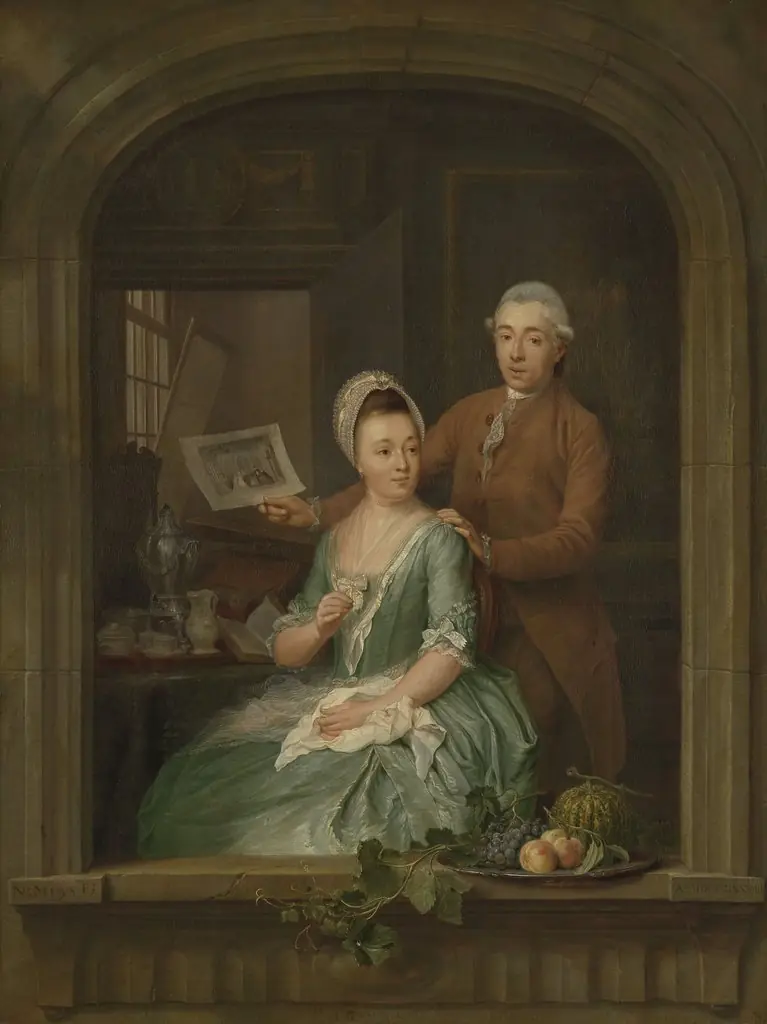 Portrait of Robert Muys and his Wife Maria Nozeman
 Les offres seduisantes
 Untitled
 Domestic Scene
 Familienbild, am Spinett
 A Painter with his Wife
 Unseemly Love, perhaps a scene of the Widower Joost with Lucia, 2nd scene from the play "De wanhebbelijke liefde" by CJ van der Lijn
 The Indiscreet Gentleman
 The Music Party