Artwork
Salvator Mundi
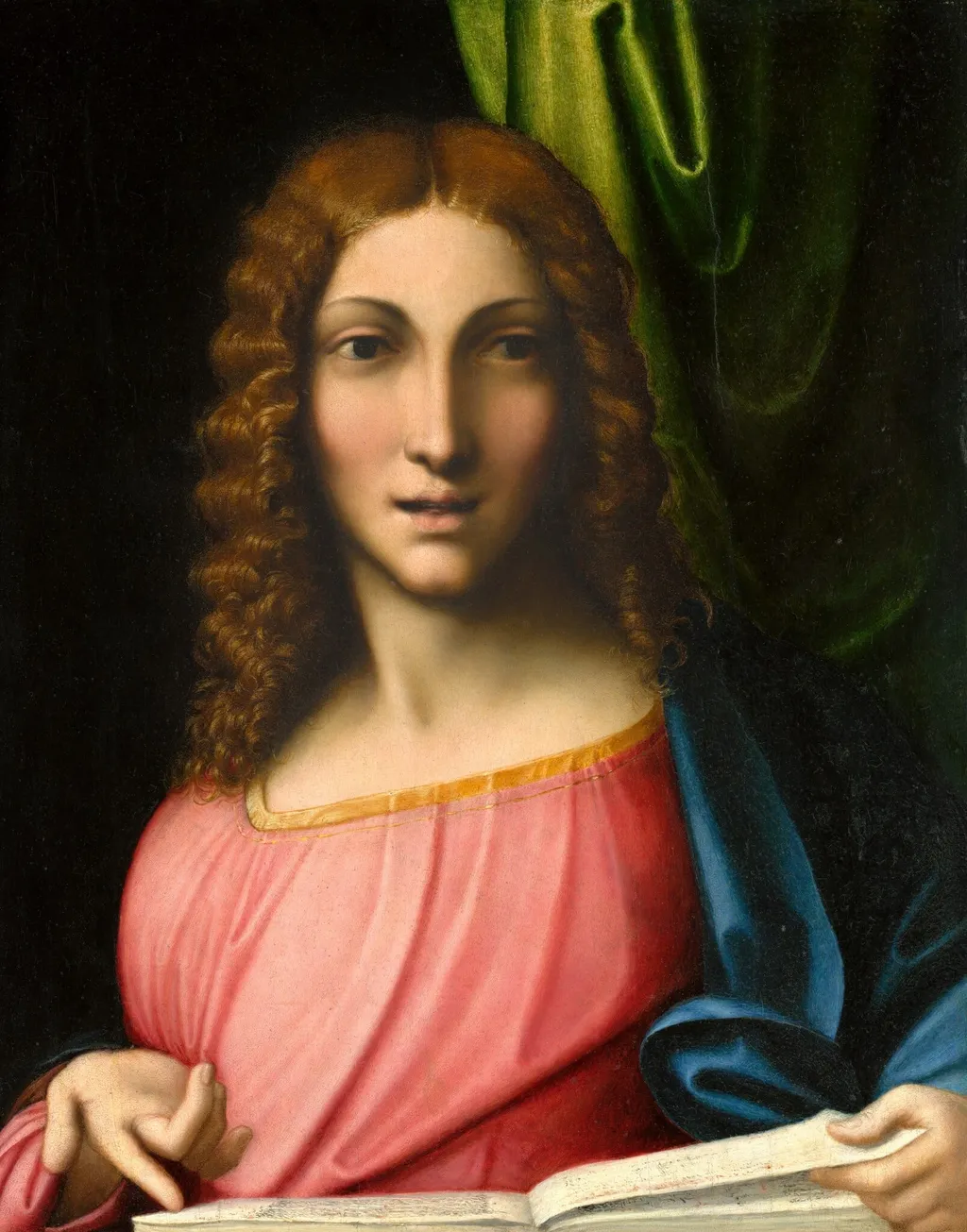
Salvator Mundi is an oil painting by the Mannerist artist Antonio da Correggio. It dates from 1515 and is held in the collection of the National Gallery of Art.
About this work
Subject & Meaning
The work depicts a youthful, beardless Christ, likely around twelve years old, shown in a half-length format against a dark background.
The work depicts a youthful, beardless Christ, likely around twelve years old, shown in a half-length format against a dark background. Iconographically, the figure wears a pink tunic with a squared gold neckline and a blue mantle. He rests a book on an implied parapet, holding a page with one hand while gesturing with the other, his mouth slightly open and gaze directed persuasively at the viewer.
This specific arrangement suggests a moment of scriptural explanation, representing either the twelve-year-old Jesus disputing with doctors in the Temple or reading from Isaiah in the synagogue at Nazareth. By isolating the figure rather than depicting the full narrative scene with scribes, the composition places the observer in the role of the learned doctors listening to Christ's wisdom. The depiction reflects Leonardesque influences, particularly in the soft modeling and feminine beauty of the subject.
History & Provenance
Dated to approximately 1513, this oil on panel by Antonio da Correggio is considered an early work, potentially created within the second decade of the sixteenth century. Scholars suggest a possible connection to a commission originally requested by Isabella d'Este from Leonardo da Vinci for a depiction of the twelve-year-old Christ, which Leonardo never executed; the Marchesa may have subsequently turned to the young Correggio while he was in Mantova. The painting remained obscure until its rediscovery around 1930 in the aristocratic collection of Lord Kinnaird at Rossie Priory, Scotland.
By 1947, it was handled by P & D Colnaghi in London and New York before passing to a private owner in Manchester. In May 1956, the Hans Schaeffer Galleries of New York acquired the work, selling it the following year to the Samuel H. Kress Foundation. Kress donated the painting to the National Gallery of Art in Washington, D.C., in 1961.
The painting is held in the collection of the National Gallery of Art in Washington, D.C., specifically within the Samuel H. Kress Collection. Its acquisition history traces from a private aristocratic collection in Scotland, reportedly by 1930, to P & D Colnaghi in London and New York by 1947. Following a period with a collector in Manchester, the work was acquired by Hans Schaeffer Galleries in New York in May 1956.
It was subsequently sold to the Samuel H. Kress Foundation in 1957 and gifted to the National Gallery of Art in 1961. The provided sources document this provenance chain but do not list specific public exhibitions or display an inventory accession number beyond the gallery's internal cataloging references.
Context
The work, an oil panel painted circa 1513 by Antonio da Correggio, portrays a youthful Christ holding a book amid a darkened backdrop, a composition linked to Leonardo’s sfumato and Venetian colorism. Scholars note its early date within Correggio’s oeuvre and its possible connection to a lost commission referenced by Isabella d’Este. The painting’s iconography, Christ among the doctors, draws on a popular Renaissance motif, yet its intimate half‑length format and gestural emphasis reflect a transitional phase toward High Renaissance naturalism.
Its provenance records a 1930 rediscovery, a 1956 sale to Samuel H. Kress, and donation to the National Gallery of Art in 1961. Critical discourse emphasizes its role as a pivotal example of Correggio’s synthesis of Leonardo’s modeling with Venetian color, marking a significant moment in early sixteenth‑century Italian art.
Overview
The painting titled Salvator Mundi is an oil on panel work depicting a youthful figure, understood to be Jesus, positioned centrally on a table. He is encircled by several older men, likely scholars or doctors, who observe him with focused attention. The composition conveys a sense of quiet intimacy, drawing the viewer into the contemplative interaction between the figures.
Technique & Style
Executed in oil on panel, the artwork demonstrates a focused approach to rendering the figures and their interaction. The painter employs a style that emphasizes the boy's composed and self-assured demeanor, contrasting with the attentive expressions of the surrounding men. The overall aesthetic, characterized by its quiet intensity and intimate scale, bears a resemblance to the artistic manner of Correggio, suggesting a shared sensibility in depicting emotional nuance and graceful forms.
Own this work as a print
Artist & collection

Artist
Antonio Allegri da Correggio, usually known as just Correggio, was an Italian Renaissance painter who was the foremost painter of the Parma school of the High Renaissance, who was responsible for some of the most…