Artwork
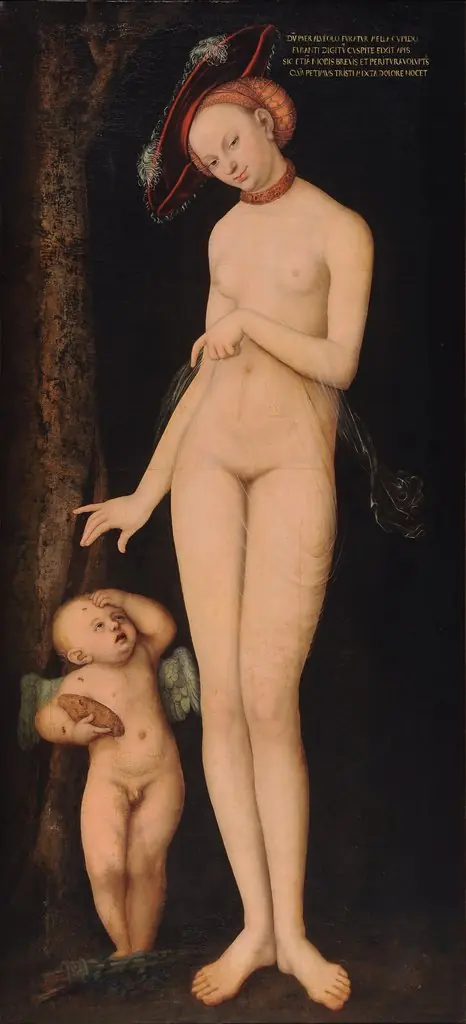
Venus and Cupid
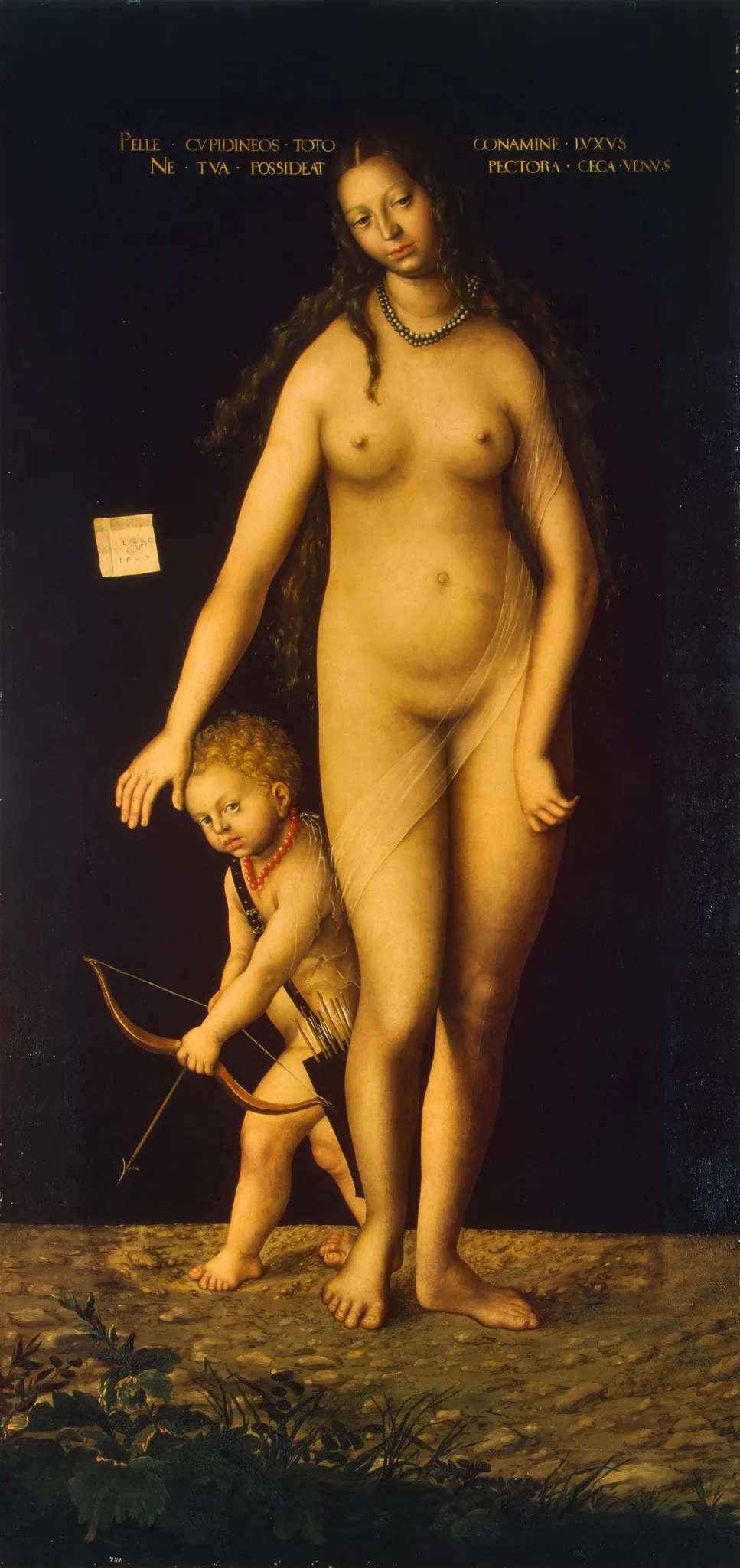
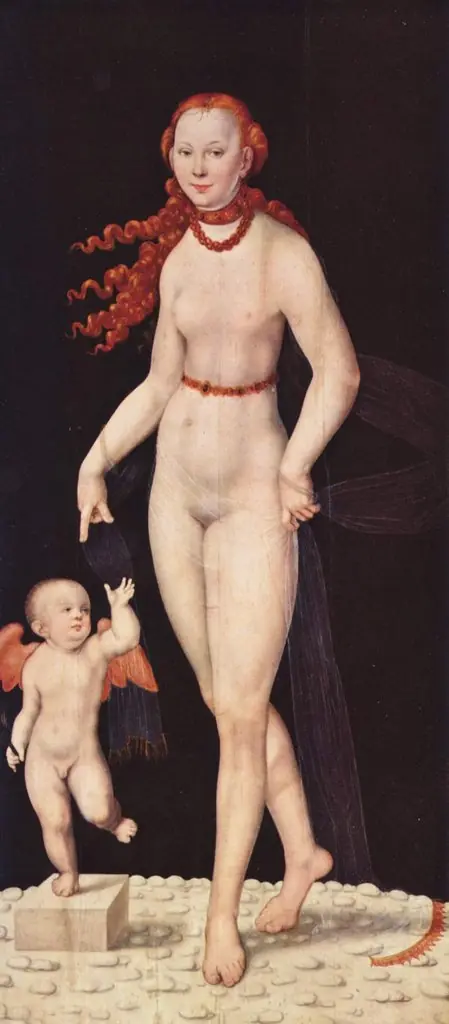
Venus and Cupid is an oil painting by the Northern Renaissance artist Lucas Cranach the Elder. It dates from 1509 and is held in the collection of the Hermitage Museum.
About this work
Overview
Venus and Cupid is a 1509 oil painting by the German Renaissance master Lucas Cranach the Elder, now held in the Hermitage Museum in Saint Petersburg, Russia.
Venus and Cupid is a 1509 oil painting by the German Renaissance master Lucas Cranach the Elder, now held in the Hermitage Museum in Saint Petersburg, Russia. Measuring 213 by 102 centimeters, this canvas work represents the first known nude depiction of Venus by a Northern European artist, marking a pivotal moment in the transmission of Italian Renaissance humanism and classical mythology to the Germanic world. The painting inaugurates Cranach's lifelong engagement with the Venus subject, a theme to which he would return repeatedly throughout his career with numerous variations. Its presence in a major Russian imperial collection underscores both the international reach of Cranach's reputation and the later redistribution of European masterworks.
Subject & Meaning
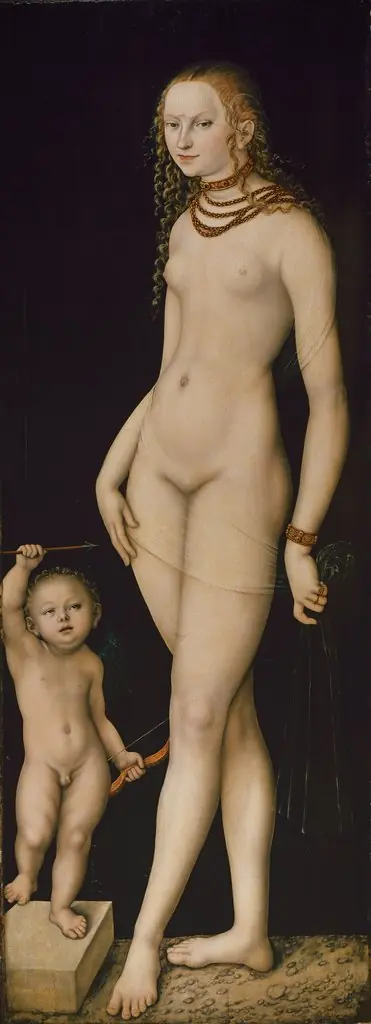
The painting depicts the Roman goddess Venus standing nude at center, her body turned slightly left, with her right hand resting upon the head of Cupid, who stands at her left. The child god of love, identifiable by his curly blond hair, carries his characteristic bow and arrow, with a quiver of arrows on his back, a red beaded necklace, and a dark strap across his chest. Venus wears a double-stranded pearl necklace and has long dark hair; a sheer translucent cloth drapes diagonally across her lower torso. The iconography carries moral significance: Cupid stands with bow armed, ready to shoot, while Venus's restraining hand signals the need to check carnal desire. This tension between erotic invitation and moral restraint reflects the fusion of Italian Renaissance sensuality with German humanist ethics. Golden Latin inscriptions appear in the upper corners, and a small rectangular cartellino floats in the left middle ground.
Technique & Style
Executed in oil on canvas, the painting employs a vertical, frontal composition with the figures occupying most of the frame against a flat dark brown-black void background. The palette is dominated by warm flesh tones, dark browns, and creamy whites. Light falls evenly from the left, modeling the figures with soft shadows. The surface is smooth with fine detail in hair, jewelry, and skin. The rocky ground with sparse vegetation in the lower left corner provides minimal spatial context. This combination of meticulous surface finish with flattened spatial depth characterizes Cranach's distinctive approach to the female nude, blending Northern precision with Italianate monumental figure presentation. The even lighting and smooth handling create an idealized, almost enamel-like surface that would become a hallmark of Cranach's mythological paintings.
History & Provenance
The painting is dated 1509 through a cartellino bearing Cranach's monogram and his winged-dragon device, located near Venus's left elbow on the background wall. The inscription reads LC 1509 with the artist's symbol between the initials. The work was later owned by Heinrich von Brühl, a prominent Saxon statesman and collector, before entering the Hermitage Museum collection in Saint Petersburg, where it remains today. Around the same date as this painting, Cranach also produced a related woodcut of similar composition, now in the British Museum, demonstrating his systematic exploration of the subject across media.
Context
Venus and Cupid emerges from the cultural crosscurrents of early sixteenth-century Germany, where Italian Renaissance ideas were being absorbed and transformed by Northern humanists. Cranach, who had visited Italy around 1508-1509, synthesized Italian Renaissance influences with German humanist and moral concerns. The painting's creation in the Holy Roman Empire places it within the orbit of Wittenberg humanism; the Latin inscriptions may have been added subsequently by a follower of this circle. As the first nude Venus by a Northern European artist, the work breaks significant ground in the reception of classical mythology in the North, where such subjects had previously been rare. The painting's moral dimension, Venus restraining Cupid's arrow, aligns with contemporary humanist debates about the proper governance of desire.
Legacy
This painting established the template for Cranach's subsequent Venus compositions, which number among the most recognizable images of the Northern Renaissance. Around 1526, Cranach introduced a significant variant showing Cupid stealing honey and complaining to Venus about bee stings, a motif drawn from classical literature that added allegorical dimensions to the theme. The Hermitage Venus and Cupid thus stands at the origin of a prolific series that would influence German and broader European art for generations. Its status as a pioneering work of Northern European mythological painting, combined with its survival in a major museum collection, has secured its place in scholarship on the dissemination of Renaissance humanism, the history of the female nude in Western art, and Cranach's own artistic development.
Artist & collection
Artist
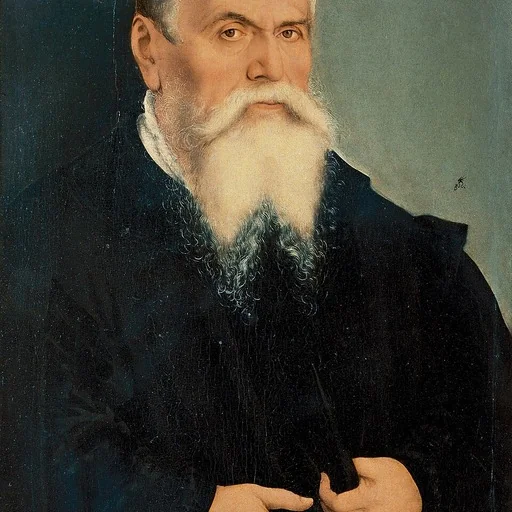
Lucas Cranach the Elder was a German Renaissance painter and printmaker in woodcut and engraving.