Artwork
Tama, the Japanese Dog
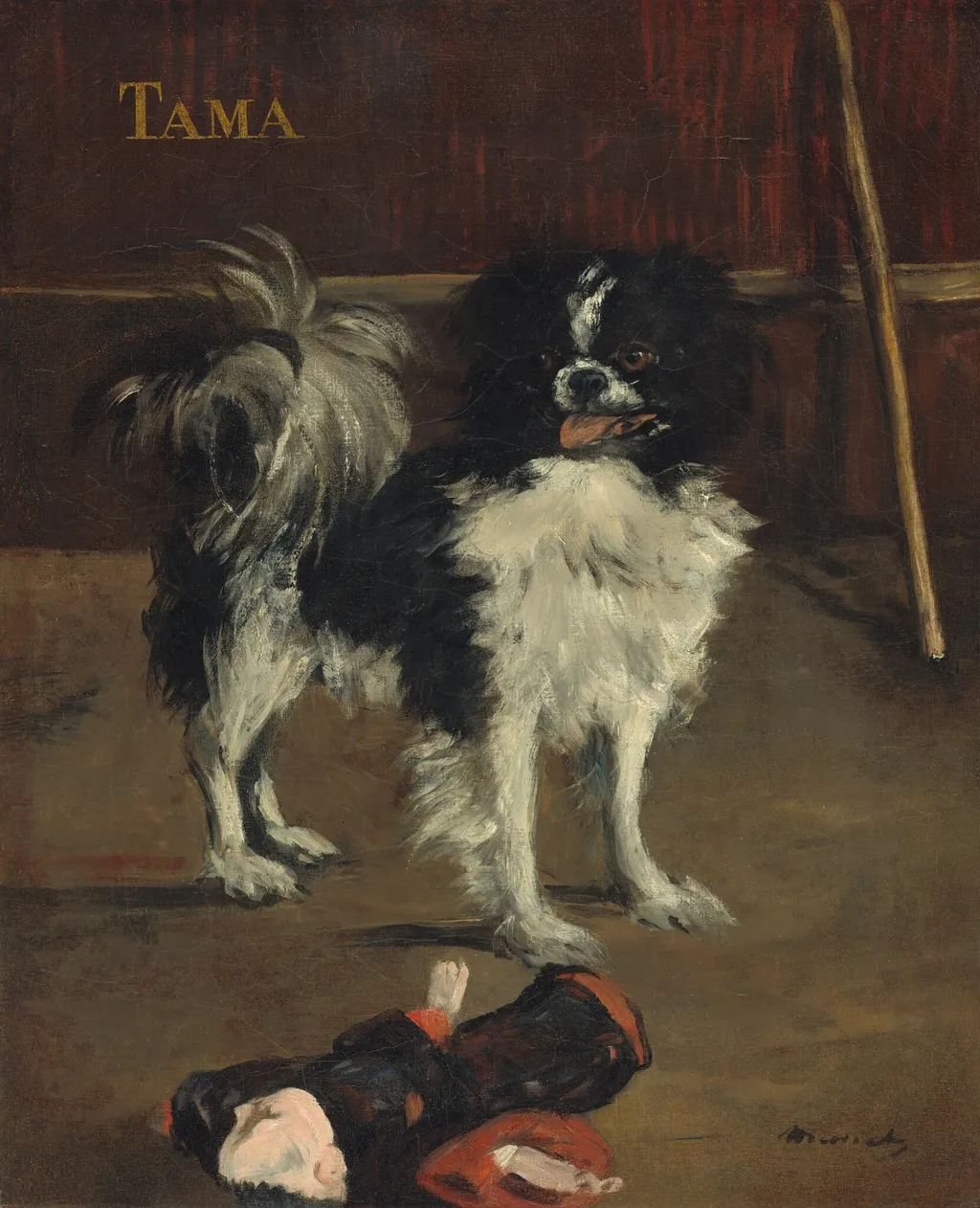
Tama, the Japanese Dog is an oil painting by the Impressionist artist Édouard Manet. It dates from 1875 and is held in the collection of the National Gallery of Art.
- Inscription
- Inscribed:lower right: Manet; upper left: TAMA
About this work
Subject & Meaning
At the dog's feet lies a Japanese doll dressed in a black robe with reddish lining and white limbs, its white head reaching the lower edge of the canvas.
The painting portrays Tama, a small Japanese Chin dog brought back from Asia in the early 1870s by Manet's school friend Théodore Duret and his companion Henri Cernuschi, who had traveled through several Asian countries partly inspired by the Japanese art and crafts shown at the 1867 Paris Universal Exhibition. Tama arrived as a "living souvenir" of that journey. The dog stands in profile at the center of the composition, its head turned slightly toward the viewer, with a black-and-white coat, a bushy raised tail, and a pink tongue protruding from its slightly open mouth. The name "TAMA" is inscribed in golden letters on the dark red wooden wall behind the animal.
At the dog's feet lies a Japanese doll dressed in a black robe with reddish lining and white limbs, its white head reaching the lower edge of the canvas. The doll's palette of white, black, and red deliberately echoes the dog's coat and tongue, reinforcing the painting's explicit Japanese references. These motifs link the portrait to the broader Japonisme that shaped Manet's circle, while the doll also anticipates a small black-and-white dog with a ball already seen at the foot of his earlier group portrait The Balcony (1868–69).
Technique & Style
Created around 1875, the work is an oil painting on canvas measuring 61 cm by 50 cm. Manet employed short, loose brushstrokes to render the dog's coat, capturing the animal's lively temperament and the texture of its fur. The composition features a standing Japanese Chin with black and white markings against a dark red background that suggests a wooden wall. A Japanese doll lies on the beige ground in the foreground, echoing the black, white, and red hues of the dog's tongue and fur.
The artist first produced pencil sketches on paper before executing the final painting, using a rapid working style to fix the vivacious subject. The name "TAMA" appears in gold letters on the wall, while the signature "Manet" is located in the lower right corner near the doll.
History & Provenance
Tama, the Japanese Dog has been in the collection of the National Gallery of Art in Washington, D.C., since 1995, when Paul Mellon of Upperville, Virginia, donated it. Mellon had acquired the painting in May 1959 from the New York dealer Sam Salz.
The work traces a long line of ownership before reaching Mellon. Théodore Duret held it in Paris through at least 1903, followed by Raphael Gérard in Paris by 1932 and Georges Bernheim in Paris by 1934. The British collectors Mr. and Mrs. H.J.P. Bomford in London owned it from at least 1942 until at least 1948.
It then passed through Marlborough Fine Arts in London in 1953 to Jean d'Alayer in Paris by 1957.
Documented exhibition loans include a 1903 showing at Bernheim-Jeune in Paris (Duret), the 1934 Venice Biennale (Bernheim), a 1942 London exhibition and a 1944 London C.E.M.A. show of the French School from a private collection (Bomford), a 1948 Dublin exhibition (Bomford), and a 1957 Paris exhibition (d'Alayer).
Context
Within Édouard Manet's oeuvre, Tama, the Japanese Dog (1875) occupies a distinctive place as a rare standalone animal portrait, reflecting the artist's engagement with japonisme, a fascination with Japanese aesthetics that grew following the 1867 Paris Exposition Universelle. The painting's inclusion of a Japanese doll and the gold inscription underscores Manet's deliberate integration of Eastern motifs, aligning with his broader experimentation with non-Western influences during the 1870s. The dog Tama was brought to France by Manet's friend Théodore Duret, a key figure in the promotion of Impressionism.
Manet's contemporary Pierre-Auguste Renoir similarly depicted the dog, though Manet's version is distinguished by its overt japoniste elements. The work offers a nuanced exploration of cross-cultural exchange and the artist's approach to portraiture beyond human subjects.
Legacy
The painting shaped Manet's subsequent output, prompting him to produce additional dog portraits after Tama proved popular among his female friends. Around the same time, his colleague Pierre-Auguste Renoir made his own portrait of the same dog, omitting the explicit Japanese references of the doll in the foreground and the lettering on the wall; that work is in the Sterling and Francine Clark Art Institute in Williamstown, Massachusetts.
The work entered the public sphere through successive loans: Théodore Duret lent it to a 1903 exhibition at Galerie Bernheim-Jeune in Paris, Georges Bernheim sent it to the 1934 Venice Biennale, and H.J.P. Bomford showed it in London in 1942 and 1944 and in Dublin in 1948. It was included in Eric Newton's 1953 Apollo article on Manet and in the 1966 National Gallery of Art publication on the Mellon collections. Robert Rosenblum later discussed it in his study of the dog in art.
The painting has been featured in the National Gallery of Art's 2014 publication "Intimate Impressionism" and in the 2016 Hamburger Kunsthalle exhibition catalogue "Manet – Sehen."
Overview
Edouard Manet's painting, Tama, the Japanese Dog, completed around 1875, is an oil on canvas work depicting a domestic animal. The composition centers on a black-and-white dog, portrayed standing on a wooden surface, with two dead birds featured in the scene. This piece exemplifies Manet's engagement with various subjects, including animal portraiture, during a pivotal period in his career.
Own this work as a print
Artist & collection

Artist
Édouard Manet was a French modernist painter. He was one of the first 19th-century artists to paint modern life, as well as a pivotal figure in the transition from Realism to Impressionism.