Artwork
The Tragic Actor (Rouvière as Hamlet)
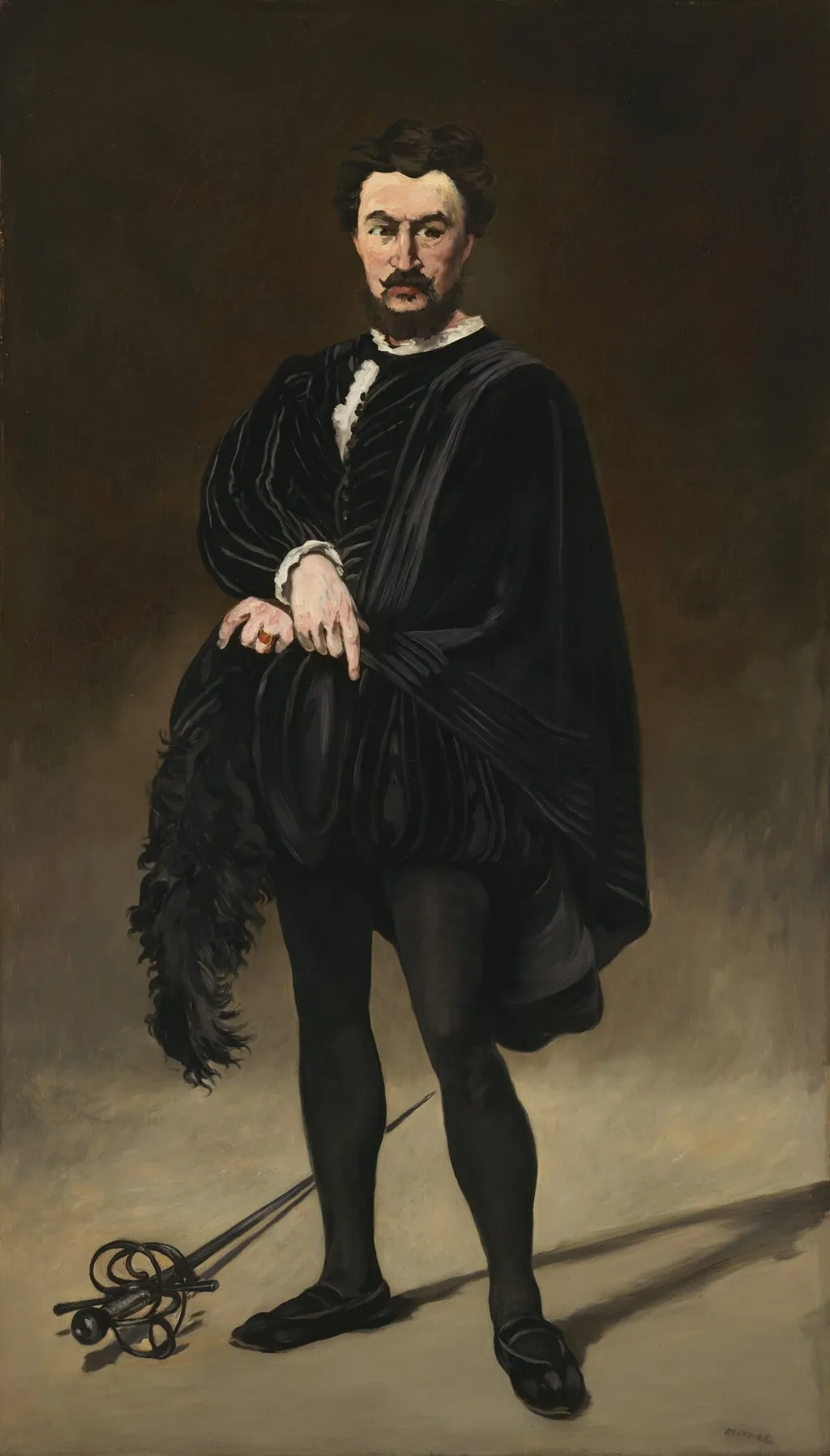
The Tragic Actor (Rouvière as Hamlet) is an oil painting by the Impressionist artist Édouard Manet. It dates from 1866 and is held in the collection of the National Gallery of Art.
- Inscription
- Inscribed:lower right: Manet
About this work
Subject & Meaning
Executed in 1866, this full-length portrait depicts the French actor Philibert Rouvière embodying the title role of William Shakespeare's Hamlet.
Executed in 1866, this full-length portrait depicts the French actor Philibert Rouvière embodying the title role of William Shakespeare's Hamlet. Set against a neutral background, the figure is clad in a black costume appropriate for the tragic character. The iconography includes specific theatrical attributes: Rouvière holds a plumed hat in his hands, while a sword rests on the floor at his feet.
These elements collectively signify the actor's performance within the famous tragedy, capturing a moment of dramatic representation rather than a casual likeness. The work functions as a historiated portrait, merging the identity of the performer with the fictional persona he portrays on stage.
Technique & Style
Executed in oil on canvas, The Tragic Actor (Rouvière as Hamlet) is a tall, vertical composition measuring 187.2 by 108.1 cm. Manet presents the sitter in a full-length historiated portrait against a neutral background, simplifying the setting so that attention falls on the figure's black Hamlet costume, the plumed hat held in his hands, and the sword resting at his feet. The restrained palette and unembellished ground are consistent with Manet's mid-1860s approach to portraiture, in which costume and pose carry the dramatic content rather than theatrical staging. The work is held by the National Gallery of Art in Washington, D.C., having entered the collection as a 1959 bequest, and remains in the institutional holdings as a painting on canvas support.
History & Provenance
The Tragic Actor (Rouvière as Hamlet) is an oil on canvas portrait painted by Édouard Manet in 1866, commissioned as a study of the French actor Philibert Rouvière in the title role of Hamlet. The work first entered the dealer stock of Durand‑Ruel in January 1872, was subsequently owned by collector Jean‑Baptiste Faure, and was repurchased by Durand‑Ruel by December 1878 before being sold on 27 February 1895 to George Washington Vanderbilt III. Vanderbilt’s inheritance passed the painting to his wife Edith Stuyvesant Dresser Vanderbilt Gerry, who bequeathed it to the National Gallery of Art in 1959.
The painting has been held by the National Gallery of Art in Washington, D.C., since 1959, following a bequest from Edith Stuyvesant Dresser Vanderbilt Gerry. Her ownership resulted from inheritance from her husband, George Washington Vanderbilt III, who purchased the work from the dealer Durand-Ruel on February 27, 1895. Prior to Vanderbilt's acquisition, the canvas circulated between Durand-Ruel and the singer-collector Jean-Baptiste Faure during the 1870s, though specific transaction records for Faure remain undocumented.
The dealer originally acquired the piece directly from the artist, Édouard Manet, in January 1872. While the work is listed in external art resources such as Google Arts & Culture and the Bildindex, specific historical exhibition records are not detailed in the provided documentation.
Overview
Edouard Manet's 1866 oil on canvas, titled The Tragic Actor (Rouvière as Hamlet), presents a portrait of the actor Philibert Rouvière. The painting captures Rouvière in character, embodying the melancholic Prince Hamlet from Shakespeare's play. This work exemplifies Manet's interest in contemporary figures and theatrical subjects, rendered with his distinctive approach to portraiture.
Artist & collection
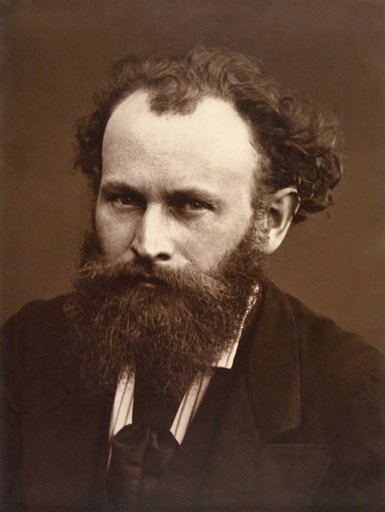
Artist
Édouard Manet was a French modernist painter. He was one of the first 19th-century artists to paint modern life, as well as a pivotal figure in the transition from Realism to Impressionism.