Artwork
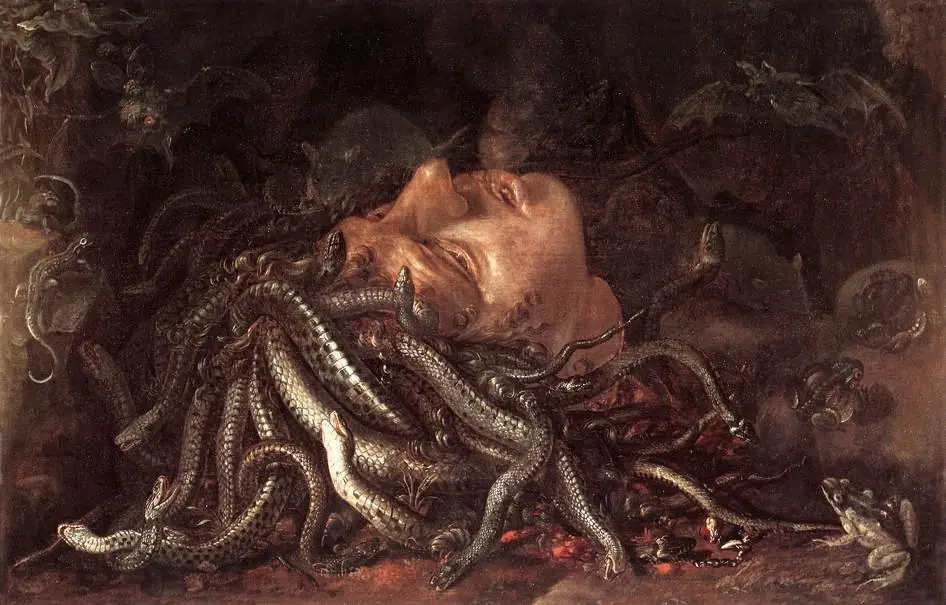
Head of Medusa
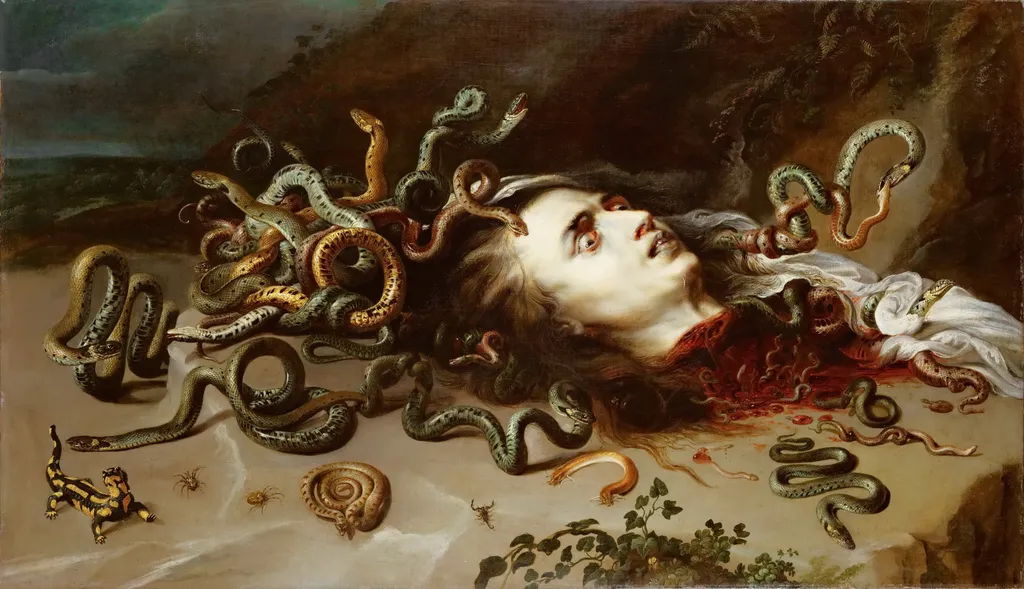
Head of Medusa is an oil painting by the Flemish Baroque painting artist Peter Paul Rubens. It dates from 1618 and is held in the collection of the Kunsthistorisches Museum.
About this work
This is a 1618 oil painting by Peter Paul Rubens. It shows the severed head of Medusa. The snakes in the work were painted by Rubens’ friend Frans Snyders.
Rubens got credit for this later. Another version sits in a gallery in Brno. Medusa’s head was a big symbol then, tied to ancient myths.
Look up Peter Paul Rubens next.
Subject & Meaning
Rubens surrounded the head with vipers, an amphisbaena, a spider, a scorpion and other creatures rendered by Frans Snyders, emphasizing the monstrous detail.
The painting presents the severed head of Medusa, a Gorgon from Greek myth, depicted as a graceful woman whose hair is encrusted with snakes. Rubens surrounded the head with vipers, an amphisbaena, a spider, a scorpion and other creatures rendered by Frans Snyders, emphasizing the monstrous detail. The composition follows the myth in which Minerva transformed Medusa's hair as punishment, and the head functions as an apotropaic emblem believed to repel evil.
In the Baroque period such imagery also served political and religious purposes, symbolising the victory of order over chaos. Contemporary observers remarked on the striking contrast between the beautiful visage and the terrifying serpentine surround.
Technique & Style
The Head of Medusa is an oil painting on canvas executed around 1617–1618, measuring 68.5 × 118 cm. The composition isolates the severed head of Medusa, rendered with a lifelike immediacy that underscores the tension between beauty and horror. Her face, partially bloodied, features wide, staring eyes and parted lips, while a writhing mass of serpents emerges from her severed neck and hair. Frans Snyders contributed the detailed rendering of the surrounding reptiles and insects, including grass snakes, vipers, an amphisbaena, and other creatures born from Medusa's blood.
Technically, Rubens employs fluid, layered brushwork to model the flesh and drapery, while Snyders's contributions emphasize precise, textured depiction of the animals. The handling balances dramatic realism with allegorical force, aligning with Flemish Baroque conventions in its vivid yet controlled execution.
History & Provenance
Created circa 1617–1618, this oil painting was executed by Peter Paul Rubens, with Frans Snyders contributing the reptiles and insects. The work entered the collection of George Villiers, Duke of Buckingham, between 1635 and 1648. Following the Duke's exile, the piece was auctioned or pledged in Flanders in 1649 before returning to Buckingham in 1650.
Later that year, Archduke Leopold Wilhelm acquired it for his brother, Emperor Ferdinand III, transferring it to the imperial collection in Prague. Since 1880 it has been housed in the Kunsthistorisches Museum, Vienna, where it is recorded under inventory number Gemäldegalerie 3834.
Attribution history reveals that an earlier version in Brno, donated in 1818 by Count Joseph von Nimptsch, lacked initial artist identification and was once ascribed to Abraham van Diepenbeeck. Rubens was not officially linked to the composition until 1899, with Snyders's collaboration confirmed during restoration work in the 1940s. The exhibition record includes a 1977 Rubens retrospective at the museum, a 2017–2018 showing titled “Die Menagerie der Medusa” that presented the Brno version, and a 2018 exhibition “Albtraumhaft Schön: Rubens' Wiener Medusenhaupt trifft auf die Brünner Fassung.”
Legacy
Rubens's depiction of Medusa captured the Baroque era's fascination with the grotesque and mythological horror, aligning with post-Thirty Years' War sensibilities and Counter-Reformation themes. The work's allegorical interpretation as a symbol of reason triumphing over evil resonated with contemporary tastes, evidenced by the existence of multiple versions and copies in various collections. Early reception was marked by shock at its lifelike intensity; Constantijn Huygens noted in 1619 how the painting simultaneously horrified viewers with its depiction of death and moved them with its beauty.
This dual effect was often enhanced in private settings by unveiling the work from behind a curtain. Over centuries, the iconography has been analyzed as an apotropaic device similar to the evil eye, while modern exhibitions continue to explore its legacy, such as the 2018 confrontation between the Vienna and Brno versions.
Overview
Peter Paul Rubens, a Flemish painter, created this oil painting titled Head of Medusa around 1618. The work depicts the mythological Gorgon's severed head, a subject that resonated with Baroque artists of the period. It showcases Rubens's dramatic style and is now housed in the Kunsthistorisches Museum in Vienna.
Artist & collection

Artist
Sir Peter Paul Rubens ( ROO-bənz; Dutch:; 28 June 1577 – 30 May 1640) was a Flemish artist and diplomat.